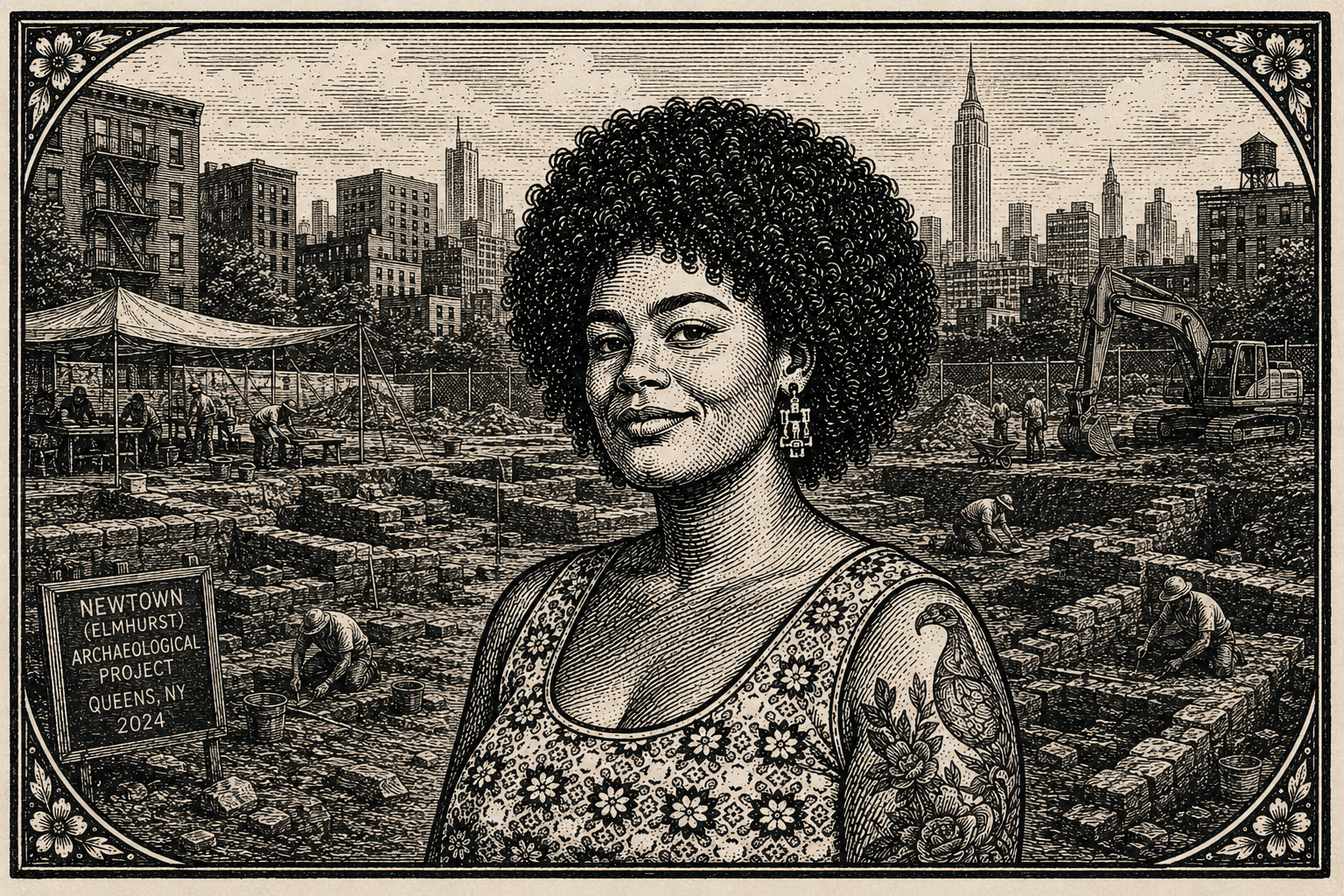
In the first installment of this conversation, Dr. Aja Lans laid out the theoretical scaffolding behind her work — how Black feminist theory and critical race theory inform the questions she asks of a skeleton before she ever picks up a bone. This installment moves from that scaffolding to the site itself: the physical, procedural, and institutional realities of doing this work at the Harlem African Burial Ground, where she serves as site bioarchaeologist alongside her mentor Dr. Rachel Watkins and the excavation team at AKRF.
The conversation here tracks two intertwined threads. The first is method in practice — how she identifies individuals within a commingled assemblage of a few thousand partial remains, using details as specific as a runaway ad’s mention of a self-emancipated man’s teeth, or a paralysis-causing injury cross-referenced against a 1920s death certificate. The second is the site’s own buried history: a cemetery established by the Dutch Reformed church in the 1660s, deliberately segregated from its white counterpart, sold off once it was no longer needed, and built over repeatedly — most recently as an MTA bus depot — until a 2015 test trench, prompted by decades of advocacy from Harlem community elders, confirmed what the neighborhood had never actually forgotten. Along the way, Lans addresses a question with obvious stakes for any burial ground like this one: why some sites get landmarked and protected while others, sitting a few blocks or a few boroughs away, simply don’t.
That question is the throughline into the Ghosts of Newtown project. The Elmhurst African Burial Ground has its own version of nearly every beat in this installment: a Dutch Reformed congregation that once oversaw the land, a site sold off once the church had no further use for it, a community that kept insisting the ancestors were still there long after the official record stopped acknowledging them, and a landmarking and protection status that remains an open, active fight rather than a settled fact. Lans’s account of how the Harlem site went from “lost history” to a confirmed, mapped, actively studied burial ground — and her insistence that its neglect was never actually forgetting, just convenient institutional amnesia — is close to a working model for what Middleburgh Triangle could become, and a reminder of exactly how long and deliberate that path usually is.

Marc Landas: When you first approach a skeleton, how do you go about it?
Aja Lans: That’s changed over the years. I introduce myself to everyone — I don’t know if they can hear me, but if they can, I want them to know why I’m here and why I’m “poking” at them. I’d rather not be doing this. It depends on what I’m looking for. When I was at Harvard, I thought a lot about Giles and his skull — I looked at him as a person, but also asked: is there anything here that helps me understand or confirm something about him?
What always stood out about Giles was his teeth — beautiful teeth, an odd detail to fixate on, but it made identification easy. He was young, probably around 20, and he’d self-emancipated after killing an overseer. Runaway ads always tried to describe features people couldn’t hide — scars, and in his case, his perfect teeth. So when I found this skull and saw those teeth, I knew: that’s him. It’s little things like that.
Or take one of the individuals from the Terry Collection — a complete skeleton with very specific trauma pathologies. For him, I found the actual death certificate, since this wasn’t that old — after the 1920s — and death certificates are fairly easy to search now. What confirmed it was an old injury noted on the certificate, one that causes paralysis, explaining a set of features on one side of his body, plus the injury site on his head. That’s him.
This reminds me of forensic anthropology in one sense: I’m trying to identify them, to find things that confirm who they are, rather than approaching it the way I was trained — “what’s this injury, what’s this disease” — and instead thinking of them as the person who lived with that.
Marc Landas: So that’s an important distinction — not forensics exactly, a slightly different step back from it.
Aja Lans: Right. The connection to forensics is that you’re identifying a person and looking at what they went through — but forensic training also teaches a level of medical detachment I’m completely opposed to in my own practice. I think: no, this is Giles, this is Lizzie, this is Carl — a person — and I want to understand what they experienced and what that tells us about their time.
But what I’ve come to be most interested in is continuities — how oppression works, and how those structures are maintained. Handing someone the fact that “here’s a black man who was lynched, but he had nice teeth” doesn’t challenge anything. I want to ask what circumstances led to this, and how it’s been normalized throughout history into a present where you can still murder black men in the street and get away with it. That’s not natural. I think one of the most important things archaeologists can do right now is keep reiterating how oppression works, how race is made, and how these systems are perpetuated and made to seem normal.
Every time I look at historic black skeletons coming from these contexts, it’s because of where we were relegated — that doesn’t mean that’s where we belong, or that it was inevitable. It simply reflects a colonial and white supremacist society, which I’d like to denaturalize in these conversations. That’s the difficulty of working inside these institutions: we’re all, for lack of a better word, colonized by them, and yes, I still catch myself doing something and think — wait, that’s a strange way to be looking at this.
Marc Landas: How did you first get involved?
Aja Lans: Through my mentor, Rachel Watkins, now at UPenn. She was brought in to fix a mess left by a previous researcher, because of course you call a black woman to solve everyone’s problems. Rachel has been a huge part of my career — there are very few of us in this field. She trained under Michael Blakey, and I met her at NYU during my master’s. Even though I went to Syracuse, she was my outside committee member, and most of what I have I owe to her mentorship. At some point she told me she had too much on her plate but thought I could take this on — she still consults on the project, mostly on community outreach, and I came on as the bioarchaeologist.
That’s through AKRF (Ed. Note: AKRF is an environmental, engineering, and planning consulting firm), which I’d consulted with before on other human remains. Most firms don’t keep a full-time bioarchaeologist on staff — you’re hopefully not always excavating human remains — so they contract out. I’ve worked with AKRF for a while now, but less than ten years. When there are human remains, I typically get called — I worked with them on a site in Ozone Park where another descendant group was reburying a Dutch cemetery.
I’d been working with them, and then they landed the contract for this burial ground. I don’t want to call it a dream come true, because I’d rather these sites not need this kind of work at all. But having come up learning about Dr. Blakey and Dr. Cheryl LaRoche at the New York African Burial Ground, it felt like a full-circle moment to be at one of these sites myself.
Marc Landas: Can you discuss the burial ground ?
Aja Lans: It is located beneath a bus depot, decommissioned in 2014, which is how the discovery came about.
Marc Landas: That’s interesting — it was always there, and people always knew. It’s just a lost history.
Aja Lans: Here’s the thing — it wasn’t lost. That’s what blows my mind about this site. The burial ground was originally segregated: in the early 1800s the church sold the land, moved the European cemetery, and left the black cemetery in place. Everyone knew. The pattern in New York City, and many cities, is that as black people get pushed out — denied property ownership — it becomes easy for institutions to claim they “didn’t know,” even when they did. So they kept building on it. But people knew.
I was on site for all the excavations, and in some areas it was clear someone had gathered bones and piled them at some point — mostly human bones, with the occasional butchered animal bone mixed in, evidently from someone who could recognize human bone but not every animal bone. Again: people knew.
The site itself — what became the Harlem African Burial Ground Task Force — was formed by women in East Harlem: the reverend of the descendant church, Elmendorf Reformed (Reverend Singletary); the former borough historian, Miss Sharon; and Melissa and Melinda, both local and connected to city council. The reverend had written her dissertation on this site, and for her whole life in Harlem she’d been saying there were ancestors buried there. It wasn’t until this initiative came together — the city, the MTA turning ownership over to the EDC — that a test trench in 2015 turned up human skeletal remains. This was decades of painstaking advocacy by community elders. Better late than never — I’m glad they’re here to see it.
Marc Landas: What’s the history of the ground itself?
Aja Lans: According to local Indigenous oral history, there was likely a village somewhere nearby, and we found artifacts predating colonization.
Marc Landas: Are there any old waterways nearby?
Aja Lans: It’s right on what’s now the Harlem River, and based on our geomorphological analysis, it was likely a floodplain — which makes grim sense as a reason black people were given this land, since it wasn’t desirable. It may have been a bluff at one point; I’m still waiting on the full site-formation analysis. Once the church sold the land, it got built on repeatedly — a casino, an amusement park.
Marc Landas: Was it always an African burial ground, or was it split?
Aja Lans: I’d have to confirm with my colleague on the detailed site history — there may have been a cemetery elsewhere on the property, but this section was specifically the “Negro section.” The site was built on so many times, with so much fill added, that nothing remains in its original place — that’s one weakness of the site archaeologically. We’ve found artifacts labeled “pre-contact” — I prefer “pre-colonization” — mixed into fill layers alongside historic garbage dumped from elsewhere. Nothing can be placed definitively, except what we know was eventually built there. It’s frustrating: you find something genuinely interesting and can’t say whether it actually originated on-site.
Marc Landas: What’s the designation of that lot now? Is it landmarked?
Aja Lans: Not as far as I know. For a long time the only archaeologically landmarked site in the city was the New York African Burial Ground in Lower Manhattan. Burial grounds aren’t automatically landmarked —
Marc Landas: It’s harder without a built structure, which is why people ask about headstones. There’s a family burial ground for a white family in Queens.
Aja Lans: The gap isn’t unique to black cemeteries in that narrow sense — but I’d point you to Cheryl Harris’s article on “whiteness as property” — older now, but essential. It’s how I interpret the treatment of non-white burial grounds generally in this country. I once consulted on a project that hit human remains — a very old Indigenous burial — and had to confirm they were human. At the same construction site, a white cemetery sat perfectly protected. I generally avoid handling Indigenous ancestors’ remains out of respect, but here I was just confirming humanity, and I knew immediately it wasn’t just one individual. The default should be treating this exactly like the protected white cemetery next door — but because our preservation laws are built on fundamentally Eurocentric ideas of what counts as worth protecting, it’s easy to just say it doesn’t matter.
Marc Landas: So how many remain? You mentioned finding stacks of bones.
Aja Lans: The preliminary report should be public by the end of this year or early next. This has been hard to explain to people, even those involved, who ask “can’t you just do X” — these aren’t intact burial areas. What we’ve recovered is probably a couple thousand or so partial human remains, in preservation terms ranging from poor to fair.
I’m inventorying all the diagnostic remains — this is an arm, this is a leg — and, importantly, I don’t do outdated race science, which people constantly ask about. Instead, I go through and see which elements can tell us something: measurements for stature where possible, pathology, trauma, activity markers, and the minimum number of individuals. There’s no existing count of how many people were originally buried here, but if this was the only burial ground for black people in the area for a long stretch, there were thousands. At the end of last field season, my minimum number — based on some surprisingly well-preserved remains — was six adults. By the end of this coming season it’ll likely be a dozen or so, plus a lot of fragmentary child remains. We’re recovering only a tiny fraction of who was originally buried here.
The original cemetery covered a specific acreage — I’d have to check the exact figure — and now we’re working within one large city block. My guess is that repeated rounds of construction pushed many remains into the river — probably the easiest way to get rid of bodies — or into back-dirt piles. There aren’t a lot of people left. But even this small amount is enough to say something meaningful.
Marc Landas: Was it a Dutch Reform church?
Aja Lans: Yes — now it’s the Elmendorf Reformed Church. I’m blanking on the original name, but it was Dutch-established.
Marc Landas: Is the church still involved with that property, given the connection?
Aja Lans: No — what often happens with cemeteries, particularly black ones like this, is the church wasn’t black-led at the time, and eventually it sells the land, or dissolves and the land is sold off. That’s why these cemeteries end up like this — the original institution no longer owns it. Now the EDC does. Originally the Dutch church owned it, then sold it in the 1800s.
Marc Landas: Did they sell it to a black organization?
Aja Lans: No — they sold it to be developed. It was in use from roughly the mid-to-late 1600s into — I don’t know the exact end date, maybe the 1820s. Eventually the land was sold in the 1800s, and once that happened, it just kept getting built on, over and over.
Marc Landas: What does that pattern teach us about the relationship between municipal development and the disappearance of black burial sites?
Aja Lans: I’ll get to that. In cities we have to balance the needs of the living and the dead — though often those needs actually align, especially somewhere like East Harlem, historically black and Spanish Harlem. These are ancestors right here, and the living community generally doesn’t want them treated carelessly once they know.
In an ideal world you’d leave cemeteries exactly as they are, but that’s not realistic — almost every park in the city sits on a former cemetery. So it’s a question of handling development responsibly. We’ve gotten much better at talking with communities, especially here, though that wasn’t always true — it was really the 1990s discovery of the African Burial Ground that changed things locally. There’s a way to do this, even relocating remains, in a culturally sensitive way — but there’s little oversight, and we generally prioritize capital and development over anything else. In a city that changes as fast as New York, where redlining’s legacy is still very present, the people whose ancestors were buried in these places have historically been pushed out quite intentionally. The land becomes “valuable” once the original community is gone, with no one left to object when a site gets destroyed.
There are plenty of cemeteries where everyone knows exactly what family is buried there, and still nothing protects them. Even in undergrad, one of my first projects involved a small family cemetery where a grocery store was going in. They knew about the cemetery, so they had everyone exhumed and studied at Binghamton University before reburial elsewhere — the minimum you should do. That standard doesn’t apply consistently to black or Indigenous people, or poor people generally — often they just get dug up. In Milwaukee, a medical school wanting to expand dug up an entire pauper’s cemetery and handed the skeletons straight to the anthropology department. That’s how people get treated outside some protected class.
This is part of why this work matters so much to me. Put simply: the treatment of black people in what is now the United States has historically been reprehensible. We haven’t valued black people in life or death, and we’ve been denied the same rights of mourning, care, and protection given to other communities’ dead. There’s no real equality until we have that too. It’s a simple argument: stop digging up and stealing our ancestors — you wouldn’t do that to anyone else. (Indigenous people are, unfortunately, a notable exception to that “wouldn’t.”) In an ideal world, that kind of disturbance simply wouldn’t be allowed to happen to anyone.



Leave a Reply