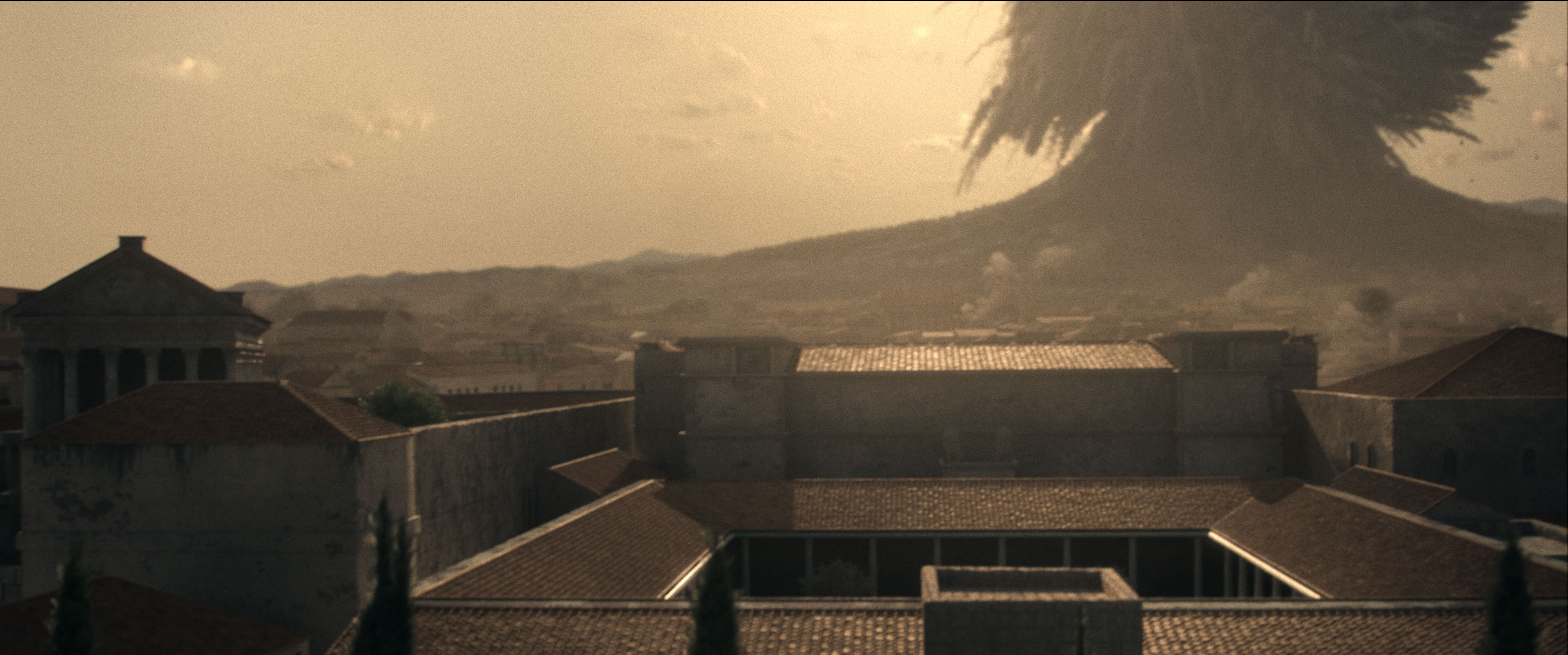
For nearly two millennia, Pompeii has stood as one of history’s most haunting archaeological time capsules—a city frozen in the instant catastrophe struck. Yet new discoveries are challenging many of our long-held assumptions about what happened during the eruption of Mount Vesuvius in A.D. 79 and the people who lived through it. In Pompeii: Out of Time with Tom Hiddleston, National Geographic combines cinematic storytelling with the latest archaeological research to reconstruct the city’s final hours in an entirely new way. We spoke with executive producer Kevin R. Wright, the former Marvel Studios vice president of development and executive producer of Loki, about bringing cutting-edge science to the screen, blending documentary and scripted drama, and why the real stories of ordinary Romans may be even more compelling than the legend of Pompeii itself.

You spent years helping shape Marvel’s cinematic storytelling, particularly with Loki. What convinced you that the same kind of ambitious, cinematic approach could transform a historical documentary about Pompeii?
It’s just they only way Tom Hiddleston and I know how to approach storytelling. We like to say it’s our job to smuggle broccoli in with the popcorn. Marvel Studios was popcorn, and we were trying to figure out how to get some broccoli in there. Make it a bit smarter. A bit more elevated.
When it comes to the docufiction, I think Tom Barbor-Might and I felt that most of what we see out there is a heck of a lot of broccoli, which is great! But, we felt, if we could lead with popcorn, we could introduce this story to an even wider audience. We want to be a gateway for general audiences who don’t normally engage with this type of show. They have so much competing for their attention these days, we want to bring them something extraordinary to earn their time and attention.
And maybe through our show, they discover a love and interest for ancient history they didn’t know they had, and suddenly they’re down the rabbit hole. It just came down to wanting to make something experiential, exciting and frankly, human. Also, we’re telling a story about one of the most famous volcanic eruptions in all of human history. It’s just asking for the disaster movie treatment!
What were the biggest creative challenges in balancing historical accuracy with emotional storytelling?
What became clear early on as Tom Barbor-Might and I began writing the series is that eventually you have to contend with the fact this took place over 2000 years ago and the archaeological record has holes. There are gaps in what we can concretely see and observe with our eyes. That’s why we responded to the word ‘Historia’.
To the Roman’s, history and story were on in the same. By combining the two, it unlocked something that felt emotionally true. One of our experts said to us, if we were to follow you around today and collect data on everything you did, everywhere you went, everything you said, it would paint a comprehensive picture of what your life is like, but it would still be missing something. How you feel. How you think. Your interior life. History really can’t capture that. But storytelling is fantastic at exploring a person’s interior life. We felt encouraged by our experts and researchers too. They pointed out that the act our using fantasy and imagination is how most historians approach their work.
Come up with a theory, paint the picture with evidence. A new discovery or piece of information runs counter to your original idea, so you rewind and like we see Tom do in the show “try again”. We took our biggest challenge and attempted to turn it into the shows most unique feature!
Why was it important to tell Pompeii through the eyes of everyday people rather than history’s elites?
I think it was just born out of an emotional response. Ordinary people navigating extraordinary circumstances makes for great stories. But deeper, Pompeii’s most remarkable draw to me is that when you stand in the forum, Vesuvius looming large over the city, you feel instantly transported back to that day 2000 years ago. It’s really the most powerful thing to stand in the ruins, because you can’t help but imagine what that day would have been like. Without even thinking about it you put yourself in the people’s shoes (sandals?).
So it just felt like the natural focus. I’m imagining myself that day navigating it’s maze like streets trying to escape. Then you learn there WERE survivors, and so you want to try to reconstruct their day.
Did they do what I think I would do? Every step of the way you can’t help but compare their choices to what you imagine you would do. Would I freeze? If I were outside the city, would I run back in like Avi to look for my family?
I’m based in Los Angeles, so like the people of Pompeii, I ignore earthquake all the time. It’s just such a universally visceral and human story, and it’s filled with many contemporary analogues which should make it relatable.
IMAGE CREDIT: National Geographic.
Leave a Reply