Immune checkpoint inhibitors have transformed the treatment of several cancers. By releasing the brakes that tumors place on the immune system, these drugs allow T cells to attack cancer cells, sometimes with dramatic and durable results. In gastric cancer, one of the leading causes of cancer death worldwide, they have become part of standard care. But they help only a minority of patients, and doctors have limited ways of predicting who will benefit.
A new study published in Science Bulletin points to a possible answer in an unexpected corner of the tumor: macrophages, the immune system’s versatile scavenger cells. By analyzing hundreds of thousands of individual cells from gastric cancer patients, researchers found that the balance between two macrophage states tracks with whether tumors respond to immunotherapy.
An Atlas of 240,000 Cells
Tumors are not just masses of cancer cells. They are complex ecosystems that include immune cells, blood vessels and supportive tissue, collectively called the tumor microenvironment. Macrophages are among its most influential residents. Depending on the signals they receive, they can help the immune system attack a tumor or help the tumor suppress that attack.
To understand how macrophages behave in gastric cancer, the researchers built a single-cell atlas from more than 240,000 cells collected from patients. Single-cell analysis reads the molecular activity of each cell individually, allowing researchers to identify distinct cell states that would be blurred together in bulk measurements of tissue.
Two Macrophages, Two Outcomes
The analysis revealed two contrasting macrophage populations. One, marked by high levels of a signaling molecule called CXCL10, the team named Mac-CXCL10. The other, marked by high levels of a protein called OLR1, they named Mac-OLR1.
What mattered was the ratio between them. Patients whose tumors had a higher proportion of Mac-CXCL10 relative to Mac-OLR1 were more likely to respond to immunotherapy and had longer progression-free survival, the time before their cancer worsened.
An Immune Hub
The two cell types appear to shape the tumor environment in opposite ways.
Mac-CXCL10 macrophages were closely associated with CD8+ T cells, the immune system’s main cancer-killing cells, specifically those responding to interferon, a family of signaling proteins that help coordinate immune attacks. Together, the macrophages and T cells formed what the study calls an “interferon-responsive immune hub,” a local network that supports T cell activation and anti-tumor function.
CXCL10 is known to attract T cells, so a macrophage population rich in it could plausibly help draw killer cells into a tumor and keep them engaged. Checkpoint inhibitors work by unleashing T cells that are already present, so tumors with such hubs may give the drugs more to work with.
Fat, Lipids and Suppression
Mac-OLR1 macrophages told a different story. They were associated with lipid metabolic programs, the cellular machinery for handling fats, and with an immunosuppressive microenvironment. The study suggests that the accumulation of oxidized lipids may help push macrophages into this state.
These macrophages also produce prostaglandin E2, or PGE2, a lipid-derived signaling molecule. According to the study, PGE2 may suppress interferon signaling in T cells and blunt their ability to attack tumors. In other words, Mac-OLR1 macrophages may actively dampen the very immune response that checkpoint inhibitors are meant to unleash.
New Targets to Explore
The findings suggest two potential uses. First, the Mac-CXCL10 to Mac-OLR1 ratio could become a biomarker to help predict which gastric cancer patients are likely to respond to immunotherapy. Second, the biology of Mac-OLR1 macrophages points to possible targets. The authors suggest that blocking lipid-associated macrophage programs or PGE2 signaling could shift the balance toward a more immune-friendly environment and improve responses to immunotherapy.
PGE2 is produced through pathways targeted by common anti-inflammatory drugs, which has made it a focus of interest in cancer immunology more broadly. But whether targeting it would help gastric cancer patients has not been tested here.
The authors note that further clinical validation is needed. The release does not report how many patients contributed samples, how outcomes were measured, or whether the ratio was tested in an independent group of patients. Associations found in a single-cell atlas also do not by themselves prove that one cell type causes a given outcome. Prospective studies would be needed to confirm that the ratio reliably predicts response, and clinical trials to show that targeting PGE2 or lipid programs improves outcomes.
Still, the study adds to growing evidence that the cells surrounding a tumor can be as important as the cancer cells themselves in determining whether immunotherapy works, and that in gastric cancer, the balance between two kinds of macrophages may help tip the scales.
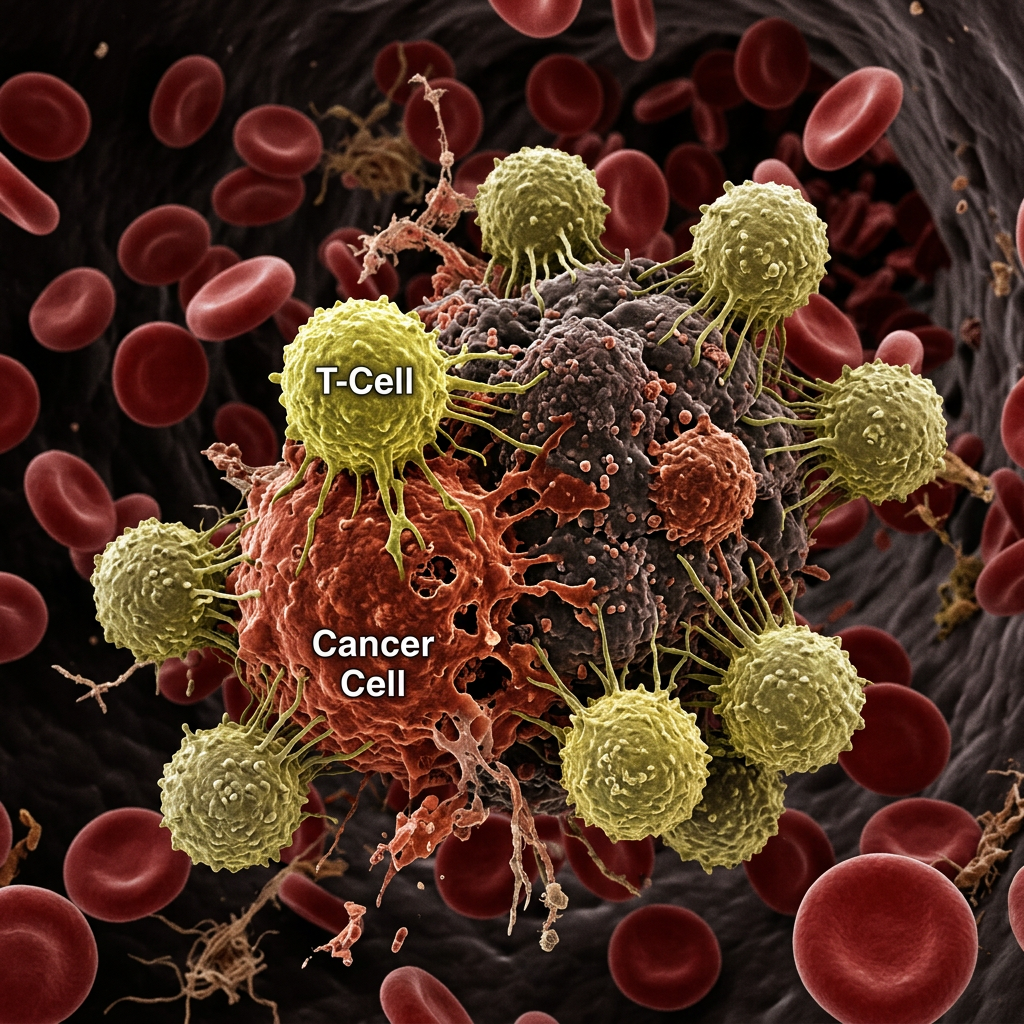
Featured image: T cells surrounding and interacting with a cancer cell. Scientific Inquirer media library. (The press release schematic of macrophage states is ©Science Bulletin, created with BioRender.com.)
Endnotes
- Single-cell study of macrophage states and immunotherapy response in gastric cancer (article title and authors not given in the press release). Science Bulletin, 2026. DOI: 10.1016/j.scib.2026.07.049.
- Science China Press. “Why some gastric tumors resist immunotherapy — and how macrophages tip the balance?” EurekAlert!, 11 August 2026. https://www.eurekalert.org/news-releases/1139645



Leave a Reply