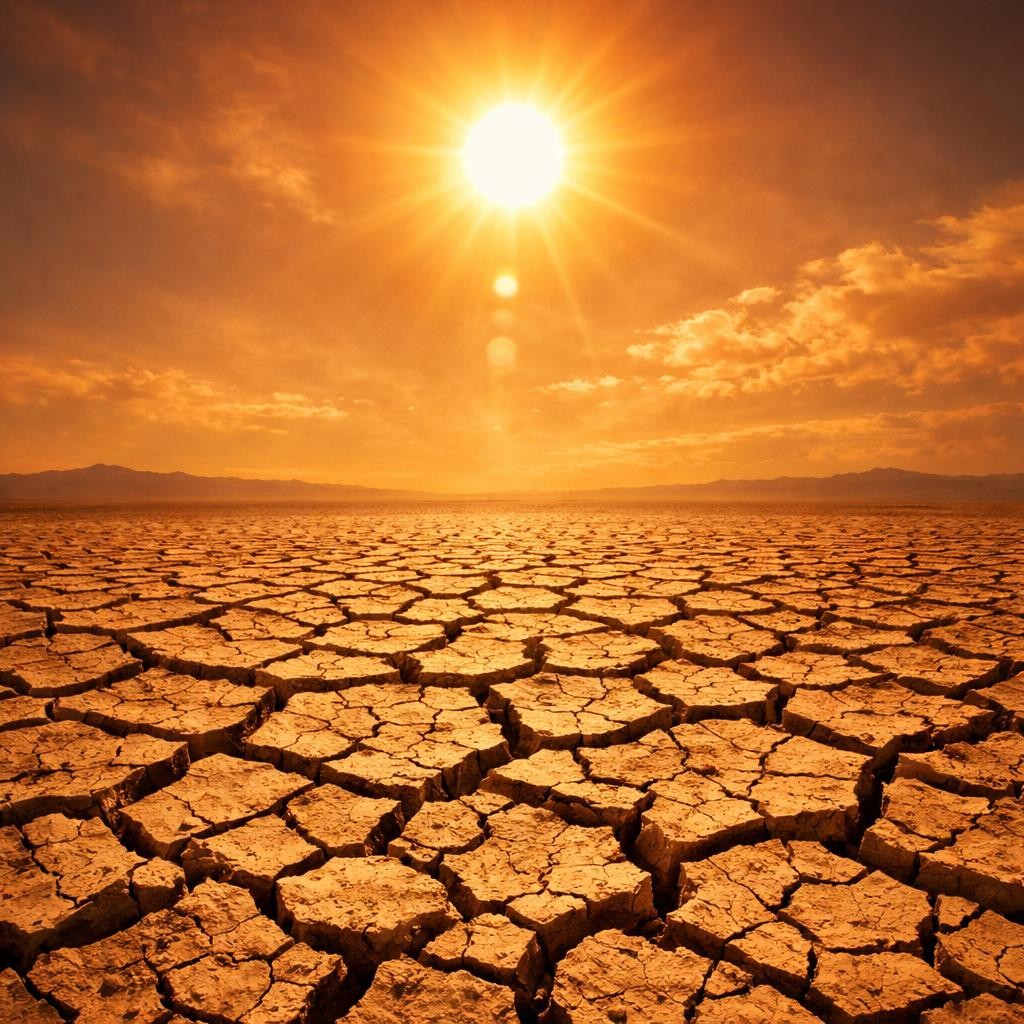
It might seem that drought would be bad news for disease. Many parasites and the creatures that carry them, from mosquitoes to waterborne worms, depend on water. Yet droughts around the world have coincided with surges in cholera and West Nile virus. A new review from the University of Colorado Boulder and the Cary Institute of Ecosystem Studies explains why drying landscapes can make some infections worse, even as they wipe others out.
The review, by ecologists Pieter Johnson of CU Boulder and Tara Stewart Merrill of the Cary Institute, was published August 12 in Trends in Ecology & Evolution.
A Drier, Less Predictable World
The backdrop is stark. A United Nations report cited by the authors finds that more than 77 percent of Earth’s land has become drier in recent decades. In the western United States, the worst megadrought in 1,200 years has left Lake Mead at about a third of its capacity, and rising temperatures are making droughts more frequent, intense and widespread.
But Johnson, a distinguished professor in CU Boulder’s Department of Ecology and Evolutionary Biology, said climate change is doing more than making the planet warmer or drier. “It is making droughts more variable and less predictable,” he said, and that unpredictability is a central challenge for managing disease in natural systems.
Lessons From Crowded Ponds
Johnson first noticed the pattern while studying waterborne parasites in California that cause frogs to grow extra limbs, making them easier prey. During the severe 2014 California drought, shrinking ponds packed amphibians into fewer and smaller bodies of water. Infections became more common and more severe.
That observation raised a puzzle: why does losing water sometimes eliminate pathogens and sometimes intensify them? Johnson concluded that drought’s effects on disease are neither simple nor linear. To map them, he and Stewart Merrill synthesized nearly 100 earlier studies to identify the main mechanisms at work.
Winners and Losers
The first mechanism is crowding. As rivers and ponds dry up, animals concentrate around whatever water and habitat remain, and those refuges can become hotspots for transmission, as with the California frogs.
The second is that drought favors parasites and disease carriers adapted to harsh conditions. In North America, West Nile virus and St. Louis encephalitis virus have become more common partly because there are fewer aquatic predators, such as dragonfly larvae, to eat mosquito larvae. Earlier studies in Florida found that periodic droughts boosted St. Louis encephalitis transmission. Valley fever, a fungal disease spread through dust, also becomes more common in drier conditions.
Not every pathogen benefits. The chytrid fungus, a major contributor to global amphibian declines, spreads poorly in dry conditions.
Predicting the Next Mix
The net result, Johnson expects, is a shifting cast of dominant diseases rather than a simple rise or fall. Some infections will vanish from some places, but intense transmission elsewhere may more than offset those losses.
The review identifies traits that may predict which pathogens come out ahead. Generalists that infect many host species, such as avian influenza, are likely to fare better than specialists that infect only one, such as measles. Pathogens that can survive outside water and jump to land animals also have an advantage over strictly aquatic ones.
As a synthesis of existing research, the review does not offer new measurements or specific projections. Johnson’s goal, he said, is to anticipate how transmission will change as droughts grow more frequent and severe, so that outbreaks can be forecast and prepared for.
Featured image: Parched, cracked earth. Scientific Inquirer media library. (The press release image, a pond in Shanahan Ridge, Boulder, Colorado, that went dry this summer for the first time in many years, is credited to Pieter Johnson/CU Boulder.)
Endnotes
- Johnson, P., and Stewart Merrill, T. “Plagued by drought: how water scarcity reshapes host–parasite interactions.” Trends in Ecology & Evolution, 12 August 2026. DOI: 10.1016/j.tree.2026.07.002.
- University of Colorado Boulder. “Drought is reshaping the spread of infectious diseases.” EurekAlert!, 12 August 2026. https://www.eurekalert.org/news-releases/1139556

Leave a Reply