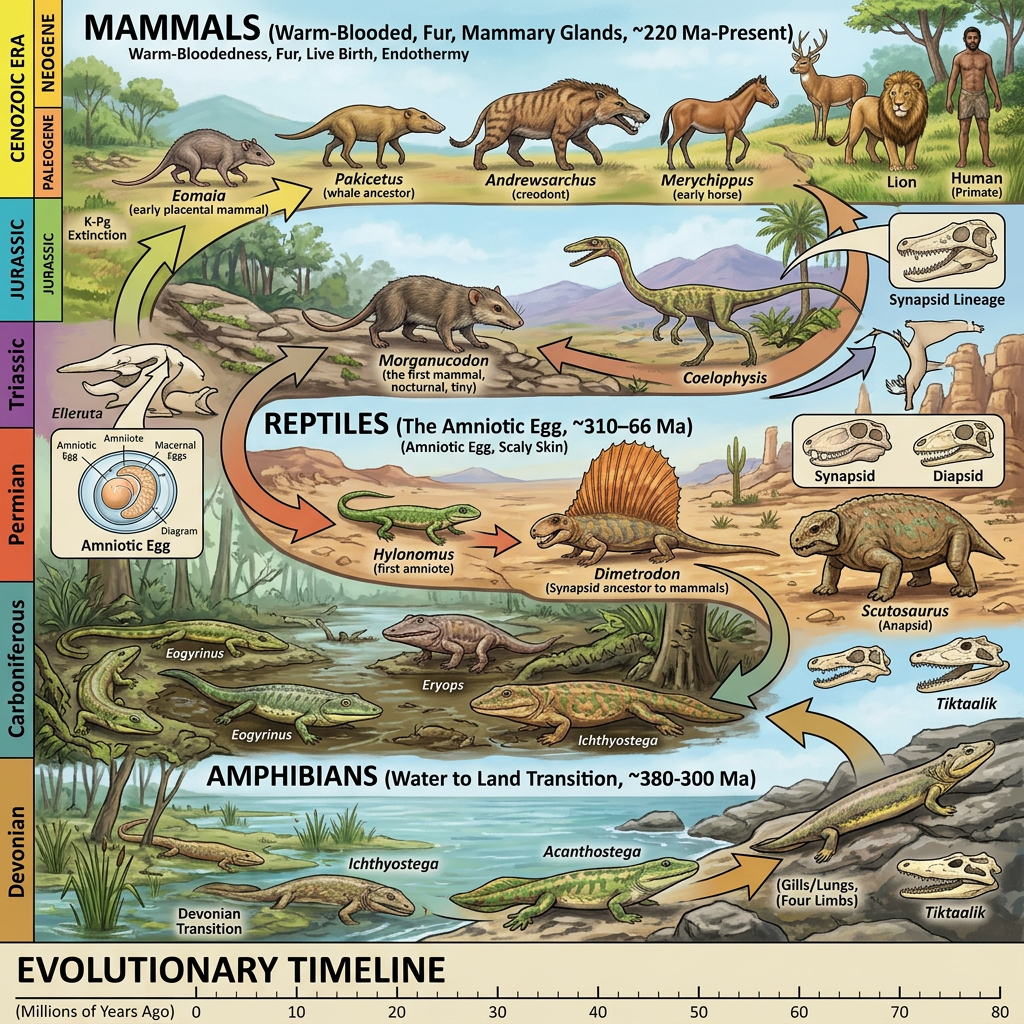
Live birth is one of the defining traits of most modern mammals, and it has generally been assumed to have arrived late in the story. The cynodonts, the group of animals that bridges early synapsids and true mammals, were long thought to lay eggs. A fossil from northwestern Argentina now challenges that view, offering what its authors call the first compelling evidence that at least one cynodont gave birth to live young.
The study, published in Frontiers in Mammal Science, suggests that live birth appeared in the mammalian lineage 90 to 95 million years earlier than previously believed.
A Line Drawn at Birth
The species, Chiniquodon theotonicus, lived about 236 million years ago during the Triassic. The clue came from a growth mark inside the bone of a fully grown specimen, spotted during a postgraduate course. Comparison with living animals suggested it was a neonatal line, a ring that forms in bone when growth speeds up abruptly after birth. Such lines are rarely preserved in fossils.
“Live birth was present in at least one mammalian ancestor,” said lead author Leandro Gaetano, a paleontologist with Argentina’s National Scientific and Technical Research Council (CONICET). That implies, he said, that viviparity arose in the mammalian lineage tens of millions of years earlier than thought.
Sizing Up a Newborn
Measuring the neonatal line allowed the team to estimate the animal’s size at birth, while the outer bone surface gave its size at death. The specimen weighed about 1.7 kilograms at birth and about 12 kilograms when it died, so the newborn was roughly 14 percent of adult body mass.
The researchers compared that ratio with data from several thousand living mammals, reptiles and birds. Turtles, snakes and crocodilians of similar adult size, weighing 8 to 14.5 kilograms, hatch at just 9 to 53 grams, a newborn-to-adult ratio of about 0.1 to 0.6 percent. Birds weighing 8 to 21.5 kilograms, such as cranes, pelicans and vultures, hatch at roughly 110 to 357 grams, or about 1.3 to 4.5 percent of adult mass. Placental mammals of 8 to 15 kilograms produce newborns of 35.5 grams to 1.87 kilograms, with ratios reaching nearly 19 percent. The bay duiker, a small African antelope, has young about the size of the Chiniquodon newborn. Egg-laying monotremes and pouch-bearing marsupials, which produce very small young, were left out of the comparison.
C. theotonicus clustered with placental mammals and clearly apart from reptiles and birds. Gaetano said the team was surprised by how cleanly it grouped with living placentals, and he described the method as an inventive way to study something that rarely leaves a trace in fossils.
Why Live Birth Paid Off
Senior author Adriana Mancuso, a CONICET researcher who studies the evolution of land ecosystems, placed the finding in its environmental context. The Triassic was a period of recovery after a major mass extinction, marked by fierce competition for resources, heavy predation and a climate trending arid and strongly seasonal. Under those conditions, she argued, the “embryos of viviparous species would be better protected” than those of egg layers.
Co-author María Miceli Baro, a graduate student at the University of Buenos Aires who also created the reconstruction illustrating the study, noted that neither embryonic tissues nor neonatal lines had previously been documented in cynodonts. The specimen shows, she said, that a trait generally linked to evolutionary success was present long before true mammals arose.
One Case, or Many?
The authors caution that the evidence comes from a single specimen. C. theotonicus may not be an isolated case and could reflect a broader early shift from egg laying to live birth along the mammalian line, but more fossils will be needed to test that. They also suggest that other traits now considered recent mammalian innovations may have appeared earlier among cynodonts than assumed.
Featured image: An overview of vertebrate evolution. Scientific Inquirer media library. (The press release image, “Triassic Mothers,” a life reconstruction of Chiniquodon theotonicus showing a pregnant female and a nursing female with relatively large young, is credited to María de los Ángeles Miceli Baro.)
Endnotes
- Gaetano, L., Miceli Baro, M., Mancuso, A., et al. “Early Origin of Viviparity in the Mammalian Lineage.” Frontiers in Mammal Science, 13 August 2026. DOI: 10.3389/fmamm.2026.1845319.
- Frontiers. “New fossil evidence challenges the story of mammalian birth.” EurekAlert!, 13 August 2026. https://www.eurekalert.org/news-releases/1139026



Leave a Reply