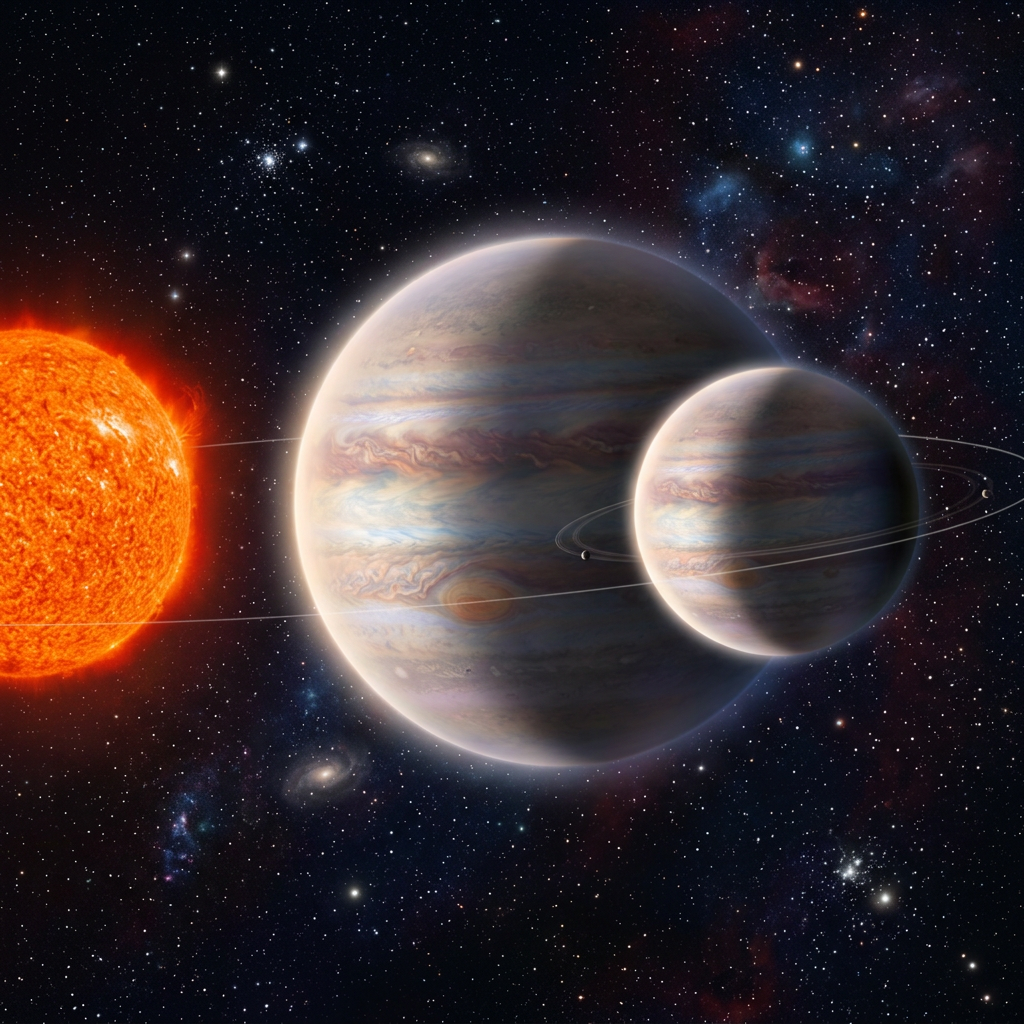
About seven light-years from the Sun drifts an object called WISE 0855. It is a brown dwarf, too massive to be a planet and too small to sustain the hydrogen fusion that powers a star. It glows only with heat left over from its formation, and at about 265 kelvin it is colder than Earth’s surface, the coldest brown dwarf known. It is roughly the size of Jupiter, with about twice the mass.
It also has weather. Using the James Webb Space Telescope, a team led by Brittany Miles of the University of Arizona has observed its water clouds thickening and thinning over time. The study, published in The Astrophysical Journal, is described as the first direct confirmation of changing water clouds on a world outside the solar system.
Eleven Hours of Watching
The team observed WISE 0855 for 11 hours, collecting a spectrum every 15 minutes, the most detailed time series of the object so far. As the brown dwarf rotates, different patches with different cloud cover and temperature turn into view. Webb’s medium-resolution spectrograph tracked those changes feature by feature across individual molecules, something no earlier observatory could manage for an object this cold.
Before Webb, astronomers had only photometry, overall brightness measurements that blend the effects of clouds, chemistry and temperature into a single signal. Mark Marley, director and department head of the University of Arizona’s Lunar and Planetary Laboratory and a co-author, compared the problem to “looking at the world through a screen door.” Light escaping from the atmosphere is filtered on its way out, he explained, so scientists have to understand both the world and the filter, which is the atmosphere itself.
Clouds Above, Churning Below
The spectra revealed two processes running at once. High in the atmosphere, water clouds thickened and thinned as the object turned. Deeper down, the team detected a rhythmic, wave-like signal in carbon monoxide and phosphine, gases carried upward by convection from far below, like hot soup rising in a pot.
That upwelling, called disequilibrium chemistry, also happens on Jupiter and has been seen in brown dwarfs before. What is new is watching it vary molecule by molecule in near real time. Miles said the team can now watch water clouds thicken and thin, and deep gases rise and fall, as they happen.
Between Planet and Star
The significance, Miles argues, reaches beyond one object. The physics of convection, clouds and chemistry that governs Jupiter appears to govern WISE 0855 too. If that physics is universal, it should also apply to the gas-giant exoplanets that Webb is now studying.
“Even though brown dwarfs are not true planets, they exhibit planet-like behavior,” Miles said. In her view the categories form a spectrum with no hard boundary, and Jupiter and WISE 0855, different as they look, share similar weather. She credits Marley’s mentorship, and his atmospheric models benchmarked against Jupiter, with shaping her sense of what the models were missing.
The results rest on a single object observed over one 11-hour window, and the extension to exoplanets is the authors’ reasoning, not a direct test. Miles plans further baseline observations with Webb to pin down WISE 0855’s rotation and map the three-dimensional structure of its atmospheric motion.
Endnotes
- Miles, B., Marley, M., et al. (2026). “Water Cloud and Chemical Modulations in the Coldest Brown Dwarf.” The Astrophysical Journal. Preprint: https://doi.org/10.48550/arXiv.2609.20664
- University of Arizona (October 8, 2026). “Discovery marks the first detection of variable water clouds outside of our solar system.” EurekAlert! https://www.eurekalert.org/news-releases/1147098

Leave a Reply