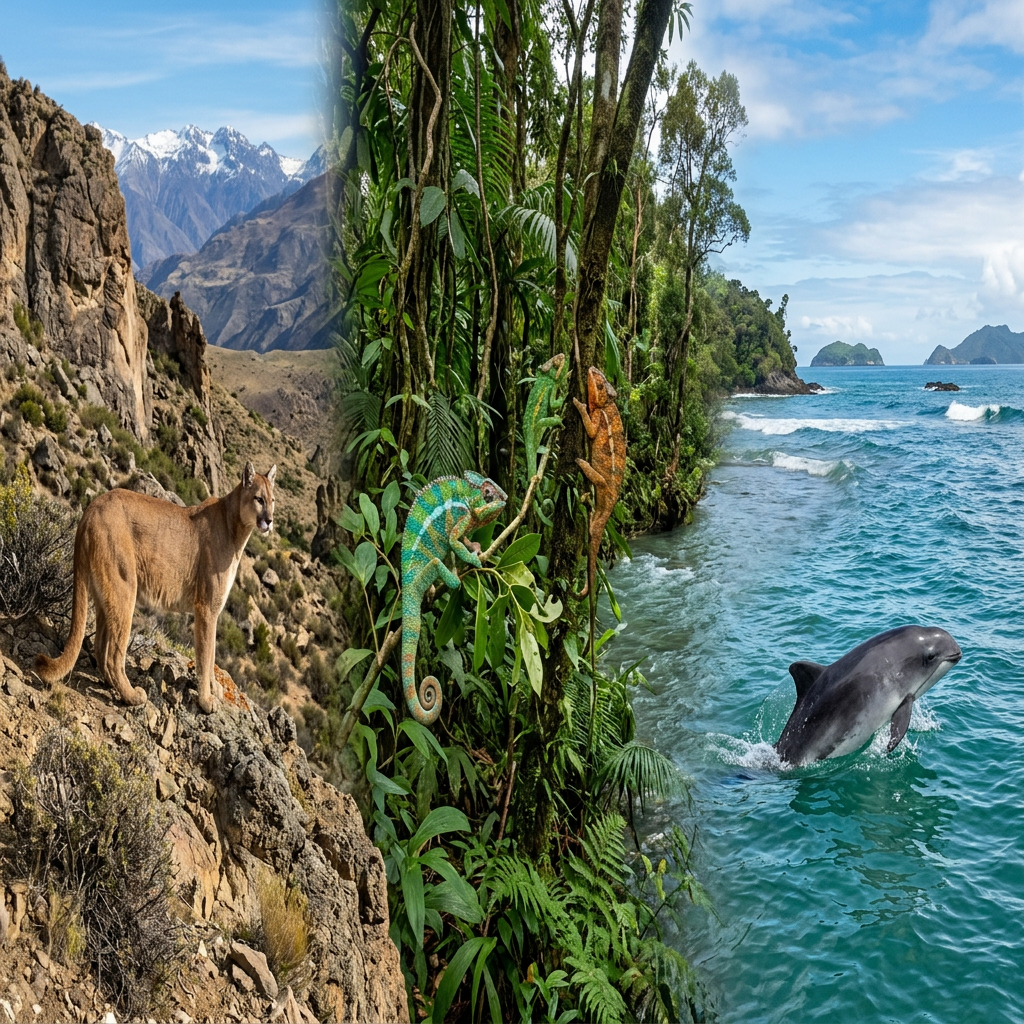
Conservation debates often rest on a reassuring assumption. Ecosystems, the thinking goes, have built-in spare capacity: several species can do the same job, so losing a few makes little difference to the benefits nature provides. An international analysis published in Nature Ecology & Evolution finds that this cushion is far thinner than assumed.
Led by King’s College London and Imperial College London, with the Natural History Museum and The Alan Turing Institute, the study is described by its authors as the largest of its kind. Its conclusion is that the benefits people draw from nature, from pollination and clean water to carbon storage and pest control, keep climbing as biodiversity increases, so losing species means losing benefits.
Benefits Keep Rising
The team pooled 423 published studies containing 222,829 data points from land, freshwater, marine and estuarine ecosystems, a database more than twice the size of the largest previous effort. They examined 23 categories of ecosystem services and functions.
For most of them, benefits did not level off once a handful of species were present. They kept rising with diversity. In ecological terms, the authors conclude that functional redundancy, the idea that species can stand in for one another, has been overestimated.
Emma Moffett, a lecturer in geography at King’s College London and the study’s lead, said the common assumption that losing a species here and there does not change much is simply not supported by the data for most of the benefits the team examined.
The Ocean Stands Out
The strongest link of all involved ocean carbon sequestration, which responded more steeply to biodiversity than any other service measured. That points to a dependence of blue carbon systems, ocean and coastal habitats such as coral reefs, saltmarshes and mangroves, on diverse marine communities, from phytoplankton up to the microbial food webs that carry carbon into deep water.
“The ocean result stopped us in our tracks,” Moffett said. It is also one of the least-studied areas the team found, resting on only a small number of datasets, and the authors flag it as an urgent knowledge gap. If blue carbon is part of climate plans, Moffett argued, marine life cannot be an afterthought.
There were exceptions. Protection against coastal flooding and erosion was relatively insensitive to overall biodiversity, because it often depends on one or two foundational species, such as the shrubs that stabilize dunes. The authors argue that conservation has to do both things: maintain diversity broadly and protect the irreplaceable species that certain services hinge on.
Forecasting the Losses
Will Pearse, an associate professor in evolutionary ecology at Imperial College London, said scientists have long known that biodiversity supports food, water, air and more. What the model adds is a precise global picture that can predict the benefits biodiversity provides in any given place, making them easier to identify and protect.
The team linked its database to the biodiversity projections that accompany the socioeconomic scenarios used by the Intergovernmental Panel on Climate Change. Under a fossil-fuel-driven development path, the model predicts a decline in natural pest control on farms, the free service provided by the predators of crop pests. The sharpest losses fall on countries with rapidly growing populations and lower levels of development.
A synthesis of this kind inherits the limits of the studies it combines, including uneven coverage of some ecosystems, as the thin ocean data show. The full database and the model’s forecasts for all 23 categories have been made public to inform policy and planning.
Endnotes
- Moffett, E., Pearse, W., et al. (October 6, 2026). “Biodiversity safeguards ecosystem services and functions worldwide.” Nature Ecology & Evolution.
- King’s College London (October 6, 2026). “Nature’s capacity to ‘bounce-back’ when species are lost vastly overestimated.” EurekAlert! https://www.eurekalert.org/news-releases/1146350



Leave a Reply