Every cell in a body belongs to a family tree whose root is a single fertilized egg. An adult human has roughly 37 trillion cells, each descended through an unbroken chain of divisions from that one cell. For simple animals such as the roundworm, scientists have long had the complete tree. For mammals, it has been out of reach.
Two teams supported by the Howard Hughes Medical Institute have now come closer than anyone before. Using two different molecular recording tools, groups led by Jonathan Weissman and Jay Shendure reconstructed cell lineage trees spanning millions of cells in developing mice, which HHMI describes as the most complete lineage maps yet for a mammal. One of the studies is published in Science.
Weissman, an HHMI Investigator at the Whitehead Institute, framed the result as a milestone four decades in the making. It is “proof of principle that we can do what was done with the roundworm” in 1983, he said, but in a mammal.
Why Mammals Are Hard
The roundworm map was possible because its embryo is transparent. Researchers could watch each cell divide under a microscope. A mouse embryo develops hidden inside its mother, growing from one cell to hundreds of millions in a few weeks, and cannot be watched continuously.
The solution both teams adopted is to make the cells keep their own records. Cells are engineered so that each division writes a small, permanent mark into their DNA. Daughter cells inherit the marks and add their own, so reading the marks later reveals how the cells are related.
Two Recorders
Weissman’s group used PEtracer, a system it unveiled in 2025. It relies on prime editing, a precise gene-editing method, to place marks at more than 100 sites in the genome. The team engineered stem cells carrying the system and injected them into a mouse embryo, where the marks spread into nearly every cell the embryo produced. Because the marks are read by sequencing individual cells, the same experiment also reveals each cell’s type and which genes it is using.
Shendure’s group at the University of Washington used DNA Typewriter, which it developed in 2022. It records each division as a new entry on a strip of DNA that works like a ticker tape. The team injected its components directly into a fertilized mouse egg and let the record accumulate as the cells divided.
Shendure explained why such tools matter. Most biological measurements rely either on live imaging, which is limited because animal tissue is usually opaque, or on genomics, which destroys the sample and captures a single moment. “Recording techniques like the ones in these studies enable measurements over time,” he said, including in places no one can see directly.
Toward a Virtual Embryo
The maps should help researchers understand how cells specialize to form tissues and organs, and when an embryo is most vulnerable to environmental or genetic stress. The same approach could show how tumors begin, grow, spread and resist treatment, since many key events in development and cancer unfold where they cannot be observed. Recording them in DNA lets researchers reconstruct them after the fact.
The data will also be used to train artificial intelligence models of embryonic development, with a long-term goal of a virtual embryo that can predict developmental outcomes. Weissman expects surprises along the way, much as the roundworm map produced unexpected findings in the 1980s.
HHMI’s summary does not give cell counts for each study or discuss the methods’ limitations, such as how many lineage branches each recorder resolves reliably. Those details are in the papers.
Endnotes
- “A DNA Typewriter records the cell lineage history of a mouse, from zygote to late organogenesis.” (October 8, 2026). Science. https://doi.org/10.1126/science.ael0508
- Howard Hughes Medical Institute (October 8, 2026). “Mapping how a single cell becomes an entire mouse.” EurekAlert! https://www.eurekalert.org/news-releases/1146673
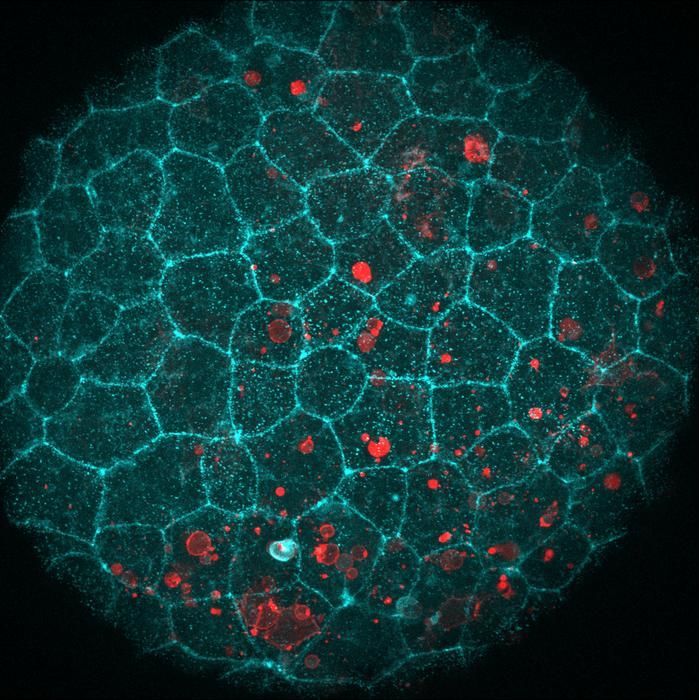
Featured image: A zebrafish embryo, shown as a stand-in (the studies used mice). Credit: Laura F. Bianchi/Centro de Regulación Genómica.


Leave a Reply