Kyushu University’s prototype uses aerial imaging optics and a micromirror array to put a separate image in front of each eye, with a gyroscope in the chair doing the tracking.
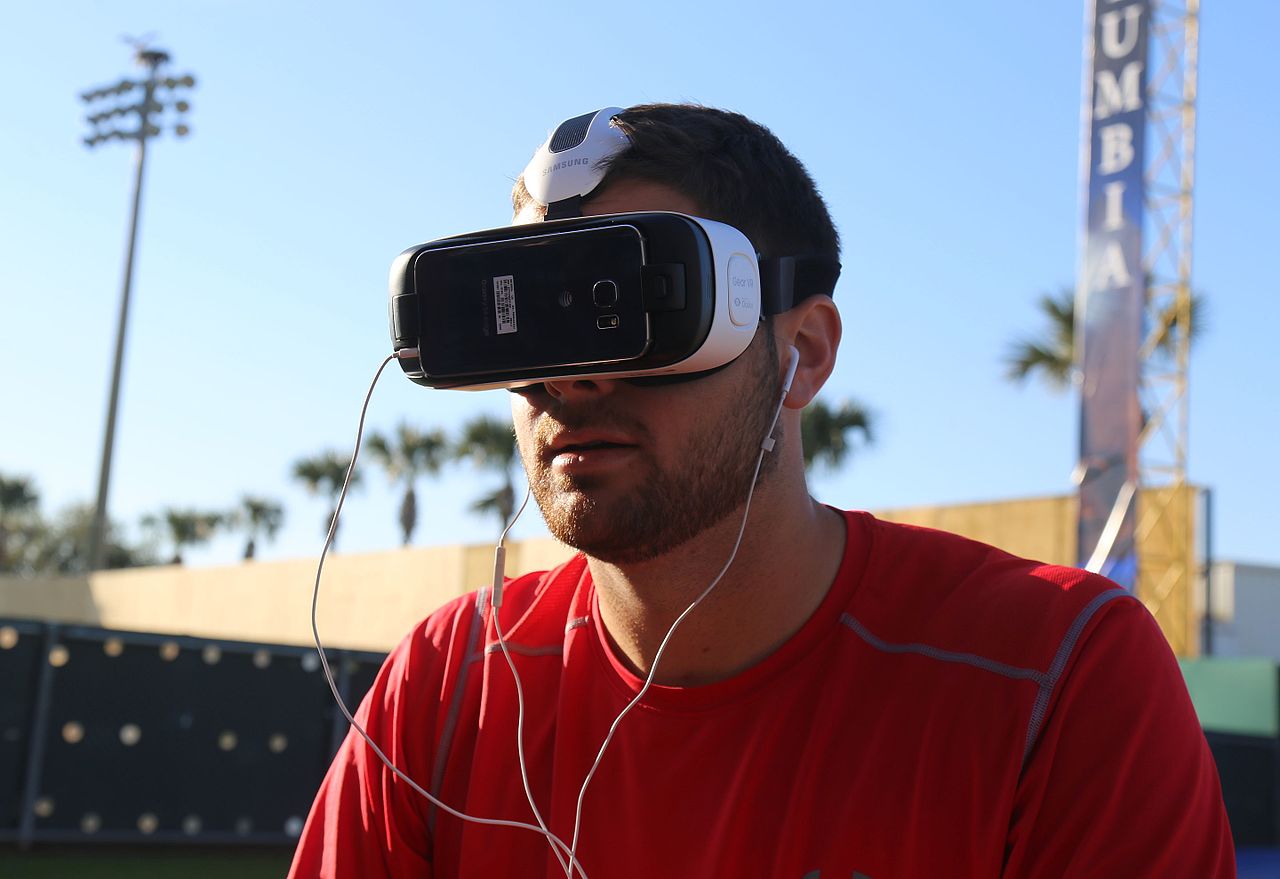
The head-mounted display has been the shape of virtual reality for forty years, and the mount is the part users complain about. A headset is heavy, hot, isolating, awkward over glasses, impossible to share quickly, and its weight on the face is one of the reasons sessions stay short.
A demonstration presented in the SIGGRAPH Emerging Technologies proceedings from Kyushu University asks what happens if the display stops following the head and the chair does the work instead.
The work is by Shogo Fukushima, associate professor in the Faculty of Information Science and Electrical Engineering at Kyushu University, who is the only person named on the release.
Images that hang in the air
The system uses aerial imaging optics together with a micromirror array to deliver a separate image to each eye. The optical module is mounted on a chair, and a built-in gyroscope tracks the chair’s rotation in real time so the virtual view follows the user’s body movement.
Aerial imaging is the enabling piece and is worth explaining, because it is what distinguishes this from putting a monitor on an arm. A micromirror array can form a real image in mid-air — light converges at a point in free space rather than on a screen — so the viewer looks at an image that is floating in front of them with no physical surface where it appears. Giving each eye its own such image is what produces stereo depth without anything in front of the face.
Mounting the optics on the chair and tracking the chair solves the registration problem in an unusual way. A headset must measure head motion precisely and redraw fast enough to keep the virtual world fixed, and failures of that loop are a major source of discomfort. Here the display and the body rotate together, and only the chair’s rotation needs measuring — which a gyroscope does cheaply and reliably.
The practical consequence the release emphasises is that users can look around the virtual scene without a headset and without system calibration.
The sickness argument
“Our system also has the potential to reduce VR sickness in the future,” Fukushima said. “Without a headset to constrain the design, larger optical components and moving mechanisms can be incorporated more freely.”
The reasoning is sound as far as it goes. Cybersickness is driven substantially by conflict between what the eyes report and what the vestibular system feels, and by the fixed optics of a headset — a single focal plane that forces the eyes to focus at one distance while converging at another. Optics unconstrained by having to sit on a face can be larger, which permits wider fields of view, better eye relief and in principle multiple focal planes.
It should be read as a hypothesis rather than a finding. The phrase is “potential to reduce”, in the future, and the release reports no measurement of sickness, discomfort or any other user outcome. A chair-mounted system also introduces its own version of the vestibular problem, since rotating the chair moves the body through the real world while the virtual scene responds — whether that feels better or worse than a headset is an empirical question nobody has answered here.
What this is
The category matters and the release is reasonably clear about it: this is a paper in the SIGGRAPH Emerging Technologies proceedings, which is a venue for hands-on demonstrations of early-stage systems rather than for evaluated research.
Emerging Technologies submissions are juried on the interest of the demonstration, and attendees try the thing rather than reading about a study. That is a legitimate and useful part of how interactive technology develops, and it means the appropriate expectation is a working prototype with an idea behind it, not performance data.
Accordingly there is none. The release reports no resolution, no field of view, no brightness, no latency figure, no viewing volume within which the aerial image remains visible, and no user testing of any kind.
The field of view and the viewing volume are the two numbers that would matter most, and their absence is the thing to notice. Aerial imaging systems characteristically produce images visible only from a restricted range of positions — move your head too far and the image vanishes or breaks — which is the obvious tension in a design whose purpose is to let people move their heads freely. How much head freedom the system actually allows is the question the demonstration exists to answer and the release does not.
Where it would be used
The applications named are in-car workspaces, interactive museum exhibits, remote-controlled construction machinery, and disaster-response robots. The team is seeking industry partners.
Those four share a characteristic that makes them better fits than consumer VR: in each case the user is seated, stays seated, and has a reason not to wear anything. A museum cannot sanitise and fit a headset for every visitor in a queue; an operator driving an excavator remotely for a full shift will not tolerate a headset on their face for eight hours; a vehicle passenger wants to be able to look out of the window. The constraint that a chair-mounted display imposes — you must be in the chair — costs nothing in any of them.
Consumer gaming, conversely, is where this would struggle, since a seated system with a restricted viewing volume gives up the room-scale movement that current VR is built around.
Fukushima’s closing remark is about research practice rather than the device: “Technical skills aren’t the most important thing to imagine a different future.” The system is a reasonable illustration of it — the components are not novel, and questioning why the display has to be on the head is the contribution.
The paper was published on 19 July 2026 and the release issued on 6 October 2026. The work was supported by the Japan Society for the Promotion of Science. The release contains no conflicts of interest statement.
Notes
- Fukushima, S. “Mountless Aerial HMDs: Designing Non-Wearable HMD Experiences Based on Aerial Imaging Optics.” Proceedings of the SIGGRAPH Emerging Technologies Conference ’26, 2026. DOI: 10.1145/3799826.3812427.
- Kyushu University. “How to head into VR without wearing a headset.” EurekAlert!, 6 October 2026. https://www.eurekalert.org/news-releases/1146597.
Photo credit: Arturo Pardavila III


Leave a Reply