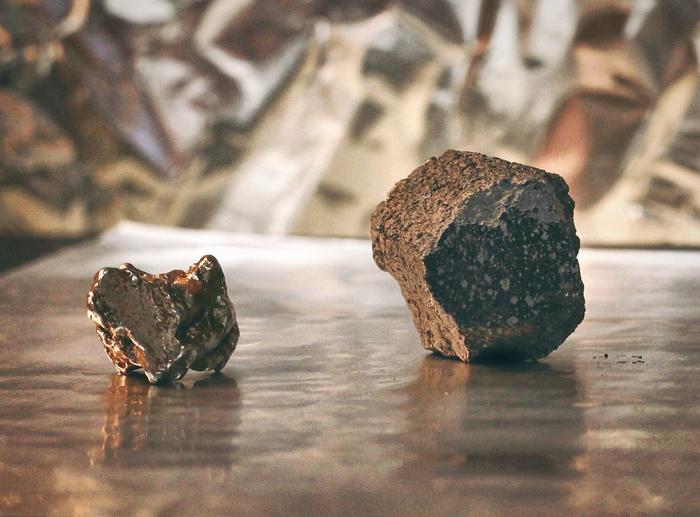
University of Osaka researchers read the electrical signature of single amino acids squeezing through a gap between two gold nanowires, then tried it on the Murchison meteorite and Atacama Desert soil.
Amino acids come in mirror-image pairs, and life on Earth has made a choice between them. Living organisms build proteins almost exclusively from L-form amino acids, while chemical processes with no biology behind them produce L and D forms in equal measure. The ratio between the two is therefore one of the more defensible biosignatures available — a departure from a fifty-fifty mix is hard to explain without something alive.
Measuring that ratio has meant laboratory chemistry: chiral chromatography, mass spectrometry, bulky instruments and consumables. A study in Nature Communications from the University of Osaka reports doing it electrically instead, by reading the current that flows when a single amino acid molecule passes through a gap between two gold nanowires.
The lead author is Takahito Oshiro and the senior author Masateru Taniguchi, both at the University of Osaka.
What the measurement actually is
The technique places a molecule in a nanogap narrow enough that electrons tunnel across it, and records the resulting current waveform over time. Because a molecule’s shape and orientation govern how it couples to the electrodes, the trace it produces carries information about its structure — and L and D forms, being mirror images, interact differently with the asymmetric environment of the gap.
Those differences are not obvious to the eye, which is where the second half of the method comes in. The waveforms were classified by machine learning.
“By combining our nanogap tunneling technique with artificial intelligence, we were able to distinguish between the L- and D-forms of amino acids with over 80% accuracy,” Oshiro said. “This is the first discrimination of amino-acid chirality at the single-molecule level and constitutes a fundamental advance in chemical sensing.”
The single-molecule claim is the substantive one. Conventional chiral analysis measures a bulk property of many molecules at once and reports an average; this measures one molecule at a time and assigns it a handedness. In principle that allows a chirality ratio to be built up from individual counts, which is a different kind of measurement from an averaged signal.
Two samples that already have histories
The team did not stop at purified standards. They applied the method to extracts from the Murchison meteorite, which fell in Australia in 1969, and to soil from the Atacama Desert in Chile.
“We analyzed natural samples from the Murchison meteorite in Australia and soil samples from the Atacama Desert in Chile,” Taniguchi said. “Our method was comparable to traditional methods, as both were capable of capturing the major features of amino acid composition.”
Both choices are deliberate. Murchison is the most intensively studied carbonaceous chondrite in existence and contains a well-characterised suite of amino acids, including several that do not occur in terrestrial biology — which makes it the standard test of whether a new analytical method reproduces known results. The Atacama is the driest non-polar desert on Earth and the conventional Mars analogue, used for decades to test life-detection hardware precisely because it sits at the edge of habitability.
Murchison also carries a cautionary history that bears on this work. Small excesses of L-form amino acids have been reported in it repeatedly, and whether those excesses are genuinely extraterrestrial or the result of terrestrial contamination has been argued over for fifty years. A meteorite that has sat in collections since 1969 is not a clean sample, which is a reason to test a method against it and a reason not to treat any chirality imbalance found in it as a finding about space.
Why eighty per cent is the number to think about
Accuracy above 80 per cent is a real result for single-molecule discrimination and a demanding figure to build a biosignature claim on, for reasons of arithmetic rather than scepticism about the technique.
A biosignature based on chirality is a claim about a ratio. If each individual molecule is classified correctly four times in five, then a sample that is genuinely 50:50 will be measured as something other than 50:50, and a sample with a modest real excess may be pushed either way. Enough measurements will average the error out — misclassifications in both directions partly cancel — but the detectable excess is set by how well the errors are characterised, and the release gives no figure for how many molecules were measured, or how precisely a ratio could be recovered.
Nor does it state the comparison quantitatively. “Comparable to traditional methods” and “capturing the major features” are the authors’ own careful phrasing, and a reader cannot tell from the release whether comparable means within a few per cent or within a factor of two.
The instrument argument
The applied case rests on what an electrical detector can be made into. The authors suggest the approach could lead to compact, electrically based instruments for detecting signs of extraterrestrial life.
That is the genuinely interesting prospect, and the reason to care about an 80 per cent single-molecule method when chromatography does better in a laboratory. Mass, power and complexity are the binding constraints on anything flown to another planet, and a chromatograph with its columns, solvents and calibration standards is a demanding payload — the one aboard the Curiosity rover has a finite number of sample cups and cannot be refilled. A nanogap device is a chip and a current amplifier.
The distance from here to such an instrument is nonetheless considerable, and the release does not map it. Nothing is said about how the nanogap performs on samples with high salt or mineral content, how it is calibrated without reference standards, whether the gold electrodes survive repeated use, or how sample preparation — extraction into solution — would work without a laboratory around it. Each of those is where life-detection hardware usually fails.
The work was funded by the Japan Science and Technology Agency and by NASA’s PICASSO programme. The release states no conflicts of interest, and the paper was published on 5 October 2026.
Notes
- Oshiro, T., et al. “Chiral discrimination of amino acids in meteorite and desert soil extracts via single-molecule nanogap conductance.” Nature Communications, 2026. DOI: 10.1038/s41467-026-77947-6.
- The University of Osaka. “An electrical technique for identifying signs of life in space.” EurekAlert!, 5 October 2026. https://www.eurekalert.org/news-releases/1146293.
Photo credit: Rayssa Martins/Ross Findlay

Leave a Reply