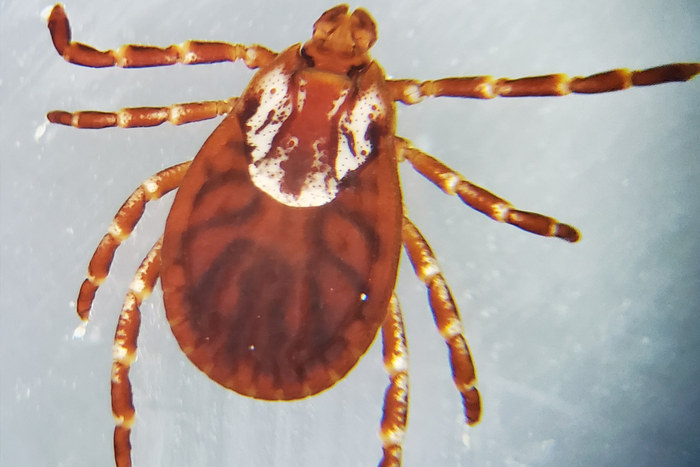
Mitogenomes and genome-wide markers from Japan, Fiji, New Caledonia and Australia show gene flow between sexual and asexual lineages of a tick now spreading worldwide.
An invasive species usually needs two individuals to establish a population. The Asian longhorned tick does not, and that is the most consequential thing about it.
Haemaphysalis longicornis was until recently confined to Japan, the Korean peninsula, China and Russia. It has since spread across Oceania and was detected in the United States in 2017. It transmits severe fever with thrombocytopenia syndrome virus, along with Rickettsia and Theileria species, and its bite can leave a person allergic to red meat.
A study in PNAS Nexus from Hokkaido University examines the genetics of that spread, and finds that the tick’s capacity for parthenogenesis — reproduction without males — appears to have arisen more than once.
Why one female is enough
Parthenogenesis changes the arithmetic of invasion completely. A sexually reproducing species arriving in a new place needs a male and a female to find each other before the founding population dies out, which is why most introductions fail. A parthenogenetic female needs nothing: she arrives on an imported animal or a shipping container, lays eggs, and the population exists.
That is the proposed explanation for how a tick native to north-east Asia reached Australia, the Pacific islands and the eastern United States, where it has since been found in a large number of states. The authors suggest the ability may help explain the spread.
The medical stakes follow from the pathogens. SFTS virus causes a disease with substantial mortality in parts of Asia, and the meat allergy — alpha-gal syndrome, in which a tick bite sensitises a person to a sugar found in mammalian meat — is a reminder that a tick does not need to carry a pathogen to cause lasting harm.
The agricultural stakes are at least as large. Theileria species cause anaemia and death in cattle, and an asexual tick population can reach densities that sexually reproducing species rarely manage — reports from the introduced range describe animals carrying thousands of individuals. A herd infestation of that scale is a veterinary problem before it is an epidemiological one.
Parthenogenesis also makes the arrival hard to catch. Surveillance that looks for an established breeding population has a window in which a sexual invader is present but not yet reproducing; a single parthenogenetic female closes that window, because the founding event and the breeding event are the same thing.
Two clades, and traffic between them
The analysis used two kinds of genetic data: complete mitochondrial genomes, which are inherited maternally and track lineage, and genome-wide single nucleotide polymorphisms obtained by MIG-seq, which reflect the nuclear genome and therefore any mixing between lineages.
Samples came from Japan, Fiji, New Caledonia and Australia, together with five laboratory strains — two that reproduce sexually and three that are parthenogenetic.
The mitochondrial tree resolved into two major clades that largely matched reproductive strategy, which on its own would suggest a clean split: one asexual lineage, descended from a single origin, and one sexual one.
The SNP data complicate that. They show gene flow between the clades, which is the finding that supports multiple origins — if asexual lineages were a single ancient branch, there should be no nuclear mixing with the sexual population. Mixing implies the asexual condition has arisen from within sexual populations repeatedly, rather than once.
There is also a loose end in the data consistent with that reading: three male ticks turned up within the mostly parthenogenetic clade, which a strictly asexual lineage should not contain.
What the inference rests on
The conclusion is reasonable and it is an inference rather than a demonstration, and the distinction is worth preserving.
Gene flow between clades can arise in more than one way. Repeated independent origins of parthenogenesis would produce it. So would occasional sexual reproduction by lineages that are usually asexual — which the three males hint at — or hybridisation between a long-established asexual lineage and sexual populations, or incomplete sorting of ancestral variation in markers that have not had time to diverge. Distinguishing these requires more than two marker types and four countries.
The sampling is also narrow for a species now on several continents. Japan represents the native range, Fiji, New Caledonia and Australia the Oceanian introductions, and nothing in the dataset comes from Korea, China, Russia or the United States — which means the lineage behind the American invasion was not examined. For a paper framed around global spread, that is the gap a reader notices.
The release reports no quantitative genetics of any kind: no sample counts per country, no divergence estimates, no measure of how much gene flow was detected. It also contains no quotation from any researcher, which is unusual enough to mention — the only attribution on the page is a paraphrase of what the authors suggest, so the interpretation reported here is theirs as summarised rather than in their words.
Why the mechanism matters practically
If parthenogenesis in this species is evolutionarily labile rather than a single ancient event, the implication for its spread is not reassuring. A trait that has arisen repeatedly is one the species is predisposed to acquire, which means asexual invasion potential is a general property of H. longicornis rather than a feature of one unlucky lineage.
It also bears on control. Strategies that work against sexually reproducing ticks by interfering with mating or releasing sterile males have no purchase on a population that does not mate, and a species that can switch strategies is harder to plan against than one that cannot.
The paper names Ryo Nakao of Hokkaido University as the lead researcher. The release does not list the other authors, does not state funding sources, and states no conflicts of interest.
Notes
- Nakao, R., et al. “Genomic signatures of native (Japanese) and introduced (Oceanian) populations of the Asian longhorned tick Haemaphysalis longicornis.” PNAS Nexus, 2026. DOI: 10.1093/pnasnexus/pgag232.
- Hokkaido University. “Globally spreading ticks evolved asexual reproduction multiple times.” EurekAlert!, 4 August 2026. https://www.eurekalert.org/news-releases/1137932.


Leave a Reply