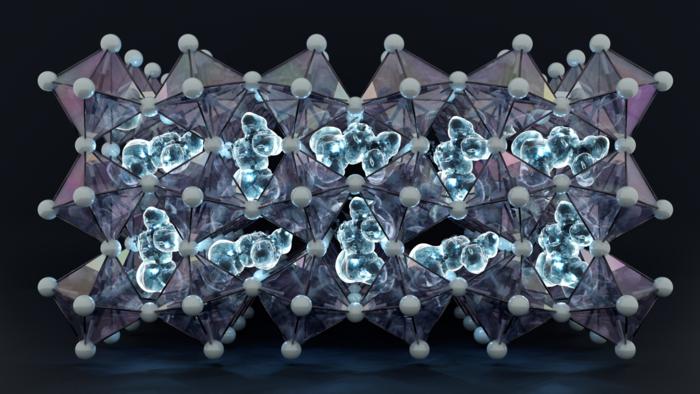
A Sungkyunkwan and Yonsei team held a dye assembly’s structure fixed while varying the surrounding liquid, and watched the charge transfer mechanism change and the exciton diffusion length nearly triple.
When a molecule absorbs light, the useful part is what happens next. The energy has to travel, and at some point a bound electron–hole pair has to separate into free charges. Organic solar cells and molecular semiconductors live or die on how well those two steps work.
The difficulty in studying them is that everything is tangled together. Change the molecule and you change its electronic structure, its packing and its environment at once. Change the solvent and the assembly usually rearranges, so any difference observed could be structural rather than electronic.
A team led by Professor Taeyeon Kim in the Department of Chemistry at Sungkyunkwan University, working with researchers at Yonsei University, built a system that separates the two. Their results appear in Nature Communications.
Holding the structure still
The platform is a molecular aggregate of perylene bisimide, a dye class used for decades in pigments and more recently as an electron-accepting material in organic electronics. PBI molecules stack into ordered columns through their flat aromatic faces, which makes them a convenient model for the stacked arrangements found in real devices.
The point of the design is that solvent polarity can be varied while the stacked nanostructure stays unchanged. That is what makes the comparison clean: the only thing differing between measurements is the dielectric environment.
“This study is significant in that it isolated the influence of the dielectric environment alone, without structural distortion, within a complex molecular aggregate, thereby revealing the fundamental principle of charge transfer,” Kim said.
Two regimes
What they found is that the charge transfer mechanism switches depending on solvent polarity, which the team reports for the first time.
In low-polarity solvents — oil-like environments — charge transfer proceeds by quantum mechanical tunnelling, which the team describes as a quasi-classical regime. In high-polarity solvents such as water or alcohol, it is governed instead by collective fluctuations of the solvent molecules, a classical regime.
The underlying idea has a long history in chemistry. The standard framework for electron transfer in solution, developed by Rudolph Marcus, treats the surrounding solvent as an active participant: its molecules must rearrange to accommodate the shifted charge, and the energy cost of that rearrangement helps set the rate. In a polar solvent, molecules with strong dipoles reorganise substantially and that reorganisation dominates. In a non-polar solvent there is little to reorganise, and the transfer depends more on the electronic coupling between donor and acceptor.
What is new here is watching the handover between the two inside one unchanged structure, rather than inferring it by comparing different systems. The measurements were made with ultrafast laser spectroscopy, which resolves events on the femtosecond scale — a quadrillionth of a second, fast enough to catch charge separation as it happens — supported by quantum chemical computations.
From 35.9 to 98.8 nanometres
The consequence with the most obvious practical edge concerns exciton diffusion. An exciton is the bound electron–hole pair created by absorbed light, and its diffusion length is how far it travels before recombining and wasting the energy.
That distance is the central design constraint in organic photovoltaics. Excitons in organic materials typically travel only around ten nanometres, which is why organic solar cells are built as finely intermixed blends of donor and acceptor: every absorbed photon has to create an exciton within a few nanometres of an interface, or the energy is lost. The whole awkward architecture of the field is a workaround for a short diffusion length.
Here, under strong illumination, the exciton diffusion length could be tuned from 35.9 to 98.8 nanometres depending on the solvent environment. Both ends of that range are long by the standards of organic materials, and the ratio between them is nearly three.
The caveat is the condition attached: this is under strong light, and in solution. A dye aggregate suspended in a chosen solvent is not a solid-state device, and the dielectric environment of a working film is set by the material itself rather than by a liquid that can be swapped out. What transfers is the principle, not the method.
What the principle buys
“We expect this to provide holistic, integrated molecular design guidelines that can maximize the efficiency of eco-friendly future energy devices such as organic solar cells and artificial photosynthesis systems,” Kim said.
The usable implication is that the dielectric environment is a design variable in its own right, separable from molecular structure and packing. If a film’s local polarity can be engineered — through side chains, additives, or a surrounding matrix — then charge transfer behaviour can be adjusted without redesigning the chromophore, which is the expensive route.
Artificial photosynthesis is the more speculative application and the more demanding one. Splitting water or reducing carbon dioxide with light requires moving charges over useful distances to catalytic sites, and losing excitons to recombination before they arrive is one of the standard failure modes. A tripled diffusion length would be worth having, if it survived the move out of solution.
The authors in the image credit are listed as Choi, H., Chae, M., Kim, T. and colleagues. The release does not state the study’s funding sources, and gives no individual names for the Yonsei collaborators. The paper was published online on 17 July.
Notes
- Choi, H., Chae, M., Kim, T., et al. “Dielectric-tuned charge and exciton dynamics in perylene bisimide supramolecular aggregates.” Nature Communications, 2026. DOI: 10.1038/s41467-026-75555-y.
- Sungkyunkwan University. “Sungkyunkwan University uncovers key principle to boost efficiency of artificial photosynthesis and next-generation semiconductors.” EurekAlert!, 3 August 2026. https://www.eurekalert.org/news-releases/1138649.

Leave a Reply