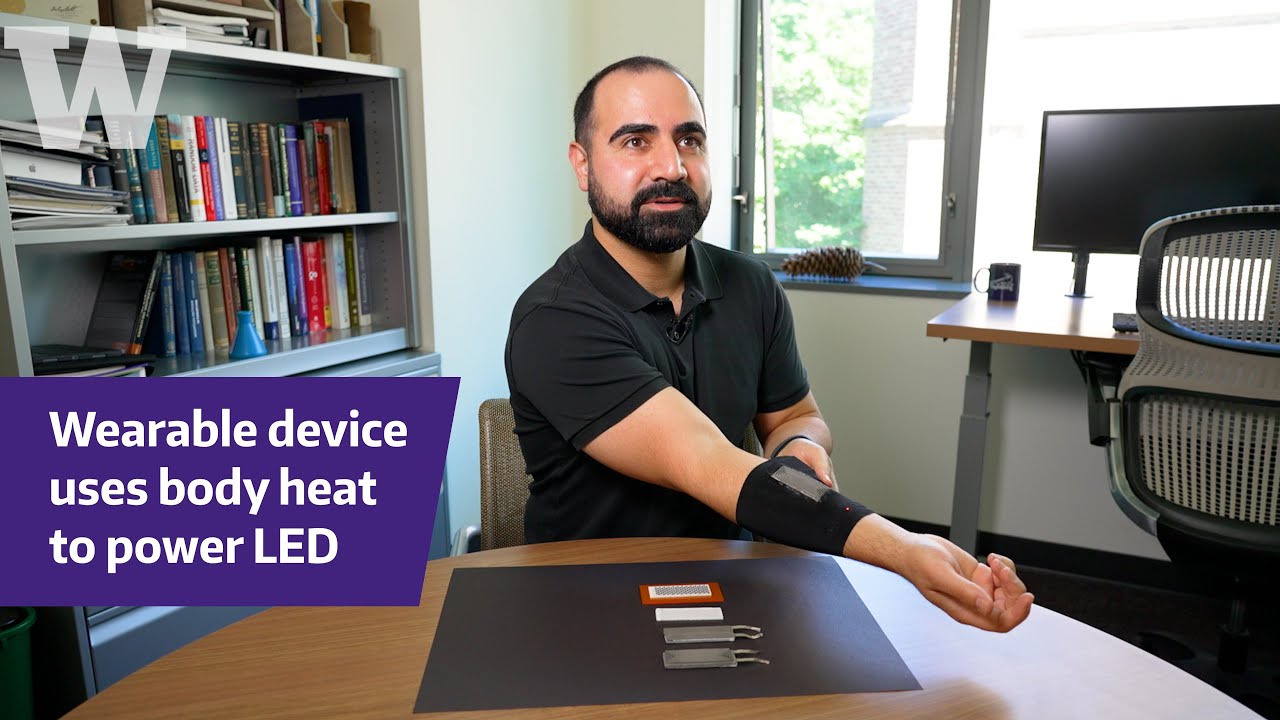
Pusan National University engineers built an organic electrochemical transistor that can be reprogrammed between digital switching and analog, synapse-like behaviour, and signals which mode it is in by changing colour.
A conventional electronic device does one job. A logic gate switches; a memory cell stores. Combining both functions usually means combining circuits, which for a device meant to sit on skin is a problem, because every additional component adds stiffness and another thing to break when the material stretches.
Engineers at Pusan National University in South Korea report a device that does both jobs by changing its chemistry rather than its circuitry. Writing in ACS Nano, a team led by Assistant Professor Hyunseok Shim of the School of Electronics and Electrical Engineering describes a fully stretchable organic electrochemical transistor that can be reprogrammed between digital logic and analog memory by altering the salt concentration around it.
Transistors that work with ions
Organic electrochemical transistors, or OECTs, do not work like the silicon transistors in a processor. Instead of controlling a current by applying a voltage across an insulating layer, they work by driving ions into and out of a conducting polymer, which changes how well it conducts.
That makes them inherently suited to contact with living tissue, since bodies run on ions and OECTs can operate in wet, salty environments at low voltages. It also makes them slow by the standards of digital electronics, because moving ions takes longer than moving electrons.
The Pusan team’s insight was that the ion concentration is not merely an operating condition but a control parameter. At high salt concentrations, the device switches rapidly between on and off, behaving as a digital logic element. At lower concentrations, it responds more gradually and retains a memory of previous inputs, producing analog behaviour the team likens to voltage profiles at a synapse.
The release gives no specific concentration values, so the range over which the behaviour shifts is not stated.
Two additives for conductivity and stretch
The conducting polymer is PEDOT:PSS, the workhorse material of organic bioelectronics, valued for conducting both electrons and ions and for being processable from water. On its own it is brittle, and films of it crack when stretched.
The researchers modified it with two additives that improved both electrical conductivity and durability under stretching. The release does not name them.
Making such a device genuinely stretchable is not a matter of the active material alone. The electrodes, the electrolyte and the substrate all have to tolerate deformation without delaminating, and mismatches between layers tend to concentrate strain at interfaces, which is where stretchable electronics usually fail.
Light blue to dark blue
The feature that distinguishes this device from a laboratory curiosity is that it reports its own state. As it switches between modes, it changes colour from light to dark blue.
PEDOT:PSS is electrochromic: its optical absorption changes as ions move in and out, by the same mechanism that changes its conductivity. The colour is not an added indicator but a direct consequence of the device’s operating state.
For a wearable device that is more useful than it sounds. A patch on skin that is doing something invisible requires an external readout to confirm it is working. One that changes colour can be checked by looking at it, which matters for a device a patient or a nurse is meant to use without instrumentation.
A bandage that tightens and loosens itself
As a proof of concept, the team built a wearable patch that senses inflammatory swelling and skin temperature, then automatically tightens or loosens a compression band.
Compression therapy is standard treatment for several conditions involving swelling in the limbs, and the pressure has to be right: too little achieves nothing, too much restricts blood flow and risks damaging tissue. The correct pressure also changes as swelling rises and falls, which a fixed bandage cannot accommodate.
A band that senses and adjusts would close that loop. The team frames it as a demonstration rather than a clinical device, and the release reports no patient testing.
“The proposed platform is suitable for smart electronic skin, wearable health monitors, and soft bioelectronic implants,” Shim said, adding that a single stretchable device could both process and store physiological signals without extra circuitry.
Why fewer components matters
The absence of extra circuitry is the core engineering claim. Most wearable sensors transmit raw data to a phone or a base station to be processed, which costs power, requires a radio and fails when the link does.
A device that processes signals where it sits avoids that, and one that can switch between computing and remembering does so with fewer parts. For a patch that must flex thousands of times a day, each component removed is a failure point removed.
Switching modes by changing the surrounding salt concentration does raise a question of control. In the laboratory the electrolyte can be swapped deliberately; on skin, sweat composition varies with exertion, heat and hydration, which is a less obedient source of ions.
The suggested applications extend to neuromorphic devices, which compute in ways loosely modelled on neurons, soft robots and adaptive prosthetics. The synapse-like analog mode is what connects the device to neuromorphic computing: an element whose response depends on its history is the basic ingredient of such systems, and most candidates are rigid inorganic materials rather than stretchable polymers.
“In the longer term, this work could lead to autonomous personalized therapeutics, such as dynamic compression bandages,” Shim said, and also described electronic skins able to respond to injury in real time, monitored through a visible colour change.
How much of this follows depends on questions the release does not address: how many stretch cycles the device survives, how stable its behaviour is as sweat and temperature alter the ionic environment on skin, and whether the salt concentration can be controlled reliably on a body rather than in a laboratory. The authors declare no competing financial interests.
Notes
- “Fully Stretchable Ionically Tunable Organic Electrochemical Transistors for Wearable Adaptive Logic Bioelectronics.” ACS Nano, 2026, 20(26). DOI: 10.1021/acsnano.6c05309.
- Pusan National University. “Pusan National University reports an adaptive organic transistor for wearable electronics.” EurekAlert!, 3 August 2026. https://www.eurekalert.org/news-releases/1138116.


Leave a Reply