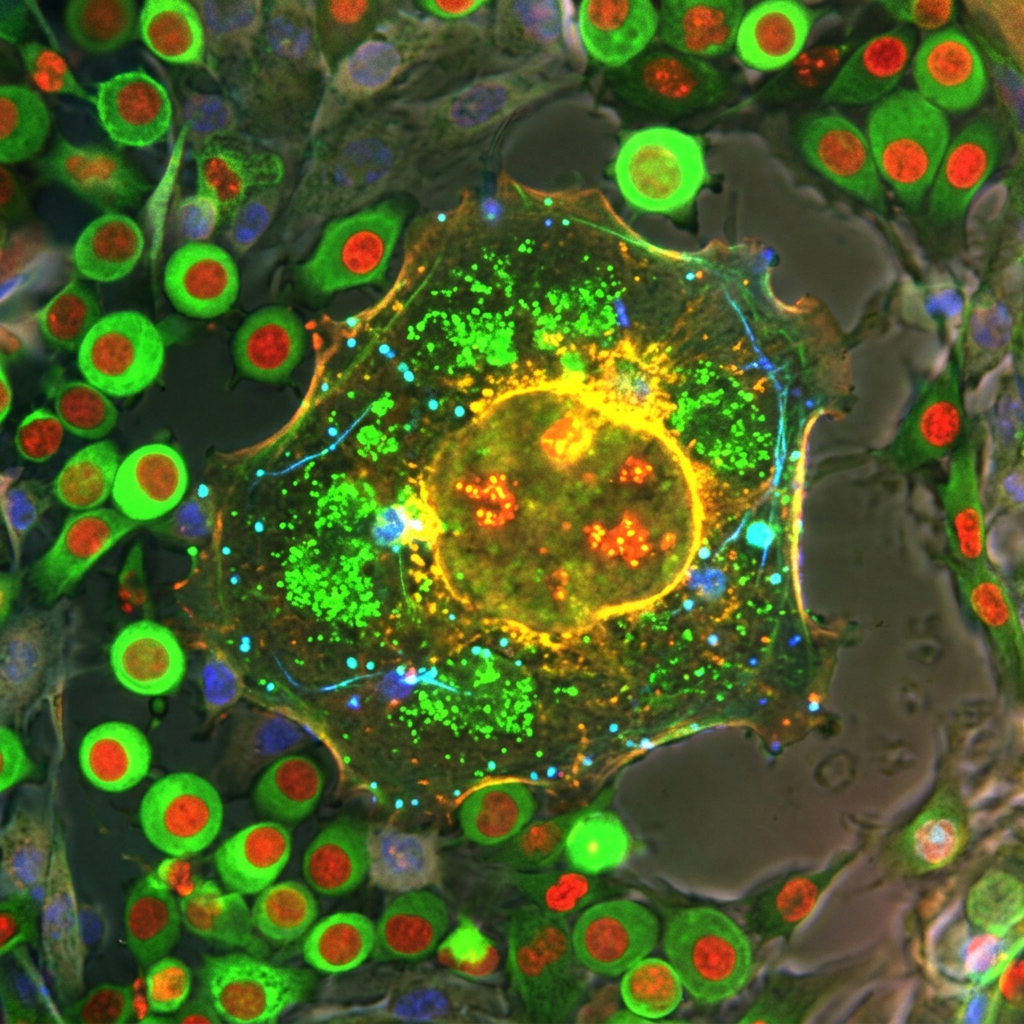
Researchers found that the repair protein RAD51C, linked to breast and ovarian cancer risk, is anchored at the Golgi by a protein called Giantin and moves to the nucleus after DNA damage.
Textbooks describe the Golgi complex as the cell’s packaging and shipping center. It receives newly made proteins and lipids, modifies them and sorts them for delivery to their destinations inside and outside the cell. DNA repair, by contrast, happens in the nucleus, where the genome is stored. The two seem to have little to do with each other.
A study from the European Molecular Biology Laboratory (EMBL) in Heidelberg, Germany, challenges that separation. Writing in the Journal of Cell Biology, researchers report that several DNA-repair proteins sit at the Golgi and move to the nucleus when DNA is damaged, and that the Golgi plays an active part in controlling repair.
“Finding DNA-repair proteins at the Golgi at all was unexpected; this is machinery you expect to see in the nucleus,” said Karolina Kuodyte, an EMBL researcher and one of the study’s authors.
An organelle with a long history
The Italian scientist Camillo Golgi first described the organelle in 1898, using a staining technique he had developed to study nerve cells. For decades some researchers doubted it was real, suspecting it was an artifact of the staining process. Electron microscopy eventually confirmed its existence, revealing a stack of flattened, membrane-bound compartments typically located near the nucleus.
Golgi shared the 1906 Nobel Prize in Physiology or Medicine with the Spanish neuroscientist Santiago Ramón y Cajal for their work on the structure of the nervous system, although the two disagreed sharply about how nerve cells were organized.
Since then, the Golgi has been studied mainly for its role in processing and sorting proteins. But evidence has accumulated that it also acts as a signaling hub, helping cells respond to stress and coordinating processes such as cell division and movement.
Mapping where proteins live
The new findings grew out of efforts to map where proteins are located in human cells. The team, including George Galea, Kuodyte and group leader Rainer Pepperkok, worked with the Human Protein Atlas, a Swedish-led program launched in 2003 to chart the human proteins, and with the laboratory of Emma Lundberg at Stanford University, which studies how proteins are organized within cells.
According to the researchers, more than 300 proteins are shared between the Golgi and the nucleus. Among them were proteins involved in DNA repair, which prompted the team to look more closely.
Proteins that turn up in more than one part of the cell are more common than once thought. Large-scale mapping projects have found that a substantial fraction of human proteins appear in multiple compartments, which suggests that many may have more than one job or may shuttle between locations to relay information.
RAD51C and its anchor
The researchers focused on RAD51C, a protein involved in homologous recombination. This is one of the cell’s most accurate ways of repairing double-strand breaks, in which both strands of the DNA double helix are severed. The process uses an intact copy of the damaged DNA as a template to restore the original sequence.
Homologous recombination is critical for maintaining genome stability, and defects in it can allow mutations to accumulate. Inherited mutations in the RAD51C gene raise the risk of breast and ovarian cancer, placing it alongside better-known genes such as BRCA1 and BRCA2, which work in the same repair pathway.
The team found that RAD51C is held at the Golgi by Giantin, a large protein that helps maintain the Golgi’s structure. When DNA was damaged, RAD51C moved from the Golgi to the nucleus, where repair takes place. When the researchers removed Giantin, repair halted.
“This was a very exciting finding, one of the first of its kind,” said Galea, an EMBL researcher.
Rethinking the cell’s division of labor
The results suggest the Golgi may function as a reservoir that keeps repair proteins in position until they are needed and helps control their release. Such an arrangement could allow cells to regulate repair more precisely, or to link it to other signals arriving from the cytoplasm.
“The work reframes the Golgi as an active participant in the DNA damage response rather than a bystander,” Pepperkok said. “More striking still, it points to cytoplasmic processes being far more closely linked to DNA repair than we assumed.”
Galea said the findings raise new questions. “This opens up a lot of new questions about how the cytoplasm and the nucleus influence each other,” he said.
Implications for cancer
The work could eventually matter for understanding and treating cancer. Many cancer therapies, including radiation and certain chemotherapy drugs, work by damaging DNA, and the ability of tumor cells to repair that damage can determine whether treatment succeeds. A class of drugs called PARP inhibitors exploits weaknesses in homologous recombination and is used to treat some breast, ovarian, prostate and pancreatic cancers.
If the Golgi helps control how and when repair proteins reach the nucleus, changes in Golgi structure or function could affect how cells respond to DNA damage. Alterations to the Golgi are common in cancer cells, although whether they influence DNA repair in tumors has not been established.
Much remains to be learned. The study identified RAD51C as one Golgi-associated repair protein, but the researchers have not yet determined how many of the other shared proteins behave similarly, or exactly how the signal to move to the nucleus is transmitted. The findings come from experiments in cells grown in the laboratory, and further work will be needed to establish their relevance in tissues and in disease.
Still, the research is a reminder that the cell’s compartments are less separate than diagrams suggest. More than a century after Camillo Golgi first saw it, the organelle that bears his name is turning out to have responsibilities well beyond shipping and packaging.
Notes
- Study on Golgi-associated DNA-repair proteins. Journal of Cell Biology, 2026. DOI: 10.1083/jcb.202605024.
- European Molecular Biology Laboratory. “New research shows the Golgi complex is involved in DNA repair control.” EurekAlert!, 30 July 2026. https://www.eurekalert.org/news-releases/1138197.
Leave a Reply