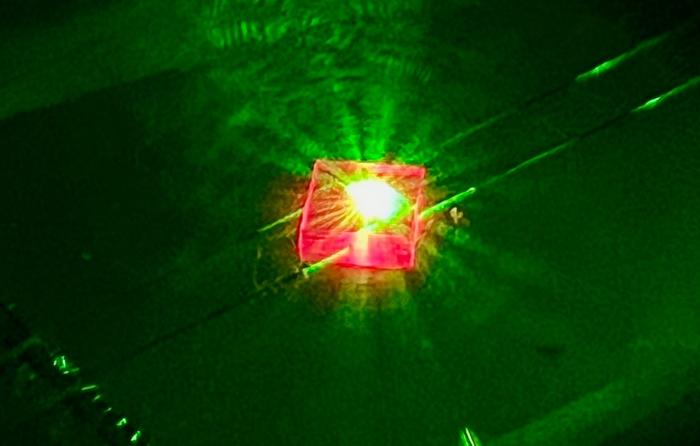
A team from École Polytechnique, Collège de France and HZDR used ultrafast terahertz pulses to modulate a gold-and-semiconductor metamaterial in time, halving its energy losses and pointing toward new ways to amplify light.
Photonic crystals are materials whose structure repeats in space, like the facets of a carefully cut gem at a microscopic scale. That repeating pattern lets them control how light travels, blocking some colors and guiding others. They are behind the iridescent colors of butterfly wings and opals and are used in optical fibers and lasers.
Physicists have long wondered what would happen if the repetition took place in time instead of space. Researchers from École Polytechnique and the Collège de France, working with the Helmholtz-Zentrum Dresden-Rossendorf (HZDR) in Germany, now report in Nature that they have built such a photonic time crystal for terahertz light.
“By extending photonic crystals from space to time, we open a new dimension for light control—and a novel path toward amplification and lasing,” said Tingwen Guo, a doctoral student at École Polytechnique and the study’s lead author. “That could be a game-changer for optical technologies at terahertz frequencies and beyond.”
A neglected part of the spectrum
Terahertz radiation lies between microwaves and infrared light. It can pass through clothing, paper and plastics, and many molecules absorb it at distinctive frequencies, giving it potential uses in security screening, medical imaging, materials testing and high-speed wireless communication. But generating, controlling and detecting terahertz waves has proven difficult.
“The THz range represents the frontier between electronic and photonic technologies,” said Yannis Laplace, an assistant professor at École Polytechnique. “It is a range full of opportunities both for science and for the society, yet is still under-developed technologically compared to its electrical and photonic counterparts. Creating photonic crystals could lead the way to the closing of this gap.”
Changing a material in time
In an ordinary photonic crystal, light encounters regions of different optical properties as it moves through space. In a photonic time crystal, the optical properties of the entire material change rhythmically in time. Theory predicts that this can create unusual effects, including regimes in which light waves are amplified rather than simply transmitted or reflected.
The challenge is speed. To act as a time crystal, a material’s properties must change significantly within a time comparable to a single oscillation of the light wave. For terahertz light, that means modulating the material in picoseconds, or trillionths of a second, and doing so strongly enough to matter.
The team’s solution was a metamaterial, an engineered structure whose properties come from its design as much as from its ingredients. It consisted of tiny gold crenellations, shaped like the battlements of a castle wall, layered over an insulator and the semiconductor indium antimonide. Such gold structures support plasmons, collective oscillations of electrons that interact strongly with light, which gives the device its name: a plasmonic metamaterial.
Driving the crystal with a powerful source
To drive the modulation, the researchers needed intense and precisely controlled terahertz pulses. They used TELBE, a terahertz source at HZDR’s ELBE accelerator, which uses beams of electrons to generate powerful pulses of radiation.
“TELBE’s unique ability to generate high-field, phase-stable terahertz pulses was critical,” said Jan-Christoph Deinert, who coordinates the facility. “Without this infrastructure, achieving the coherent, ultrafast modulation needed for the PTC regime would have been impossible.” PTC is short for photonic time crystal.
The strong terahertz pulses modulated the properties of the metamaterial on picosecond timescales, causing its reflectivity to oscillate in time. The experiments showed that this modulation reduced the dissipation of energy in the system by half.
Theory to guide the next steps
Reducing losses is a crucial step. Energy dissipation is one of the biggest obstacles to achieving amplification in photonic time crystals, because any gain must overcome the energy that leaks away. Halving the losses brings the system closer to the regime in which the time crystal could actively amplify light.
The team developed a theoretical model to explain the results. “The theory not only reproduces the experiment but also provides the basis for guiding future discoveries in this system,” said Marco Schiró, a research scientist at the Collège de France.
Photonic time crystals have been an active area of theoretical research for years, but experimental demonstrations have been limited, with most at radio and microwave frequencies, where electronic circuits can switch fast enough. Reaching higher frequencies requires much faster and stronger modulation of material properties, which is why the TELBE source was central to the work.
The name echoes, but differs from, another idea in physics. In 2012, the Nobel laureate Frank Wilczek proposed time crystals as phases of matter whose structure repeats in time on its own. Photonic time crystals, by contrast, are driven from outside: their rhythm is imposed by an external source, in this case the terahertz pulses from TELBE.
Toward new terahertz devices
The demonstration is a proof of concept rather than a working device. It relied on a large accelerator facility to drive the modulation, which is not practical for everyday use, and the researchers have not yet achieved amplification or lasing. Developing compact sources capable of driving such crystals, or materials that can be modulated more easily, will be important for any applications.
If those hurdles can be overcome, photonic time crystals could provide new ways to amplify terahertz signals and build terahertz lasers, helping to fill the gap between electronics and optics that Laplace described. The principles could also extend to other frequencies of light.
More broadly, the work adds time to the dimensions physicists can use to engineer how light behaves. Just as patterning a material in space gave rise to a rich range of optical technologies, patterning it in time may open possibilities that are only beginning to be explored.
Notes
- Guo, T., et al. “Plasmonic metamaterial time crystal.” Nature, 2026. DOI: 10.1038/s41586-026-10825-9.
- Helmholtz-Zentrum Dresden-Rossendorf. “Shaping light like never before – with photonic time crystals.” EurekAlert!, 30 July 2026. https://www.eurekalert.org/news-releases/1138063.
Chong Zu laboratory, Washington University in St. Louis


Leave a Reply