University of Osaka researchers showed that many real-world optimization problems share a distance-based structure that can be recast as convolutions, making them suited to optical computing.
Where should a city put its new fire stations? How should a delivery company route its trucks? How can millions of data points be sorted into meaningful groups? These are all optimization problems, in which the goal is to find the best option among an enormous number of possibilities. As they grow larger, the computing power needed to solve them can rise steeply.
Researchers at the University of Osaka report a way to make a broad class of these problems more manageable, particularly for computers that use light instead of electricity. In a study published in Communications Physics, the team identified a hidden mathematical structure shared by many real-world problems and showed how to reformulate those problems for optical computing.
Computing with light
Conventional computers process information by moving electrons through circuits. Optical computers instead use beams of light. Because light can travel and interact in parallel, optical systems are seen as promising for optimization problems, in which the number of interactions between elements can be vast.
“Instead of considering every possible interactions one by one, optical systems can rapidly measure how good a candidate solution is by encoding it as a pattern of light,” said lead author Hiroshi Yamashita. “This makes it possible to search through enormous numbers of possibilities far more efficiently than conventional electronics. This is well suited for solving optimization problems, where the goal is to identify the best option from a vast number of possibilities.”
The machine the team has in mind is known as a spatial photonic Ising machine, or SPIM. In such a device, many variables are represented by the spatial pattern of a laser beam, typically shaped by a spatial light modulator, allowing them to be processed in parallel.
Ising machines take their name from the Ising model, a classic model in statistical physics that describes magnetic spins pointing up or down and interacting with their neighbors. Many optimization problems can be translated into the language of the Ising model, in which finding the best solution corresponds to finding the arrangement of spins with the lowest energy.
The problem with dense problems
Mathematically, the problems the team studied belong to a class called quadratic unconstrained binary optimization, or QUBO. In a QUBO problem, each variable takes one of two values, and the quality of a solution depends on how pairs of variables interact. Many QUBO problems are known to be extremely hard to solve exactly as they grow.
A particular difficulty has been handling “dense” problems, in which many variables influence one another at once. Representing all of those interactions can overwhelm the hardware, optical or otherwise.
A shared language of distance
The Osaka team noticed that many real-world problems have something in common: their interactions depend on spatial relationships, such as the distances between elements. The cost of placing two facilities, for example, depends on how far apart they are, not on their absolute positions.
“We take advantage of the fact that these problems use a common mathematical language,” said senior author Hideyuki Suzuki. “By identifying patterns based on relative positions and distances, we show that a wide range of real-world challenges can be represented in a form that is amenable to optical computation.”
Interactions that depend only on relative position have a repeating pattern, and mathematically they can be written as a convolution, an operation that slides one pattern across another. The researchers exploited these repeating patterns to reduce the computational demands of large problems.
The convolutional structure has another benefit. Convolutions can be computed efficiently using fast Fourier transforms, a classic algorithm that underlies much of modern signal processing. According to the release, this yields efficiency gains even on conventional hardware, not only on optical machines.
Optics and Fourier transforms are natural partners. A simple lens can perform a Fourier transform on a beam of light, which is one reason optical systems have long been considered for this kind of computation.
Testing on practical problems
To show that the approach works, the team applied it to two types of problems. “To demonstrate the method, we solved problems involving facility placement and data clustering,” Yamashita said. “These tests show that complex optimization challenges can be translated into the new framework while preserving the information needed to find solutions.”
Facility placement asks where to locate a set of sites to best serve a population. Data clustering groups similar data points together, a common task in data analysis and machine learning. Both involve distances between elements, making them natural fits for the framework.
Toward greener computing
The researchers see their work as a step toward faster and more energy-efficient computing systems. Broader use of optical hardware for optimization in social infrastructure and industry could, they suggest, contribute to a carbon-neutral future. The work was funded by the Japan Science and Technology Agency’s Advanced Technologies for Carbon-Neutral (ALCA-Next) program.
The study is computational and theoretical, and the release gives no benchmarks or performance figures. It shows that the problems can be reformulated for optical computation, not that optical hardware has yet solved them faster than conventional computers. Optical computing still faces practical hurdles, including precision and noise in the physical devices.
Notes
- Yamashita, H., et al. “Convolutional Formulation of Large-Scale Quadratic Unconstrained Binary Optimization with Dense Interactions.” Communications Physics, 29 July 2026. DOI: 10.1038/s42005-026-02747-9.
- The University of Osaka. “Solving complex optimization problems using optics.” EurekAlert!, 29 July 2026. https://www.eurekalert.org/news-releases/1137688.
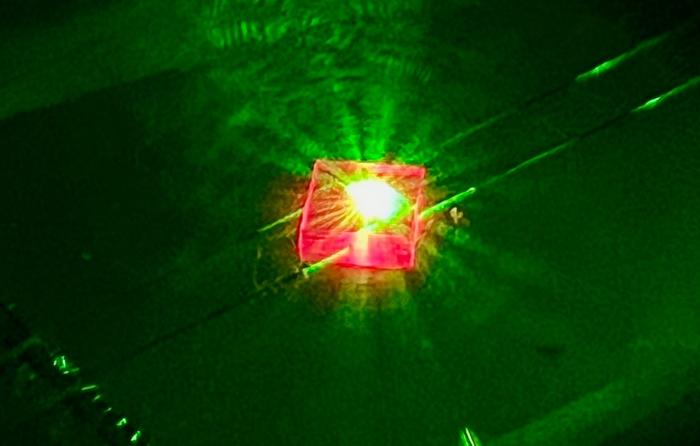
Featured image: File image of a laser laboratory. Credit: Chong Zu laboratory, Washington University in St. Louis



Leave a Reply