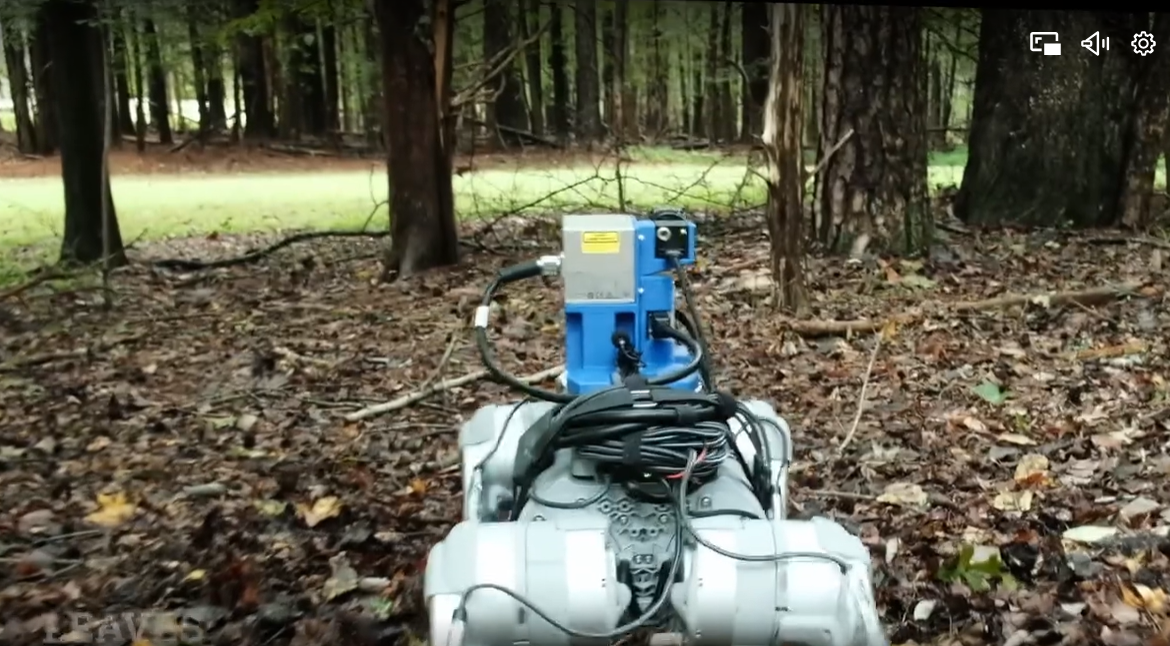
Across five experiments with a real delivery-style robot and immersive VR, 92 percent of people judged a machine approaching from behind as quicker than an identical one approaching head-on — a quirk of perception engineers may need to design around.
Anyone who has stepped aside on a crowded sidewalk for a cyclist they only heard coming knows the feeling: whatever is closing in from behind seems to be arriving faster than it should. A team at Toyohashi University of Technology in Japan has now put a number on that intuition, and it turns out to be remarkably consistent. When an autonomous mobile robot rolled toward people at exactly the same physical speed, the approach from behind was judged to be faster than the approach from the front by nearly everyone tested.
The study, led by Associate Professor Hideki Tamura of the university’s Department of Computer Science and Engineering and published September 10 in IEEE Robotics and Automation Letters, ran five separate experiments using both a real robot and immersive virtual reality. Ninety-two percent of participants showed the same perceptual bias.1 The researchers then fed that bias into a robot navigation model and found that a machine designed with human perception in mind would give pedestrians a noticeably wider berth.2
Machines among us
Autonomous mobile robots — the wheeled machines that ferry packages through warehouses, deliver food along sidewalks, and guide visitors through airports and hospitals — increasingly share space with people who never signed up to work alongside them. Engineers have long focused on the hard safety problem of keeping robots from colliding with anyone. But a robot that technically misses you by a comfortable margin can still feel threatening, and earlier research had already shown that people experience more discomfort, and want more personal space, when a robot comes up from behind rather than from the front.2
What nobody had tested directly was whether the robot’s speed itself is perceived differently depending on where it comes from. Tamura’s group, drawing on the university’s Vision and Action Laboratory, Visual Perception and Cognition Laboratory, and Cognitive Neurotechnology Unit, set out to answer that question with the tools of psychophysics, the branch of psychology that measures the relationship between physical stimuli and what people actually experience.
Memorize, turn, judge
In the first experiment, participants learned two reference speeds — 0.5 meters per second and 1.0 meter per second, roughly the range between a slow stroll and a brisk walk. A real robot then approached them from the front or from behind at one of seven speeds between those two anchors, and each participant had to decide whether the robot felt closer to the slow reference or the fast one.2
The answer was lopsided. At the same physical speed, the robot coming from behind was consistently rated as faster. Four follow-up experiments, several of them conducted in VR where the researchers could control variables a physical robot could not, chipped away at the obvious explanations. The bias did not come from how participants’ bodies were oriented while they learned the reference speeds. It did not depend on the spatial relationship between the observer and the robot, on what the approaching object looked like, or on motor noise — the small, unavoidable jitter in a person’s own movements.2
What remained, the team concluded, were vision-dependent factors that arise when people turn around to look at something approaching from behind. In other words, the act of twisting to catch sight of a machine already closing in appears to change how fast that machine seems to be moving.
From perception to path planning
The researchers did not stop at describing the illusion. They built the measured bias into a standard robot navigation model and simulated a common real-world scenario: a robot overtaking a pedestrian from behind. Compared with the conventional model, the perception-aware version began its avoidance maneuver earlier and kept more distance from the walker. Using the largest bias observed in the experiments, the robot passed as much as 0.40 meters farther from the pedestrian and started steering away 0.57 seconds sooner than the baseline model.2
Those numbers sound small, but in the close quarters of a hallway or a crowded sidewalk, 40 centimeters and half a second can be the difference between a machine that feels courteous and one that feels like it is cutting someone off.
Tatsuto Yamauchi, the study’s first author and a second-year Ph.D. student in the department, said the work challenges how engineers have traditionally thought about robot motion. “Robot speed has traditionally been considered only in terms of its physical value, such as how many meters per second a robot travels,” he said. “Our findings show that humans perceive the same physical speed differently depending on the direction from which the robot approaches.”2
That gap between physics and perception, Yamauchi argued, should shape the next generation of robot behavior. “As AMRs become increasingly common in everyday environments, designing robot motion based not only on physical safety but also on how humans actually perceive robot speed will contribute to safer, more comfortable, and more acceptable human–robot coexistence,” he said.2
Open questions
The study measured perceived speed, not how people feel or act in response to it. The team says future work needs to establish how the bias affects subjective comfort, perceived safety, and real avoidance behavior when people and robots actually share a space. It also remains to be seen whether the effect holds at speeds outside the 0.5 to 1.0 meter-per-second range tested here, and for robots of different sizes and shapes.2
Still, the finding points toward a design philosophy that treats human perception as an engineering input rather than an afterthought. A robot that can calculate a collision-free path is one thing. A robot that knows it will seem faster than it is when it comes up on someone’s blind side — and slows or swings wide accordingly — is something people may actually be willing to live alongside.
The research was supported by Japan’s New Energy and Industrial Technology Development Organization (NEDO), the Japan Science and Technology Agency, the Nitto Foundation, the Foundation of Amano Institute of Technology, and the Tokai Pathways to Global Excellence program under Japan’s Ministry of Education, Culture, Sports, Science and Technology.2
Notes
- Yamauchi, T., Minami, T., Nakauchi, S., & Tamura, H. (2026). Speed perception bias for objects approaching from behind and its implications for robot motion design. IEEE Robotics and Automation Letters (Early Access). https://doi.org/10.1109/LRA.2026.3732839
- Toyohashi University of Technology. (2026, September 30). Robots approaching from behind are perceived as moving faster [Press release]. EurekAlert! https://www.eurekalert.org/news-releases/1145983


Leave a Reply