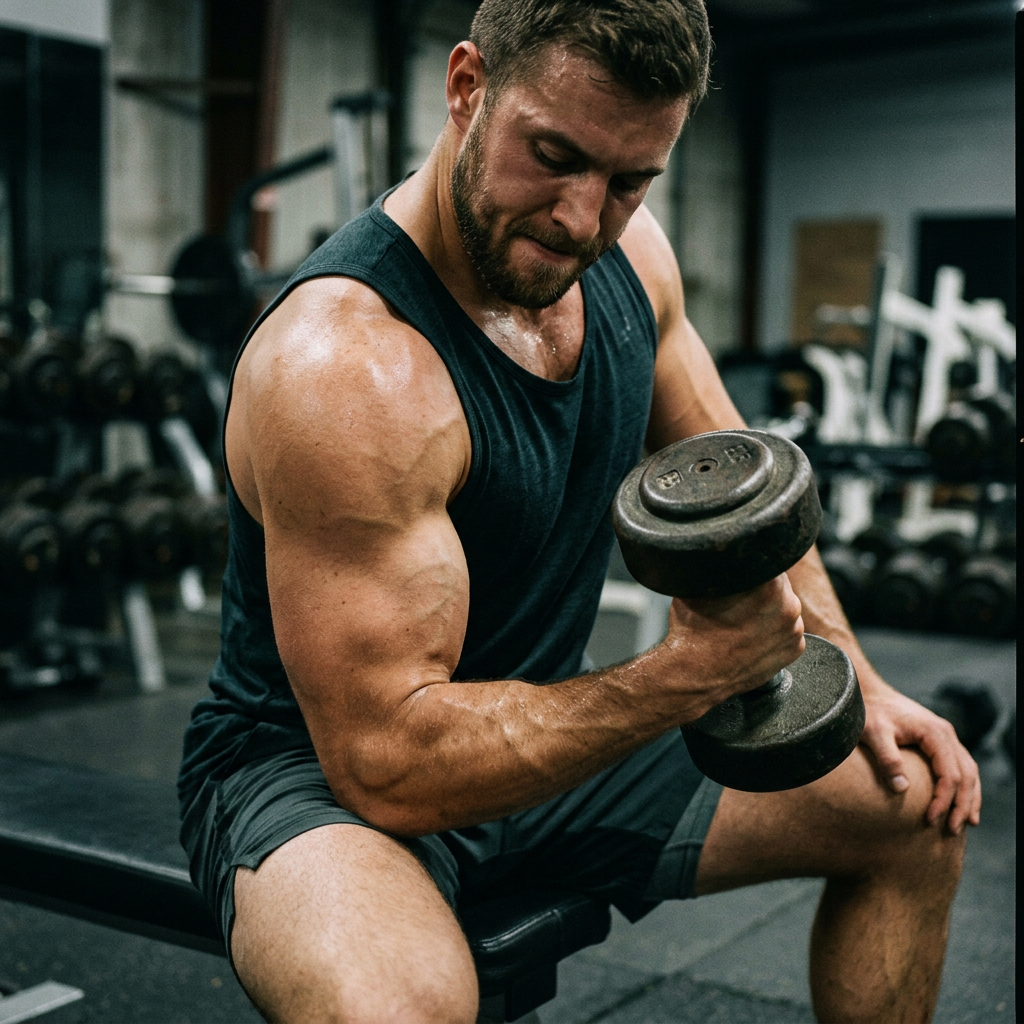
A German team has mapped, protein by protein, how human muscle detects and clears exercise damage and then rebuilds itself stronger.
Every serious lifter knows the feeling the day after a hard session: the stiffness, the tenderness, the sense that something has been taken apart. In a way, it has. High-intensity resistance exercise places enormous mechanical strain on muscle fibers, producing microscopic damage to the very machinery that generates force. And yet, done consistently, the same punishing workouts make muscles bigger and stronger.
How the body gets from damage to growth has remained surprisingly murky. Now a team of exercise physiologists, cell biologists and protein specialists from the Universities of Hildesheim, Bonn and Freiburg has traced the process at the molecular level. Their study, published in Nature Communications, shows that resistance training activates a specialized repair system that finds damaged parts of the muscle’s contractile apparatus, removes them, and drives production of fresh replacements.
The findings could help coaches fine-tune training programs, guide rehabilitation for patients, and inform strategies to fight the gradual muscle loss that comes with age.
Why strength training matters more than ever
Physical activity is a cornerstone of healthy aging, but not all exercise is equal when it comes to muscle. Endurance activities such as running or cycling are excellent for the heart and lungs, yet on their own they are not enough to preserve muscle mass. That job requires resistance work intense enough to challenge muscle fibers directly.
Recognizing this, the World Health Organization now recommends moderate muscle-strengthening activities at least twice a week, including for older adults, to help prevent the loss of muscle strength. The reasoning is sound: muscle mass and strength decline with age, and that decline is linked to frailty, falls and loss of independence.
But the very intensity that makes resistance exercise effective also makes it damaging in the short term. Until now, scientists had only a partial picture of how muscle copes with that damage and adapts over repeated training sessions.
Biopsies before and after
To find out, the researchers took small muscle samples, or biopsies, from healthy volunteers before and after a bout of high-intensity resistance exercise. They also examined what happened when training was reduced over a longer period and when it stopped altogether, allowing them to see how the muscle’s molecular response depended on training history.
The samples were then analyzed using advanced proteomics, techniques that catalog and measure the full set of proteins present in a tissue. The team used a fractionated approach to focus specifically on the contractile apparatus, the tightly organized protein structures inside muscle fibers that shorten to produce movement.
What they found was a coordinated, two-part response. First, resistance exercise activated a system that recognizes damaged components of the contractile machinery and tags them for removal. Second, the same repair network promoted the synthesis of new contractile proteins to replace what had been lost. The net effect was to preserve and reinforce the muscle’s force-generating structures.
The study also identified previously unknown members of this repair network and showed how they are regulated in response to training.
Proteins that rush to the scene
The proteomics work was led by Professor Pitter Huesgen of the University of Freiburg. “Our analytical approaches allowed us to identify proteins that are recruited to the contractile apparatus after resistance exercise, where they perform essential protective and repair functions,” he said.
Identifying those proteins was only the first step. To understand what they actually do, the team turned to the laboratory of Professor Jörg Höhfeld at the University of Bonn’s Institute for Cell Biology. Working with cultured muscle cells, Höhfeld’s group showed that the repair proteins act as a kind of cleanup crew.
“Using cultured muscle cells, we demonstrated that these repair proteins first recognize damaged muscle structures and then remove them through a cellular degradation pathway known as autophagy,” Höhfeld said. “This clears the way for muscle repair and adaptation to resistance training.”
Autophagy, which translates roughly as “self-eating,” is the process by which cells break down and recycle their own worn-out or damaged components. It is a fundamental housekeeping system found throughout the body, and its role in muscle maintenance has drawn growing interest. The new work places it at the center of how muscle responds to the specific stresses of lifting.
Training history shapes the response
The human side of the study was carried out by Professor Sebastian Gehlert and his team at the University of Hildesheim, who collected the biopsies and performed the initial analyses of exercise-induced damage. One of the most practically important findings is that the muscle’s response depends on how hard people train and what training they have done before.
“Our findings reveal how training intensity and training history influence both muscle damage and the activation of the repair machinery,” Gehlert said. “This knowledge will help us optimize the sequencing of training sessions for athletes as well as rehabilitation programs for patients in clinical settings.”
That has direct implications for how training is structured. If the repair machinery needs time to clear damage and rebuild, then the spacing and sequencing of hard sessions matters. Push too hard too often and damage may outpace repair. Understand the timing well, and training can be organized to work with the body’s own maintenance schedule rather than against it.
From the lab to the training center
Gehlert is not waiting for the findings to filter slowly into practice. He is already incorporating them into the education of exercise scientists and into evidence-based training strategies for elite athletes at Germany’s Olympic Training Centers, as well as for members of the police and armed forces, groups for whom physical performance and injury resilience are central to the job.
The broader promise lies with populations far from the podium. Age-related muscle loss affects nearly everyone eventually, and patients recovering from illness, surgery or prolonged bed rest face rapid declines in muscle mass. A clearer understanding of how muscle repairs and rebuilds itself could help design rehabilitation programs that maximize recovery while minimizing harm.
The work also drew support from the German Space Agency at the German Aerospace Center, a reminder that muscle wasting is a serious concern for astronauts, whose muscles deteriorate in the weightlessness of space. Insights into how resistance exercise maintains muscle on Earth could inform countermeasures in orbit.
A collaborative puzzle
The study brought together researchers from the Universities of Hildesheim, Bonn and Freiburg, along with the German Sport University Cologne and the University of Duisburg-Essen, with funding from the German Research Foundation. Its interdisciplinary design, linking human exercise physiology, large-scale protein analysis and cell biology, was key to tracing the response from the gym floor all the way down to individual molecules.
The result reframes the soreness that follows a hard workout. It is not just damage. It is the signal that a sophisticated repair system has been switched on, clearing away the broken parts and building something sturdier in their place.
Endnotes
- “Fractionated proteomics identifies a protein network mitigating resistance exercise-induced damage in human skeletal muscle.” Nature Communications (published July 28, 2026). DOI: 10.1038/s41467-026-75501-y.
- University of Bonn. “Resistance training activates the muscle repair machinery.” News release via EurekAlert!, July 28, 2026. https://www.eurekalert.org/news-releases/1137822

Leave a Reply