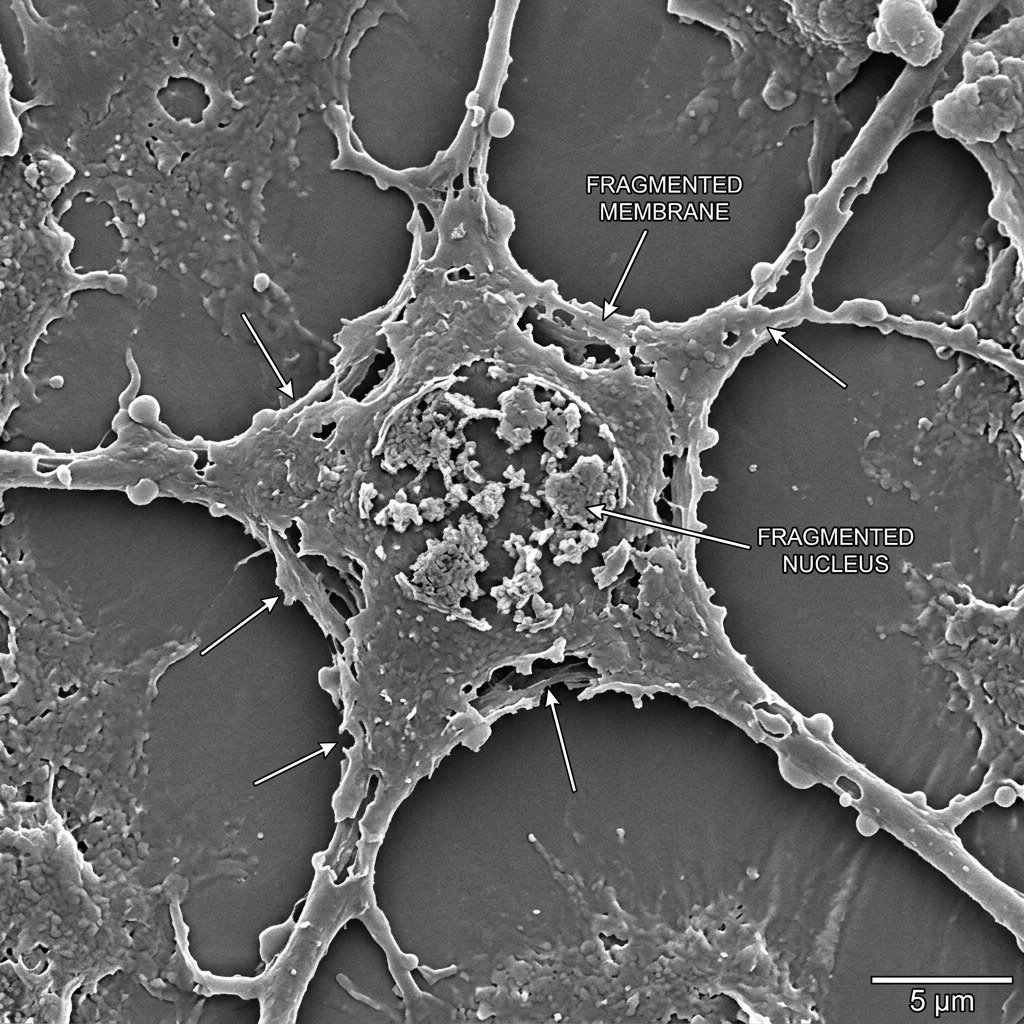
LMU researchers have discovered an unusual three-way partnership between a ciliate, bacteria, and archaea that gives a single-celled organism a magnetic sense.
Scientists have thoroughly investigated so-called magnetotactic bacteria, which use Earth’s magnetic field as a biological compass. Some eukaryotic single-celled organisms — more complex organisms like ciliates that, unlike bacteria, have a cell nucleus — also possess this capability, but how they acquire it has largely remained a puzzle. An international team led by Professor William Orsi from the Department of Earth and Environmental Sciences at LMU has discovered a previously unknown magnetotactic ciliate that pursues an unusual strategy: partnership with two other organisms inside its cell.
The researchers found the new ciliate, Tropidoatractus magnetotacticus, in oxygen-poor river sediments near Libreville in Gabon. Electron micrographs revealed that the ciliate possesses tiny magnetite particles arranged in chains resembling strings of pearls, which help it orient itself in the magnetic field. The images also showed that these particles originate from living bacterial symbionts inside the single-celled organism.
“When we first observed these cells, we immediately realized we were looking at something different,” said lead researcher Leon Kaub, who found that the organisms navigate using these endosymbionts.
Cooperation as adaptation to habitat
Further micrographs indicated that the ciliate has additional microbial partners, a finding confirmed by genetic analyses. In addition to the magnetite-producing symbionts, the ciliate hosts methane-producing archaea, which process its metabolic byproducts and create favorable conditions for the partners’ energy metabolism in the anoxic sediments. Combined with the use of Earth’s magnetic field to swim downward and reach low-oxygen sediments faster, this symbiosis helps all three partners survive more efficiently.
“Our discovery opens up new perspectives on the evolution of magnetoreception,” said Chitnis, a member of the research team. Orsi added that this type of symbiosis will likely reveal “more similar cooperations” in anoxic environments.
Journal: Proceedings of the National Academy of Sciences
DOI: 10.1073/pnas.2609513123
Article Title: Magnetotaxis in an anaerobic ciliate via tripartite syntrophy
Publication Date: 20-Jul-2026
Source: EurekAlert


Leave a Reply