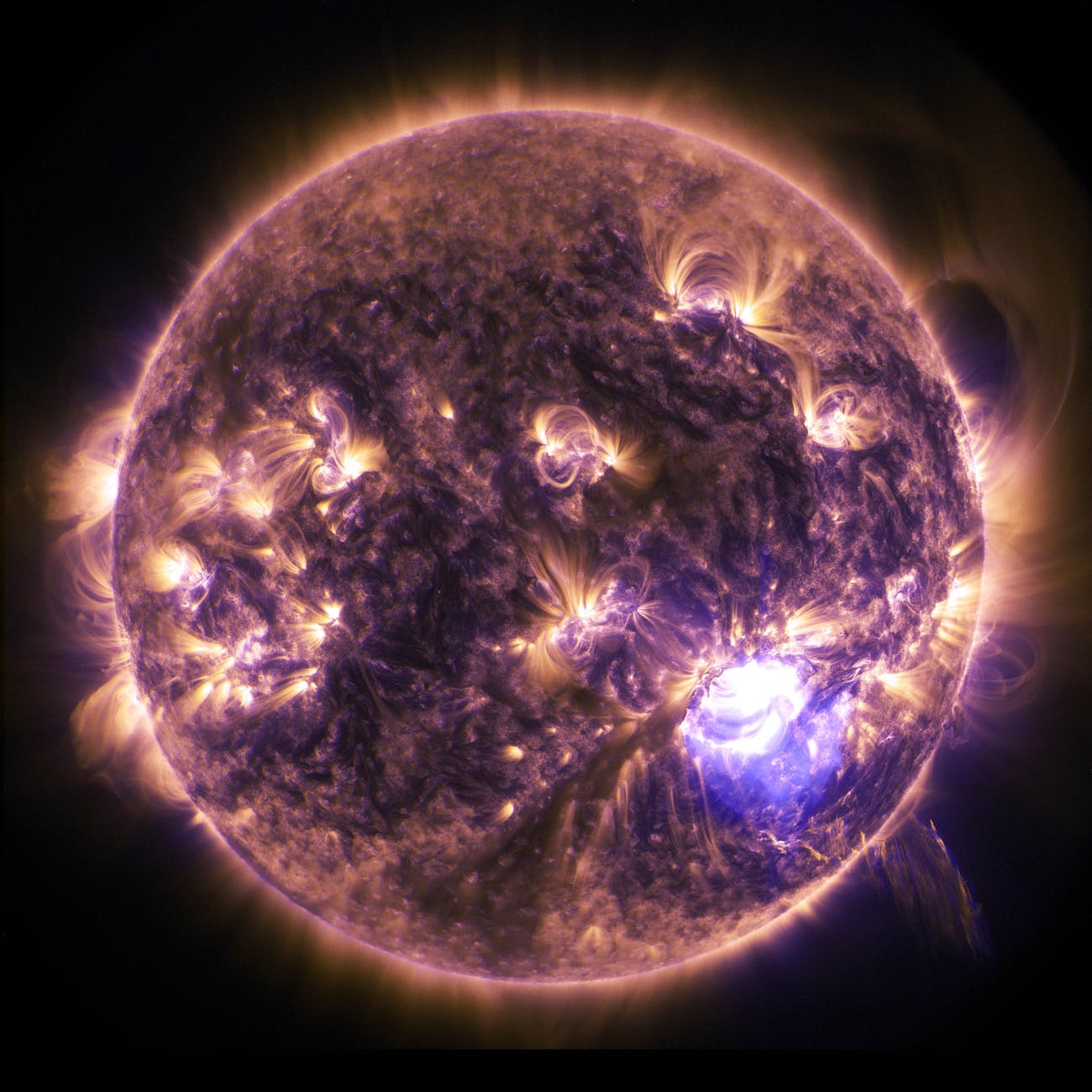
Researchers at the Max Planck Institute for Solar System Research have demonstrated that our Sun possesses the potential to generate superflares—massive energy releases exceeding the force of trillions of hydrogen bombs. The study examined data from NASA’s Solar Dynamics Observatory between 2010 and 2016, analyzing 300 significant solar flares to establish correlations between released energy and active region size.
The investigation focused on historical sunspot records spanning approximately 400 years. The April 1947 sunspot, covering roughly 0.6 percent of the solar disk with a diameter approximately 40 times Earth’s size, provided a crucial case study. Lead researcher Natalie Krivova stated: “Our Sun has superflare potential. It can produce massive sunspots that, in principle, can serve as the starting point for the most extreme bursts of radiation.”
The research suggests superflares occur roughly once per century on Sun-like stars. While no direct superflare observation has occurred during the space age, evidence from radioactive isotope spikes in tree rings and ice cores indicates Earth has experienced intense solar particle bombardment historically.
Journal: Philosophical Transactions of the Royal Society A
DOI: 10.1098/rsta.2025.0290
Article Title: Empirical flare energy limits for the largest historical sunspots
Publication Date: 10-Sep-2026
Source: EurekAlert




Leave a Reply