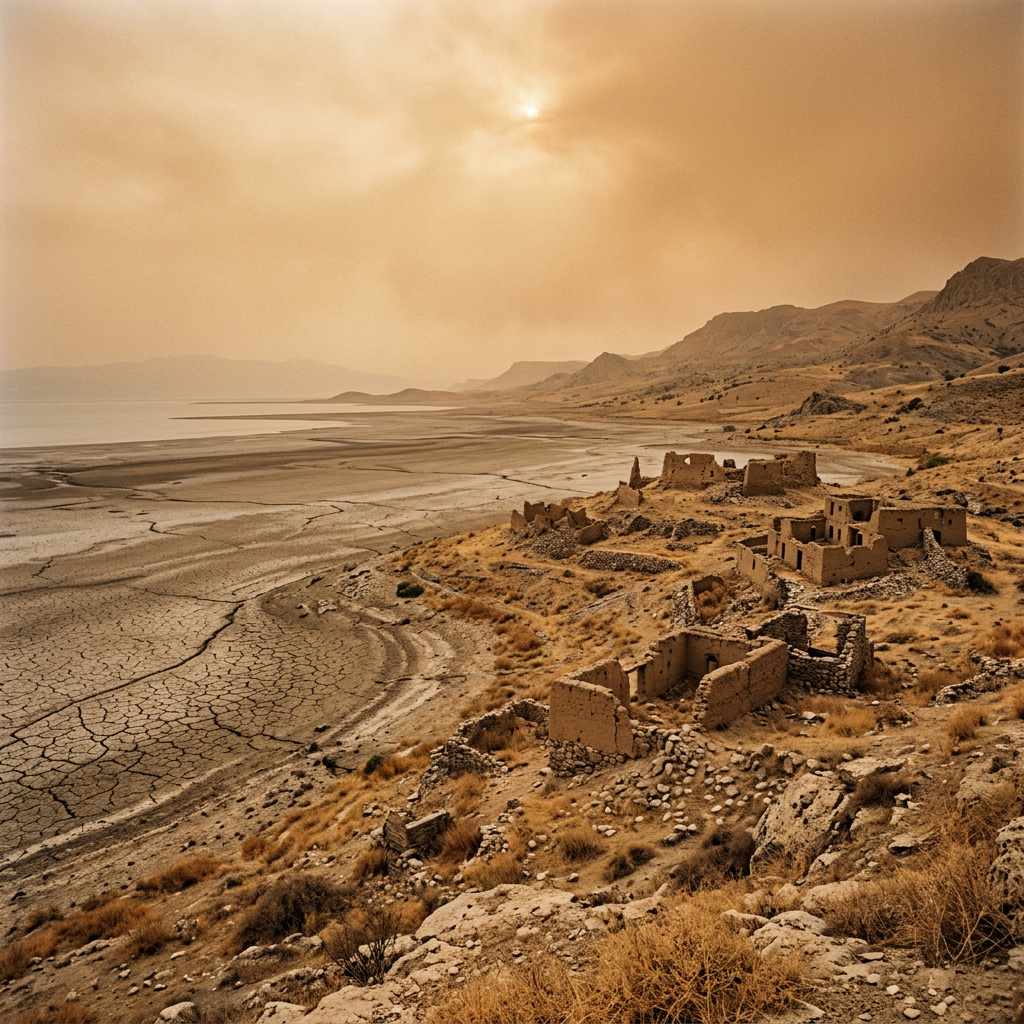
Around 3,200 years ago, the interconnected world of the Late Bronze Age Eastern Mediterranean came apart. The Mycenaean palaces of Greece burned and were abandoned. The Hittite Empire, one of the great powers of the ancient Near East, dissolved. The Minoan world of Crete had already faded. Trade networks that had linked Egypt, Cyprus, the Levant, and the Aegean for centuries collapsed within a few generations. Historians and archaeologists have debated the causes for decades — invasion by the mysterious “Sea Peoples,” internal political breakdown, earthquakes, and, increasingly, climate.
A new study published in Science Advances offers the most detailed mechanistic account yet of what was actually happening to the region’s climate during this pivotal period — and it complicates the simple story of “a drought caused the collapse.” According to Katherine Power, a PhD student in the Department of Physical Geography at Stockholm University and the study’s first author, the most damaging droughts weren’t singular events at all. They were the product of multiple climate cycles, operating on wildly different timescales, that happened to line up.
“Rather than being caused by a single climatic event, we found that the most extreme droughts emerged when natural climate cycles operating over different timescales coincided,” Power said. “This helps explain why the drought associated with the Late Bronze Age collapse were so severe.”
Power and her co-author Qiong Zhang, a professor of paleoclimate modeling at Stockholm University, reached this conclusion using the EC-Earth3-Tr8K simulation, a transient climate model that tracks the Eastern Mediterranean’s climate continuously across the last 8,000 years, rather than snapshotting isolated moments in time. That distinction matters. Proxy records — the tree rings, cave formations, lake sediments, and pollen cores that paleoclimatologists rely on — can tell researchers that a region got drier around a certain date, but they struggle to disentangle why, since each archive integrates multiple, tangled climate signals at once. A physically based model, by contrast, can isolate the individual drivers and show how they interact mechanistically.
What the model revealed was a story with two layers. The first is a slow, multi-millennial drying trend across the Eastern Mediterranean, driven by the gradual, predictable wobble of Earth’s orbit — a decline in summer sunlight reaching the Northern Hemisphere that weakened the West African monsoon, pushed the tropical rain belt southward, and starved the Mediterranean of moisture transported up from the tropics. This backdrop drying was real but modest, and it played out unevenly: the Levant grew steadily drier over thousands of years, while cooling in the Balkans and Anatolia partly offset the loss of rainfall by reducing evaporative demand, allowing forests to expand even as skies grew less generous.
Layered on top of that slow trend, though, was a second, faster-moving set of processes rooted in the Atlantic Ocean. The strength of the Atlantic meridional overturning circulation, the vast system of currents that includes the Gulf Stream, waxed and waned on multidecadal and centennial timescales. So did broader Atlantic sea-surface temperature patterns and the North Atlantic Oscillation, a seesaw of atmospheric pressure that governs how far south winter storm tracks penetrate into the Mediterranean basin. Individually, none of these oscillations was catastrophic. But when a dry phase of the millennial orbital trend coincided with a dry phase of the centennial Atlantic cycles and a dry phase of decade-to-decade internal variability, the effects didn’t simply add up — they compounded, producing droughts that vastly exceeded what any single mechanism could have generated on its own.
“Our results show that the region underwent a gradual drying trend over thousands of years, driven by slow changes in Earth’s orbit. Superimposed on this long-term trend we also found shorter-term fluctuations in the Atlantic Ocean and atmosphere,” Power explained.
The model reproduces three major multicentury drought intervals over the mid-to-late Holocene, and two are especially notable. One, running from roughly 2600 to 2100 BCE, corresponds to the so-called “4.2-kiloyear event,” a widely documented episode of aridity associated with the collapse of the Akkadian Empire in Mesopotamia and disruptions as far away as the Indus Valley and China. The other, running from about 1400 to 900 BCE, aligns precisely with the “3.2-kiloyear event” and the Late Bronze Age collapse itself. In the model, this later drought arrived after the region’s background climate had already shifted toward a cooler, drier state, meaning the drought’s effects landed on a system with far less resilience than it might have had centuries earlier — precipitation and temperature anomalies during this episode exceeded those of the earlier 4.2-ka event, and effective moisture in the Balkans and Turkey dropped by some of the steepest margins of the entire simulation.
This pattern lines up with a growing body of archaeological and paleoclimate research. A 2013 study of pollen and geochemical data from Cyprus and Syria described a roughly 300-year drought bridging the Late Bronze and Early Iron Ages. A 2023 tree-ring study published in Nature found evidence of a severe, multiyear drought coinciding with the fall of the Hittite capital around 1198–1196 BCE. And speleothem records from the Peloponnese have been used to link drought conditions directly to the destruction of the Mycenaean palace at Pylos. What the new modeling work adds isn’t the existence of these droughts — proxy evidence for that is already extensive — but a physical explanation for why they were so much more severe than the long-term drying trend alone would predict.
Importantly, the researchers are careful not to reduce the Late Bronze Age collapse to a simple climate story. The societies of the period were already under strain from trade disruptions, political fragmentation, and possibly conflict; the drought didn’t act on a blank slate.
“The convergence of these processes pushed the Eastern Mediterranean beyond a critical hydroclimatic threshold, reducing water availability and increasing pressure on agriculture and food security within already vulnerable societies,” Power said, framing climate as an amplifier of existing fragility rather than a sole cause of collapse.
The findings also carry a warning for the present. The Mediterranean is widely regarded as a climate change hotspot, projected to grow both hotter and drier over the coming century as greenhouse warming continues. Climate models further suggest the Atlantic overturning circulation may weaken under future warming scenarios — the same system the new study identifies as a key driver of past centennial-scale Mediterranean droughts.
“The Mediterranean is one of the world’s climate change hotspots and the area is projected to become warmer and drier during the coming century,” Power said. “Our findings suggest that future drought risk may depend not only on long-term human-driven warming, but also on how natural variability in the Atlantic Ocean interacts with that background trend.”
In other words, the same compounding logic that turned a modest orbital drying trend into a civilization-straining catastrophe 3,200 years ago could, in principle, apply again — this time with anthropogenic warming standing in for orbital forcing as the long-term backdrop. If Atlantic variability aligns unfavorably against that backdrop in the coming decades, the result could be droughts considerably worse than steady warming trends alone would suggest. Whether the modern Mediterranean crosses similar ecological and societal thresholds, the researchers note, will depend on both how far the background climate shifts and how the ocean’s internal rhythms happen to fall into phase.
Notes
1. K. Power, Q. Zhang, “Holocene ocean-atmosphere coupling and Mediterranean sensitivity to Atlantic circulation: Lessons from the Late Bronze Age collapse,” Science Advances 12, eaed5439 (2026). DOI: 10.1126/sciadv.aed5439.
2. Stockholm University, “Unravelling the climate behind the collapse of Bronze Age civilizations,” press release via EurekAlert!, July 24, 2026.
3. D. Kaniewski et al., “300-year drought frames Late Bronze Age to Early Iron Age transition in the Near East: New palaeoecological data from Cyprus and Syria,” Regional Environmental Change 19, 2287–2297 (2019).
4. S. W. Manning et al., “Severe multi-year drought coincident with Hittite collapse around 1198-1196 BC,” Nature 614, 719–724 (2023).
5. M. Finné et al., “Late Bronze Age climate change and the destruction of the Mycenaean Palace of Nestor at Pylos,” PLOS ONE 12, e0189447 (2017).
6. E. Weiberg, M. Finné, “Resilience and persistence of ancient societies in the face of climate change: A case study from Late Bronze Age Peloponnese,” World Archaeology 50, 584–602 (2018).
7. M. Bini et al., “The 4.2 ka BP Event in the Mediterranean region: An overview,” Climate of the Past 15, 555–577 (2019).

COPY II (2-3 PARAGRAPHS)
IMAGE CREDIT: NASA.

Leave a Reply