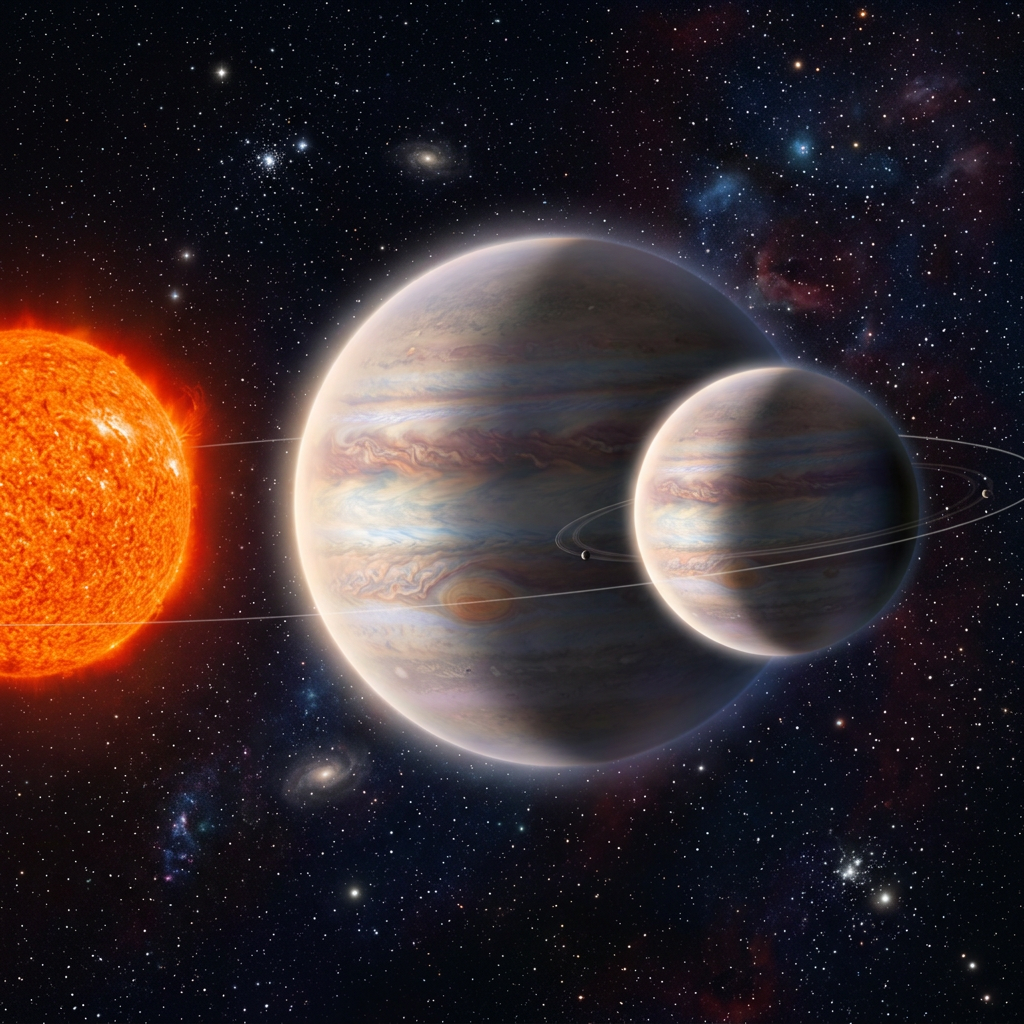
An international team of astronomers has identified two of the most rarefied planets ever observed: a pair of Jupiter-sized worlds so diffuse that each is less dense than a wisp of cotton candy. The discovery, led by researchers at the University of Oxford in collaboration with Université Côte d’Azur/Observatoire de la Côte d’Azur and the University of Birmingham, was published June 25 in Monthly Notices of the Royal Astronomical Society.
The two planets, designated TOI-791 b and TOI-791 c, orbit an F-type dwarf star roughly 1,110 light years from Earth in the southern constellation Volans. Both are close to Jupiter in physical size, but their masses are a small fraction of the gas giant’s, leaving them with densities of just 0.038 and 0.047 grams per cubic centimeter. Jupiter, by comparison, averages about 1.33 grams per cubic centimeter, making it 28 to 35 times denser than either of the newly confirmed worlds. Both planets are even lighter than cotton candy, which typically measures around 0.05 grams per cubic centimeter, and roughly 100 times less dense than Earth, which weighs in at 5.5 grams per cubic centimeter.
Astronomers refer to planets this rarefied as “super-puffs,” and they are exceedingly rare. Only four other known systems contain more than one such planet, which makes TOI-791 an unusually rich laboratory for understanding how worlds this extreme take shape.
“Only a handful of these super-puffy planets are known, and it is even rarer to find two in the same system,” said lead author Dr. George Dransfield of Oxford’s Department of Physics, who also presents for BBC Sky at Night. “Their extremely low densities make them fascinating targets for understanding how planetary systems form and evolve.”
The two planets are thought to be siblings, having formed together out of the same disc of gas and dust that once surrounded their young star. They are now locked in a 5:3 mean-motion resonance, a gravitational relationship in which the inner planet completes five orbits for roughly every three completed by the outer one. That repeated tug-of-war between the two worlds produces small, measurable shifts in the timing of their transits — the moments when each planet passes in front of its star and dims the starlight slightly.
Those shifts turned out to be the key to weighing the planets. TOI-791 b and TOI-791 c were both first flagged as candidates by volunteers with the Planet Hunters TESS project, a citizen-science effort that combs through data from NASA’s Transiting Exoplanet Survey Satellite in search of new worlds — TOI-791 b in 2019 and TOI-791 c in 2023. From there, researchers around the world spent the better part of eight years confirming the find and pinning down the planets’ properties. The size of each planet came from how much starlight it blocked during a transit; the mass of each came from analyzing how the two planets’ gravity nudged the timing of each other’s transits, a technique that let the team calculate just how little material is actually packed inside these puffy giants.
Reaching that conclusion required an unusual amount of patience, and an unusual location. Among the observatories involved was the ASTEP telescope — short for Antarctic Search for Transiting ExoPlanets — based at Concordia Station in Antarctica and jointly operated by Université Côte d’Azur/Observatoire de la Côte d’Azur and international partners. The Antarctic winter, with its months of uninterrupted darkness, let the team capture each planet’s transit, lasting more than 11 hours, in a single unbroken observation. Those are the longest continuous planetary transits ever recorded in their entirety from the ground, and they were essential for nailing down the planets’ sizes and orbital timing with enough precision to detect the subtle resonance between them.
Why a planet would end up this diffuse in the first place remains an open question. One leading idea holds that super-puffs carry enormous, hydrogen- and helium-rich atmospheres that make up an outsized share of their total mass — envelopes that may have built up when the planets formed far from their star, in the colder outer reaches of the protoplanetary disc, where gas could cool and accumulate quickly around a solid core. Whether that explanation holds for TOI-791 b and TOI-791 c, or whether some other process is at work, is something the team hopes to settle with further observation.
“This system offers a unique laboratory for understanding how super-puff planets form and evolve,” said Professor Amaury Triaud of the University of Birmingham, the UK principal investigator of ASTEP and a co-author of the study. “We propose to carry out space-based observations using the James Webb Space Telescope to assess if the puffy atmosphere contains carbon-, nitrogen-, and oxygen-bearing species, revealing new insight into how these unusual planets formed.”
Professor Tristan Guillot of Université Côte d’Azur, ASTEP’s other principal investigator and a co-author on the paper, framed the discovery as a testament to sustained international cooperation. “These multi-planetary systems are complex, with gravitational interactions between the planets that evolve over very long periods, tens of years or more,” he said. “This discovery highlights the importance of continued international collaboration in astronomy. Bringing together observations from Antarctica, space telescopes and observatories across several continents was essential to revealing the true nature of these extraordinary planets.”
The researchers now plan follow-up observations aimed at narrowing down which formation story actually explains TOI-791’s two oversized, underweight planets — and, in the process, at testing some of the leading theories for how super-puffs come to exist anywhere in the galaxy.
Endnotes
- George Dransfield et al., “ASTEP confirmation of a pair of long-period Jupiter-sized planets with extremely low densities transiting TOI-791,” Monthly Notices of the Royal Astronomical Society, June 25, 2026, DOI: 10.1093/mnras/stag864.
- University of Oxford, “‘Super-puff’ planets lighter than candy floss discovered by international team,” news release via EurekAlert!, June 25, 2026.
- Encyclopædia Britannica, “Jupiter: Basic Astronomical Data” and “Earth: Basic Planetary Data,” reference entries on planetary density.
- Physics World, “The physics of candyfloss on Earth and in space,” background on the density of spun-sugar confections used as a comparative benchmark.
- Jingjing Chen and David Kipping, “Inflating and Deflating Super-Puffs,” The Astrophysical Journal, 2014 — on the leading hydrogen/helium-envelope model for super-puff formation.



Leave a Reply