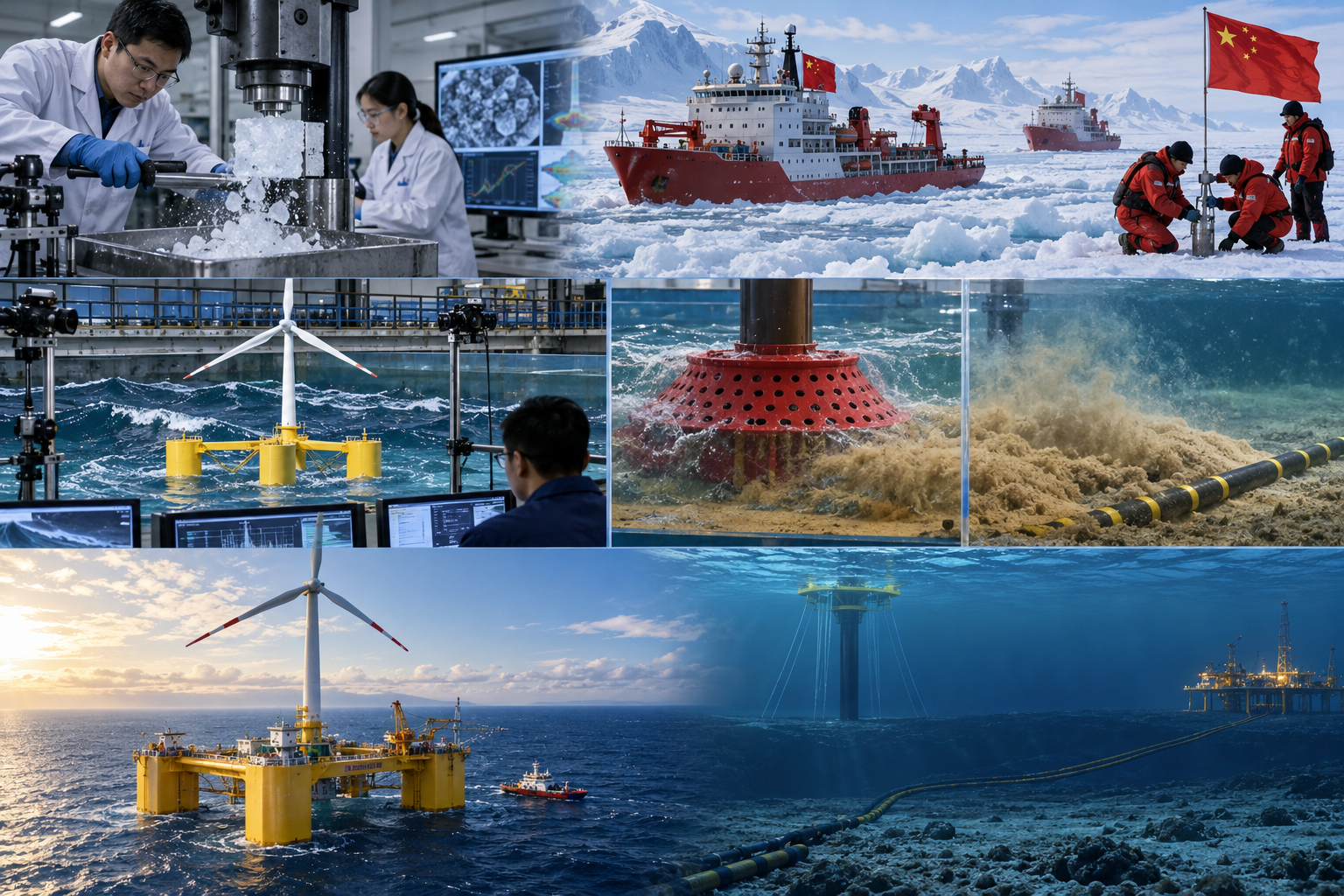
China’s push into deeper water is no longer just a fleet of icebreakers and oil platforms. It is being built, piece by piece, in tanks and cold rooms on the Liaodong Peninsula.
A recent CCTV report from the State Key Laboratory of Coastal and Offshore Engineering at Dalian University of Technology shows researchers crushing real polar ice shipped back from the Arctic and Antarctic, not the artificial blocks used in earlier work.
Professor Lu Peng’s team is feeding those tests into a domestic sea-ice physics and mechanics database. For years, design parameters for ice-class ships and polar structures came from foreign sources. The laboratory now generates its own numbers, a small but strategic shift as China’s 16th Arctic Ocean expedition works the central Arctic aboard Xuelong and Xuelong 2.
The ice work is only one bench. In the same complex, a wave basin fitted with optical systems, force balances, and pressure sensors scales a floating wind-turbine model down by a factor of 70. A modest laboratory swell corresponds to a 3.5-metre wave at full size. Nearby, a red, hat-shaped perforated collar is tested against an artificial “sandstorm”: fast currents that scour sediment from around piles and expose submarine cables. Water passing through the device is meant both to shield the bed and to drop new silt behind it, burying the cable deeper. The point of the whole “simulated ocean” is to certify hardware before it ever meets a real typhoon or ice ridge.
That pipeline of tests has already fed hardware in the field. CNOOC’s *Haiyou Anlan*, a 16-megawatt tension-leg floating wind platform that entered service in August 2026, sits about 136 kilometres off Guangdong in 136 metres of water. Engineers say the platform’s tilt stays within one degree in a Category 17 typhoon. The unit supplies the Lufeng oilfield through a short subsea cable and is billed as the farthest-offshore, deepest-water TLP of its class. The CCTV piece rounded the distance to 150 kilometres; the engineering specs cluster around 136. Either way, it is a working example of the lab-to-field loop the Dalian group describes.
The larger context is Beijing’s long campaign to become a “maritime power”: indigenous data instead of imported coefficients, floating wind that electrifies offshore oil instead of burning diesel, and test facilities that can reproduce 3,000-metre seabed conditions. A new deep-water marine-engineering laboratory at DUT, jointly funded with China Three Gorges and slated for completion around the end of 2026, is intended to close that last gap. Earlier national projects—the Hong Kong–Zhuhai–Macao Bridge, deep-water drilling platforms, ports along the Maritime Silk Road—already drew on the same laboratory’s results. Polar ice, typhoon waves, and seabed scour are now treated as one continuous design problem.
None of this happens in a vacuum. Arctic sea ice is thinning and the Polar Silk Road remains a stated Chinese interest; South China Sea typhoons set the design envelope for floating renewables that also cut oilfield emissions. The Dalian tanks will not decide those geopolitics. They do, however, determine whether the next icebreaker, cable, or floater is certified on Chinese measurements rather than someone else’s.
End notes
1. CCTV News Client, “China is accelerating its expansion into deep seas…,” 6 September 2026 (source text for laboratory visit, Lu Peng, Lin Yifeng, scour device, and 3,000 m lab claim).
2. Global Times / CGTN / China Daily / CNOOC reporting, August 2026, on Haiyou Anlan (16 MW TLP, ~136 km offshore, 136 m water depth, Category 17 typhoon design, ≤1° tilt).
3. Xinhua / Global Times / CGTN, July–September 2026, on China’s 16th Arctic Ocean expedition (Xuelong, Xuelong 2, ice stations, China–Russia joint ice observations).
4. China Daily, 11 October 2024, on DUT’s Deep-Sea Engineering Innovation Experimental Base / joint deep-water wind-wave-current laboratory (completion targeted end-2026).
5. Published DUT / CHINARE datasets and papers on Arctic sea-ice thickness and physical properties (Lu Peng and colleagues).



Leave a Reply