As telescopes like MeerKAT, ASKAP and the future Square Kilometre Array (SKA) generate ever-larger volumes of astronomical data, researchers are turning to an unusual tool to keep up: virtual reality. A team led by the University of Cape Town’s (UCT) Department of Astronomy and the Inter-University Institute for Data Intensive Astronomy (IDIA) has released version 1.0 of iDaVIE (immersive Data Visualisation Interactive Explorer), a VR software suite that lets astronomers step inside their 3D datasets to inspect, clean and interpret them by hand, or rather, by headset.
The milestone release is detailed in a paper published in Astronomy and Computing (Volume 56, July 2026, DOI: 10.1016/j.ascom.2026.101109), which describes the software’s design and documents its growing track record in published research.
iDaVIE was developed by the UCT/IDIA Visualisation Lab (UCT/IDIA Vislab) in collaboration with the Astrophysical Observatory of Catania at Italy’s National Institute for Astrophysics (INAF-OACT).
Built on the Unity game engine and SteamVR, with custom plug-ins for parsing, downsampling and analysing astronomical FITS files, it allows researchers using commercial VR headsets to import 3D data cubes, fly through them in real time, select and crop regions of interest, overlay source catalogues, and export results directly back into their existing data-reduction pipelines.
Why astronomers need to get inside the data
Modern radio astronomy surveys increasingly rely on automated pipelines and machine learning to sift through enormous three-dimensional data cubes (grids of sky position and radial velocity or frequency) in search of galaxies and other phenomena. But automated detections still need human quality control, and spotting faint or unusual structures hidden in noisy, high-dimensional data is difficult on a conventional 2D screen. iDaVIE aims to reduce that cognitive burden by letting scientists see and manipulate the data volumetrically, the way they would a physical object.
“Getting iDaVIE into researchers’ hands has been a long time coming,” said Dr Lucia Marchetti of UCT’s Department of Astronomy, director of the UCT/IDIA Vislab and one of the leading authors of the paper. “It’s the product of years of development, and the fact that many scientific papers have already made use of it even before its official release tells us it’s genuinely solving a problem for the community. We can’t wait to see what astronomers and researchers in other disciplines do with it next.”
Already at work on real survey data
The paper reports several published science cases in which iDaVIE has already proven its worth. In a MeerKAT HI survey of the Fornax A galaxy group, researchers used iDaVIE to inspect and refine an automatically generated detection mask, importing the neutral hydrogen data cube into VR and adjusting the mask by hand to recover missed emission and remove spurious detections. In a separate MeerKAT observation, a team serendipitously discovered 49 gas-rich galaxies across several interacting groups, using iDaVIE to spatially and spectrally explore the cube and confirm disturbed HI morphologies and unusual star formation signatures. iDaVIE has also supported the discovery of two polar ring galaxies in data from the ASKAP-based WALLABY survey.
Professor Roger Deane, professor of astronomy and director of IDIA, said the release reflects the institute’s broader mission. “iDaVIE is part of IDIA’s broader mission to advance data-intensive science in South Africa. It is a good example of how investment in research software and new ways of interacting with complex data can translate into new scientific capability, while also driving innovation in visualisation technology.”
Built to grow, and built to share
iDaVIE is released as free, open-source software, a choice the team says is intended to encourage collaboration and further development by the global research community. While designed for astronomy, its authors note the platform is scalable enough to handle other types of volumetric data, with early multidisciplinary applications explored in fields such as biology and medicine.
Version 1.0 is a milestone, not an endpoint: the team’s paper outlines plans for subcube loading, additional volumetric rendering modes, scripting tools for automated video generation, and collaborative multi-user capabilities that would let several researchers explore the same dataset together in VR.
Dr Alexander Sivitlli, lead author of this paper and lead developer of iDaVIE, adds: “As we write, iDaVIE v1.1 is soon to be released with several new features mentioned in the paper already implemented. Release v2.0 is also in the making, adding particle rendering and analysis tools. This will enable scientists to explore a range of complex datasets from next-generation asteroid catalogues to cosmological simulations.”
The release also carries a personal dedication. Dr Marchetti and the UCT/IDIA Vislab team dedicated the milestone to the late Professor Tom Jarrett, the lab’s founding director, who died in July 2024 before the software’s public launch. “The entire UCT/IDIA Vislab team and I would like to dedicate this release to our late director, mentor and friend, Tom, who sadly passed away too soon, before this important milestone that he initiated and to which he contributed for many years could be announced. He would have cherished this publication with us today,” Marchetti said.
Availability
iDaVIE’s source code, documentation and installation instructions are freely available at idavie.readthedocs.io.
Journal: Astronomy and Computing
DOI: 10.1016/j.ascom.2026.101109
Article Title: iDaVIE v1.0: A virtual reality tool for interactive analysis of astronomical data cubes
Article Publication Date: July 2026
Funding: European Research Council (ERC), Horizon 2020 research and innovation programme, MAECI, DSI-NRF, CPRR Projects
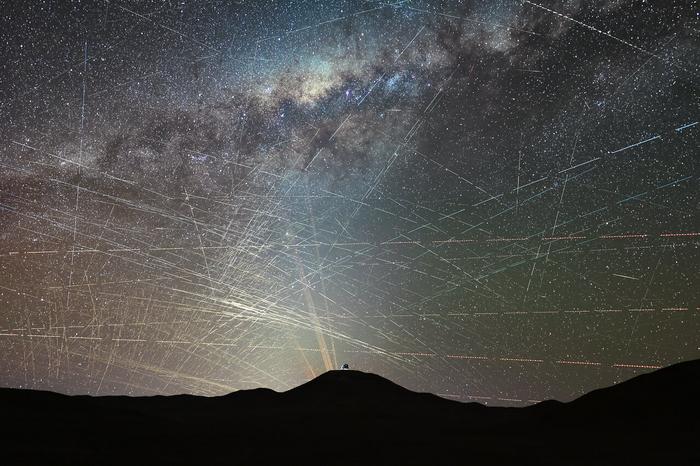
Featured image credit: F. Kamphues, ESO/M. Kornmesser
Source: EurekAlert



Leave a Reply