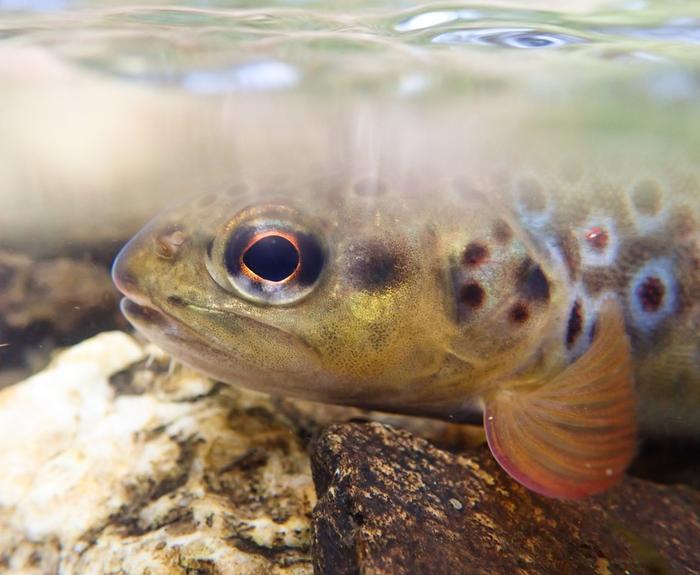
Trout living in rivers polluted by metal from old mines across the British Isles are genetically “isolated” from other trout, new research shows.
Researchers analysed brown trout at 71 sites in Britain and Ireland, where many rivers contain metal washed out from disused mines.
While trout in metal-polluted rivers appear healthy, they are genetically distinct – and a lack of diversity in these populations makes them vulnerable to future threats.
By comparing the DNA of trout in rivers with and without metal pollution, the researchers found that metal-tolerant trout populations split from the wider species during periods of peak mining activity.
The study, by the universities of Exeter and Cardiff, was carried out in four regions: west Wales, northeast England, southwest England and southeast Ireland.
“We found massively reduced genetic diversity in some of these trout populations inhabiting metal-impacted waters,” said Professor Jamie Stevens, from the University of Exeter.
“These fish carry a high burden of metals, with toxic binding of dissolved metals to their gills causing suffocation, but trout that can tolerate this have emerged in polluted rivers.
“If fish without this tolerance swim into these rivers, they must either leave or die from that exposure.

“This means the metal-tolerant fish are genetically isolated, not exchanging genes with other trout populations.
“So, while these fish may be healthy where they are, the genetic diversity that allowed them to adapt to this rapid change in their environment is now lacking – leaving them more vulnerable to future changes.”
Common metal pollutants in former mining areas include lead and copper, and many fish and other species in these rivers have already been wiped out.
The emergence of metal-resistant trout, with high genetic differentiation from neighbouring populations and reduced diversity, was seen in populations inhabiting metal-polluted rivers in Cornwall, Wales and northeast England.
“This is likely the result of selection pressure – evolution driven in this case by survival, or non-survival, depending on the ability to withstand metal pollution,” said Dr Daniel Osmond, of the Westcountry Rivers Trust, who conducted the research as part of his PhD at Exeter.
The study found the highest levels of genetic isolation in rivers that were both polluted with metal and affected by physical barriers such as dams and weirs.
Metal pollution levels fluctuate, often rising during periods of high rainfall.
Dr Osmond explained: “Throughout different periods of history, these mined regions have been globally important in their industrial production of many metals. This however has left polluted landscapes such as West Cornwall, which is effectively a giant honeycomb of old mines.
“When rain comes, these can fill with water and that can flow out into rivers.”
Freshwater migratory fish have declined significantly in many areas and, while trout are not considered to be a threatened species, the study shows trout may be more vulnerable than previously believed.
The researchers say that reducing mine water wash-out and the removal of physical barriers in rivers could help to reduce genetic isolation.
The study used simulations of populations through time, modelling different historical evolutionary scenarios and the effects of these on the genetic diversity of populations, comparing these with the sampled populations today, to predict which evolutionary scenarios were most credible.
IMAGE CREDIT: Daniel Osmond.
Sign up for the Daily Dose Newsletter and get the morning’s best science news from around the web delivered straight to your inbox? It’s easy like Sunday morning.



Leave a Reply