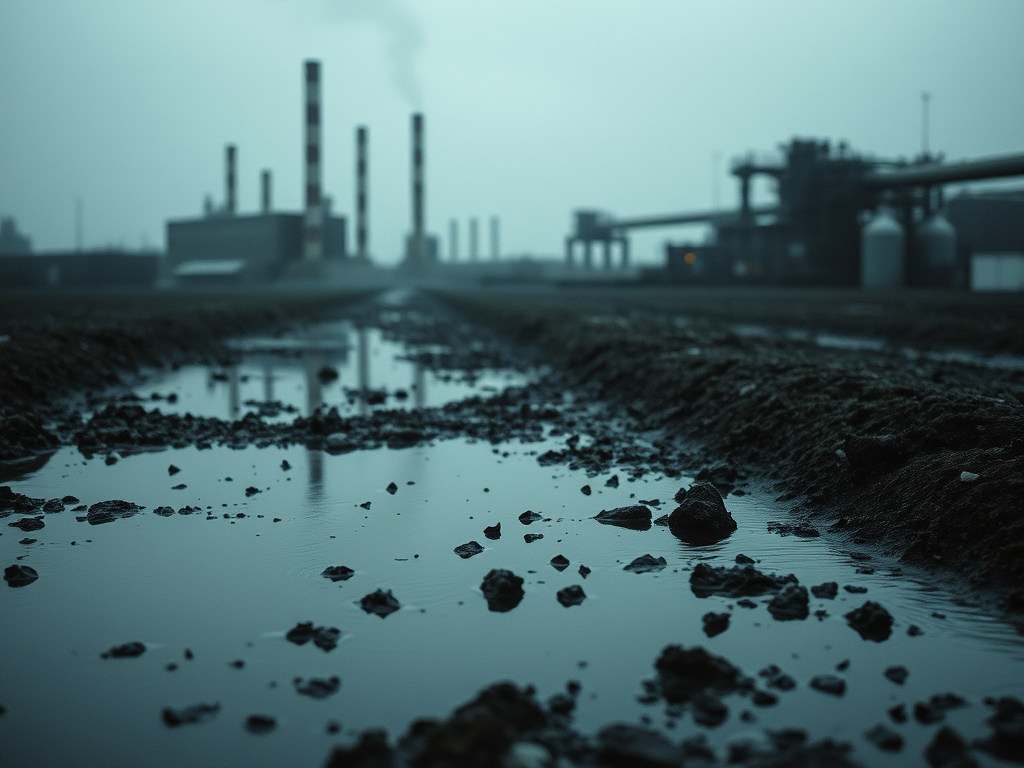
Arizona State researchers ran a catalytic membrane continuously for 58 days, capturing more than 90 per cent of each PFAS compound and breaking the carbon-fluorine bonds rather than merely collecting them.
Almost everything currently done about PFAS contamination is collection rather than destruction. Activated carbon, ion exchange and membrane filtration all capture the compounds effectively, and all of them leave the contaminants intact in a waste stream that still has to be dealt with. The problem gets concentrated and moved.
A team led by Bruce Rittmann, director of the Biodesign Swette Center for Environmental Biotechnology at Arizona State University, reports in the Proceedings of the National Academy of Sciences a membrane that does both jobs: it captures six PFAS compounds of regulatory concern and takes them apart.
Across 58 days of continuous operation it removed more than 90 per cent of each compound and stripped about 83 per cent of the fluorine overall — which is the number that distinguishes destruction from filtration.
Why these compounds survive everything
“PFAS are hard to break down, and normal processes that we use don’t work,” Rittmann said. The reason is a single bond.
“It’s called the strongest bond in organic chemistry,” he said, of the carbon–fluorine bond. “There’s really no place to get a start to break it down.”
The chemistry behind that is straightforward. Fluorine is the most electronegative element, and the bond it forms with carbon is the strongest single bond carbon makes. In a per- or polyfluorinated molecule, the carbon backbone is sheathed in fluorine atoms that are both strongly held and physically in the way, so the reactive sites that chemistry normally exploits are either absent or inaccessible.
That is also why the compounds are useful. Non-stick coatings, firefighting foams and water-repellent fabrics all depend on exactly the inertness that makes the molecules persist. “We all have PFAS in us,” Rittmann said. “They stay in the environment. They move up the food chain, and so they’re a big legacy problem.” PFOS and PFOA are listed under the Stockholm Convention on Persistent Organic Pollutants, and of the thousands of PFAS compounds in existence only a small fraction have been thoroughly tested for toxicity.
Hunter and killer in one surface
The approach the release calls hunter-killer chemistry puts the capture step and the destruction step on the same material.
“The palladium attracts the PFAS molecule, and the palladium attracts the hydrogen and puts them together,” Rittmann said.
The configuration matters. Hydrogen is delivered from inside the membrane to the base of the palladium layer, so it arrives at the catalyst from behind rather than having to be dissolved in the water being treated. Palladium has a long-known affinity for hydrogen — it absorbs the gas into its lattice and dissociates it into reactive atomic hydrogen, which is a far more aggressive reductant than hydrogen gas.
The reaction is hydrodefluorination: atomic hydrogen replaces fluorine on the carbon backbone, and each substitution weakens what remains. Delivering hydrogen through the membrane also means it is supplied where it is consumed, which avoids the inefficiency of saturating a whole water stream with a gas to get a reaction at one surface.
The universality claim is the one Rittmann emphasises. “We showed that this mechanism worked for all six,” he said. “It’s a universal mechanism.” Six compounds is not thousands, but PFAS vary considerably in chain length and functional group, and a mechanism that attacks the backbone rather than a particular head group has a reasonable claim to generality.
The metal is the problem
“Palladium is expensive,” Rittmann said. “It’s around $50,000 a kilogram.”
That figure is the central obstacle, and it is worse than the number alone suggests. Palladium is a platinum-group metal produced largely as a by-product of nickel and platinum mining in a handful of countries, with a price history of severe volatility. A water treatment process whose cost depends on it inherits a supply risk as well as an expense.
Reducing palladium use is accordingly described as a top research priority. There are established routes — dispersing the metal as nanoparticles to maximise surface area per gram, or alloying it with cheaper metals — but every reduction in loading tends to cost activity or durability, and the 58-day run reported here was presumably done at a loading that worked.
Fifty-eight days is nonetheless the most reassuring detail in the study. Catalytic water treatment fails in characteristic ways — the catalyst fouls, the active metal leaches, the surface poisons — and most of those show up within weeks. A continuous run of nearly two months at better than 90 per cent removal is a meaningful durability result, even if it is far short of the years an installed system would need.
Adding bacteria
The group’s next step combines the chemistry with biology: hybrid membranes pairing palladium nanoparticles with pollutant-degrading bacteria, giving two breakdown routes on one surface. “We’ve shown that this works too,” Rittmann said.
The pairing has a logic beyond redundancy. Partial defluorination leaves fragments that are less fluorinated and therefore more amenable to biological attack than the parent compounds, so a chemical step that opens the molecule up and a biological step that finishes the job are complementary rather than parallel. That the group’s centre is an environmental biotechnology institute suggests this was the intended destination.
What the release does not provide is the context that would let anyone judge feasibility: no flow rates, no influent concentrations, no energy figures, and no indication of whether the 58-day test used real contaminated water or a prepared solution. The difference matters, because real groundwater contains the organic matter, competing ions and biological material that foul catalysts.
The work was done with collaborators at Rice University, Tongji University, the National University of Singapore and Nanjing University, none of whom the release names. It does not state the study’s funding sources.
Notes
- “Catalytic Reactive-Hydrogen Membranes for Rapid Capture and Hydrodefluorination of Six PFAS of Regulatory Concern.” Proceedings of the National Academy of Sciences, 2026. DOI: 10.1073/pnas.2613985123.
- Arizona State University. “New ‘hunter-killer’ chemistry captures and destroys forever chemicals.” EurekAlert!, 19 October 2026. https://www.eurekalert.org/news-releases/1148006.

Leave a Reply