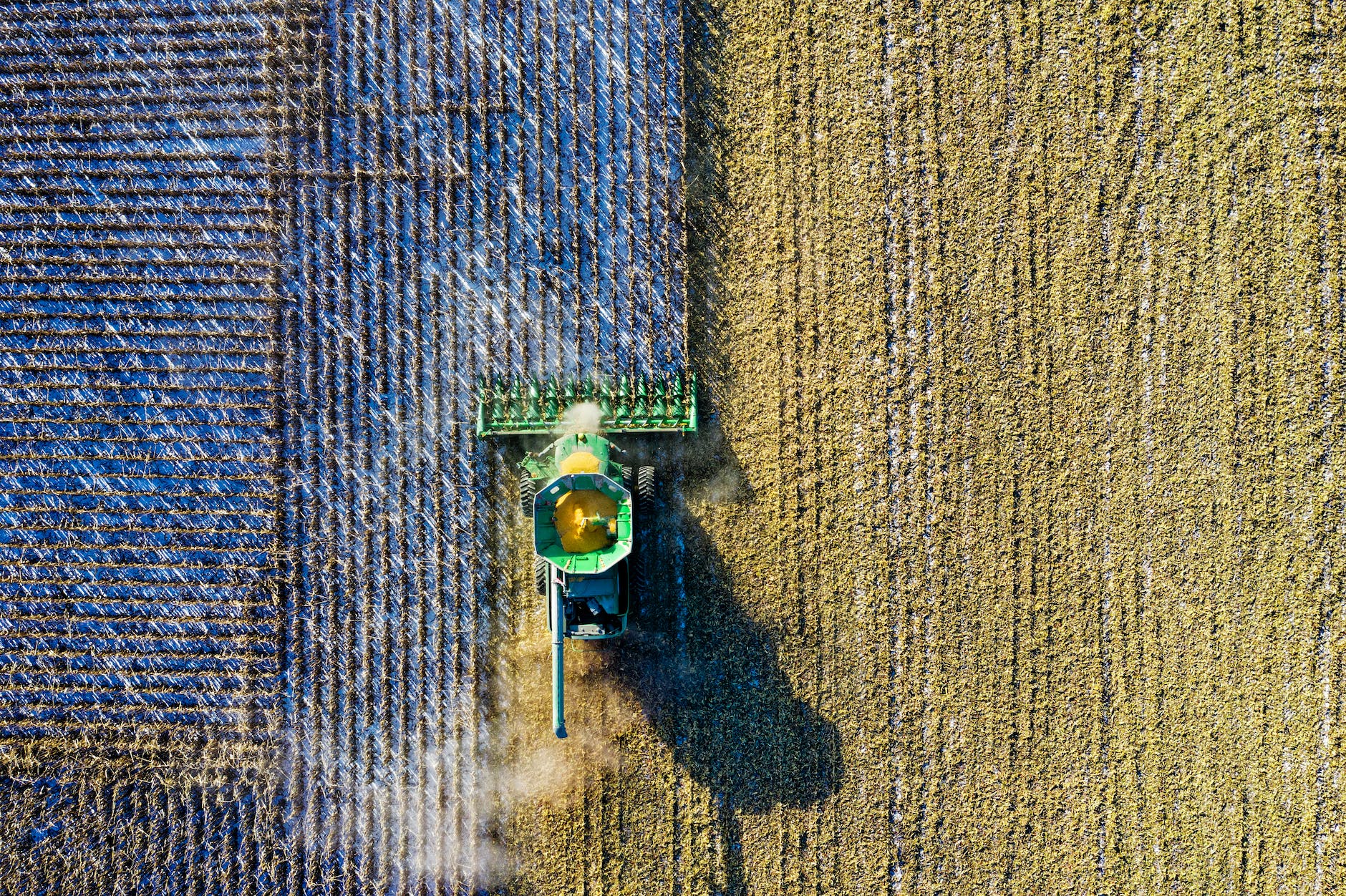
Bonn researchers wrote to more than 8,000 experts to find where robots, drones and precision machinery are actually in use, and found environmental governance the strongest predictor of profitability.
Agricultural technology is usually sold on its environmental merits: apply fertiliser only where it is needed, spray only the weeds, irrigate only the dry parts of a field. The claims are plausible. Whether farmers can afford to act on them is a different question, and it is the one that determines whether any of it happens.
A study in the Proceedings of the National Academy of Sciences from the University of Bonn attempts to answer it globally. Smart farming technologies already pay off on 42 per cent of the world’s cropland, the researchers conclude — and the variable that best explains where is not climate, farm size or wealth, but how strictly a country regulates.
“These smart farming technologies have the potential to make crop farming more sustainable and environmentally friendly,” said Professor Dr David Wuepper of the Institute for Food and Resource Economics.
Writing to eight thousand people
The data problem came first. Nobody maintains a global register of which fields use weeding robots, so the team built one by asking.
“So we wrote to more than 8,000 smart farming experts around the world,” said Shahrear Roman, a doctoral student in Wuepper’s group. From those responses the team identified more than 4,000 locations using smart irrigation, weeding robots or drone analysis.
The study covers five technology categories: autonomous irrigation, weeding robots, drone and field-mapping tools, variable-rate input machinery, and GPS steering. They are a varied set — GPS guidance is a modest add-on that has been standard on large machinery for years, while an autonomous weeding robot is a substantial capital purchase — and lumping them under one label obscures that a farm adopting one is not necessarily close to adopting another.
The economic case Roman describes is mostly about inputs. “So money can be saved by only applying these products where you really need to,” he said. Fertiliser, herbicide and water are bought by the farmer, and applying less of them shows up directly in the accounts, which is why precision application is the part of the technology with the clearest payback.
Governance as the strongest signal
“We found that smart farming already pays off where environmental governance is strongest,” Roman said. “It is by far the most important predictor in our models.”
The mechanism is not mysterious once stated. Regulation turns an environmental externality into a cost on the farm’s books. Where nitrogen application is capped, discharge is monitored or pesticide use is restricted, a technology that achieves the same yield with less input stops being a nice-to-have and becomes a way of staying compliant and productive at once. Where none of that applies, the cheapest approach is often to apply more and accept the waste.
The modelling turns that into numbers. The 42 per cent share could rise to 50 within twenty years on current trends. If every country tightened its environmental regulations it could reach 75 per cent; if every country loosened them it would fall to 31.
The spread between those last two figures is the study’s real finding, and it is large — more than a factor of two in global adoption, driven entirely by policy rather than by anything technical. Whether the model deserves that much confidence is harder to say: extrapolating adoption twenty years out from a cross-sectional survey of current users requires assumptions about technology cost, farm consolidation and commodity prices that a press release cannot convey.
Where it works and where it does not
Profitability is highest in high-income, high-education regions with large fields and strict environmental rules — Western Europe, Canada, the United States and Australia. Smart irrigation is often profitable where water is short, which gives the technology a foothold in arid regions regardless of income.
Sub-Saharan Africa is where the potential is currently most limited, and the reason is not primarily capital.
“This is partly because the available technologies are poorly suited to small-scale agriculture,” Wuepper said. At the moment, he added, the equipment is being developed with a focus on large, capital-intensive operations, and going forward agricultural research and development should be stepping up the search for solutions appropriate to smaller farms.
That is a point about who the technology was designed for. A weeding robot sized for a 500-hectare field is not a smaller version of anything useful on a two-hectare plot, and machinery economics reward scale: the per-hectare cost of a fixed capital item falls as the hectares increase. A field pattern of many small plots with different crops and no straight lines defeats much of what GPS steering and variable-rate machinery are good at.
There is an uncomfortable reading available here. The regions where agriculture is least efficient in its use of inputs, and where improvements would do the most good per hectare, are the regions where the technology is least applicable — and the finding that strict regulation drives adoption describes a mechanism available mainly to countries with the administrative capacity to regulate farming closely.
The gains are not automatic
The study’s conclusion is less about technology than about the conditions under which it delivers anything.
“Ecological and economic benefits often go hand in hand,” Wuepper said. “But they do not arrive on their own: without policy, most of the environmental gain stays on the table.”
The logic is worth being clear about, because it cuts against how precision agriculture is usually promoted. A farmer who buys variable-rate equipment and uses it to cut fertiliser costs captures a saving; the reduced runoff is a by-product nobody pays for. A farmer who buys the same equipment and uses it to apply inputs more precisely at the same total rate, chasing yield rather than savings, gets no environmental benefit at all. Which of those happens depends on incentives, not on the machine.
The work was carried out with colleagues at ETH Zurich and the University of California, Berkeley. It was funded by the German Research Foundation as part of the PhenoRob Cluster of Excellence (EXC 2070, 390732324) and by the European Research Council (Grant 101075824).
Notes
- “Modelling the Global Potential of Smart Farming Innovations.” Proceedings of the National Academy of Sciences, 2026. DOI: 10.1073/pnas.2530081123.
- University of Bonn. “Smart farming starts paying off.” EurekAlert!, 19 October 2026. https://www.eurekalert.org/news-releases/1147899.
Photo by Tom Fisk on Pexels.com


Leave a Reply