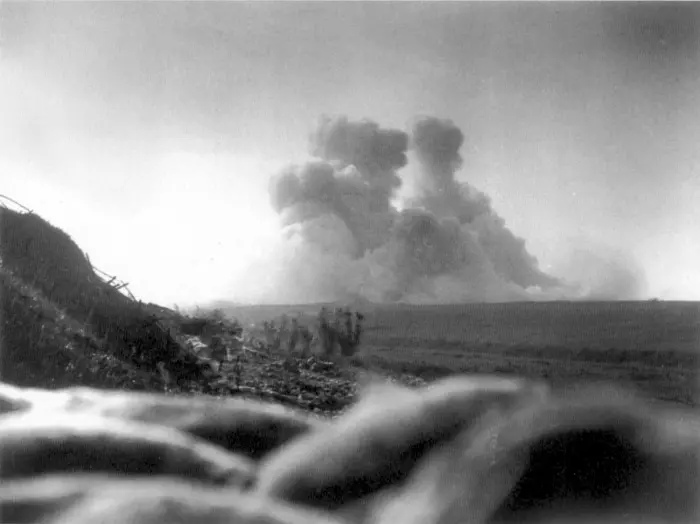
The spectacular explosion of the mine at Hawthorn Ridge – a fortified German front-line position in the First World War – marked the beginning of the Battle of the Somme, and remains one of the best-known pieces of film from the whole conflict.
More than 60ft below the surface, British miners had dug a gallery for more than 900 metres from their lines and packed it with 40,000 lbs of explosives. It was one of 19 mines placed beneath German front positions that were detonated on 1st July, 1916 to mark the start of the offensive.
But the detonation of the mine at Hawthorn Ridge, famously captured by film director Geoffrey Malins, took place 10 minutes before the whistles blew at 7.30am. The early detonation, later described as a ‘colossal blunder’, alerted the Germans the infantry attack was imminent and gave them enough time to take up defensive positions in the newly-formed crater, leading to heavy losses among the attacking British troops.

Now, findings from the first ever multi-disciplinary scientific investigation of the 107-year-old crater have been published in the Journal of Conflict Archaeology. The team of researchers, scientists and historians, led by Keele University, used a range of cutting–edge technology, including drones with imaging cameras, to examine the area like never before.
Researchers discovered and excavated two sections of trenches, known as fire bays, that were used to consolidate newly-formed craters, highlighting how the Germans successfully incorporated the crater rim into their front line after the blast. They also recovered probable communication wire and distinctive German barbed wire, and found evidence of a previously unknown shallow tunnel, believed to have been dug out from the crater by German forces to provide an advanced position in No Man’s Land. They say their findings reveal new details on the history of the crater, its capture by the Germans and how they successfully incorporated it into their front line after the blast.
Dr Jamie Pringle, a forensic geoscientist at Keele University, said: “The explosion of the mine was the very first action of the Battle of the Somme, intended to give Allied forces the upper hand. We found physical evidence for the first time of how German soldiers had consolidated part of the crater left behind after the explosion, and actually used it to their advantage as a new defensive position.”
The group were given exclusive access to the site in France after the Hawthorn Ridge Crater Association took on a 99-year lease from the local authority in 2018 to protect it for future generations. The association was set up as a Franco-British organisation dedicated to the preservation and protection of the site, and carried out extensive clearance works that provided the first opportunity for detailed study.
A second mine was blown by British forces on November 13th, causing a new crater to be formed. This explosion was much more effective, aiding the 51st Highland Division to capture the ridge and nearby village of Beaumont Hamel, which had been a prominent feature of the German frontline position.
The researchers were able to pinpoint the epicentres of the two separate mine detonation locations, and identified 27 post-explosion impact shell homes, fired from British lines as they tried to dislodge the Germans. They also found an unexploded British shrapnel artillery shell with its time-fuse still intact, representative of the large number that failed to explode on the Somme, and an empty ammunition box for a Vickers Machine Gun, reflecting the period of British occupation of the site.
Dr Kris Wisniewski, a lecturer in Forensic Science at Keele University, said: “The land had been in private ownership for almost 100 years, so this scientific study, the first to be carried out on this historically important crater, was both exciting and significant. Using a range of scientific methods, we were able to map out the epicentres of both blasts and the boundaries of the subsequent craters caused by the first and second explosions, as well as post-blast defensive positions and Allied shell impact craters.
“Using drones with imaging cameras, we were able to image remotely a probable sap or shallow tunnel to the northwest of the crater, showing the German mastery of No Man’s Land after the initial detonation.”
Professor Peter Doyle, a military historian at Goldsmiths, University of London, who was part of the team, said: “The Germans had quickly mastered the art of capturing craters and used this to their advantage. Though they lost many men in the initial blast, the crater became a part of the German frontline, meaning that the chance to break through the line here was lost.
“Our study has provided new evidence of the strongpoint the Germans built from the captured crater in the middle of No Man’s Land that doomed the British attack to failure. This reinforces the idea that blowing the mine ten minutes early, to give the earth time to settle, was a very bad idea. It was only with concerted effort four months later, and a new mine, that Hawthorn Redoubt was captured by the Highlanders.”
The research team included representatives from Keele University, London South Bank University, Staffordshire University, Atlantic Technological University, Goldsmiths, University of London, Stoke-on-Trent Archaeology Service and Cotswold Archaeology.
IMAGE CREDIT: Ernest Brooks
Sign up for the Daily Dose Newsletter and get the morning’s best science news from around the web delivered straight to your inbox? It’s easy like Sunday morning.

Leave a Reply