Finding and describing new species can be a tricky endeavor. Scientists typically look for distinctive characters that can differentiate one species from another. However, variation is a continuum that is not always easy to quantify. At one extreme, multiple species can look alike even though they are different species—these are known as cryptic species. At the other extreme, a single species can be highly variable, creating an illusion of being different species. But what happens when you encounter both extremes simultaneously?
Herpetologist Dr Chan Kin Onn (previously at the Lee Kong Chian Natural History Museum, Singapore, now with the University of Kansas Biodiversity Institute and Natural History Museum, USA) led a study describing a new species of pit viper from Myanmar that is both similar and different from its sister species. The discovery is published in the open-access journal ZooKeys.
“Asian pit vipers of the genus Trimeresurus are notoriously difficult to tell apart, because they run the gamut of morphological variation. Some groups contain multiple species that look alike, while others may look very different but are actually the same species,” they say.

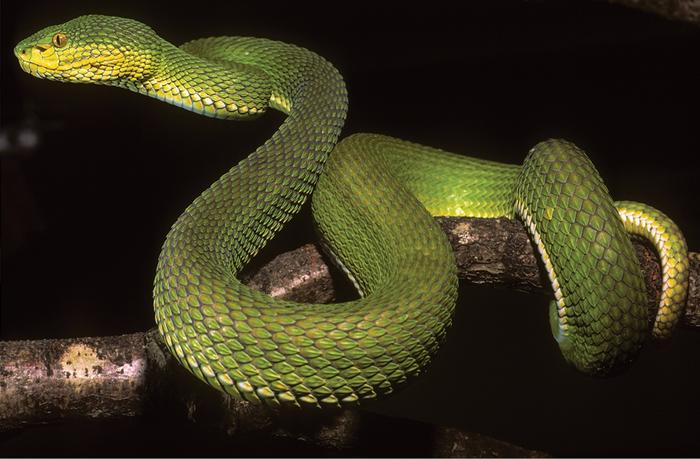
The redtail pit viper (Trimeresurus erythrurus) occurs along the northern coast of Myanmar and is invariably green with no markings on its body. A different species called the mangrove pit viper (Trimeresurus purpureomaculatus) occurs in southern Myanmar. This species typically has distinct dorsal blotches, and incredibly variable dorsal coloration including gray, yellow, brown, and black, but never green. Interestingly, in central Myanmar, sandwiched between the distribution of the redtail pit viper and the mangrove pit viper, a unique population exists that is green with varying degrees of blotchiness, which appears to be a blend between the redtail pit viper and the mangrove pit viper.
“This mysterious population in central Myanmar baffled us and we initially thought that it could be a hybrid population,” the researchers said. In a separate paper, Dr Chan used modern genomic techniques and determined that the population in central Myanmar was actually a distinct species and not a hybrid population.
But this was not the end of the story. The researchers discovered another surprise when they examined the snake’s morphological features: they found that the new species was also highly variable. Certain populations are dark green with distinct blotches, easily distinguishable from its closest relative, the redtail pit viper, which is bright green with no blotches. However, some populations of the new species are bright green with no blotches and look virtually identical to the redtail pit viper.
“This is an interesting phenomenon, where one species is simultaneously similar and different from its closest relative (the redtail pit viper). We think that at some point in the past, the new species may have exchanged genes with the redtail pit viper from the north and the mangrove pit viper from the south,” says Dr Chan.
The new species is called the Ayeyarwady pit viper (Trimeresurus ayeyarwadyensis) in reference to the Ayeyarwady River, which is the largest and one of the most important rivers in Myanmar. The river forms an expansive delta that is bounded by the Pathein River to the west and the Yangon River to the east. These rivers and their associated basins also mark the westernmost and easternmost distribution boundaries of the Ayeyarwady pit viper.
IMAGE CREDIT: Wolfgang Wüster.
Sign up for the Daily Dose Newsletter and get the morning’s best science news from around the web delivered straight to your inbox? It’s easy like Sunday morning.



Leave a Reply