In an innovative endeavor to create a sensory bridge to the ancient past, a team of researchers led by Barbara Huber of the MPI of Geoanthropology has recreated one of the scents used in the mummification of an important Egyptian woman more than 3500 years ago.
Coined ‘the scent of the eternity’, the ancient aroma will be presented at the Moesgaard Museum in Denmark in an upcoming exhibition, offering visitors a unique sensory experience: to encounter firsthand an ambient smell from antiquity – and catch a whiff of the ancient Egyptian process of mummification.
The team’s research centered on the mummification substances used to embalm the noble lady Senetnay in the 18th dynasty, circa 1450 BCE. The researchers utilized advanced analytical techniques – including Gas Chromatography-Mass Spectrometry, High-Temperature Gas Chromatography-Mass Spectrometry, and Liquid Chromatography-Tandem Mass Spectrometry – to reconstruct the substances that helped to preserve and scent Senetnay for eternity.

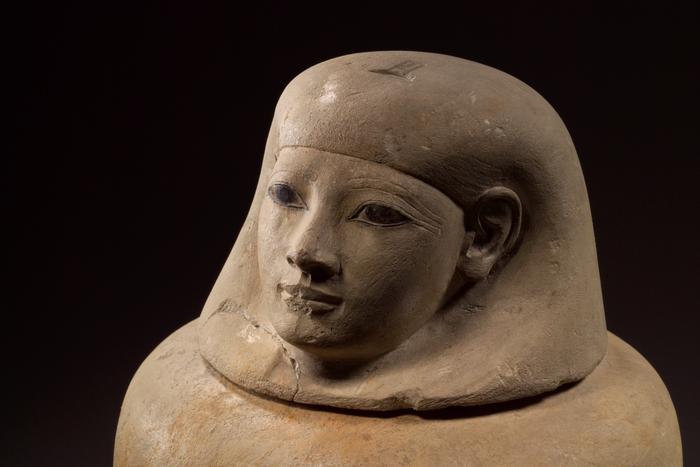
“We analyzed balm residues found in two canopic jars from the mummification equipment of Senetnay that were excavated over a century ago by Howard Carter from Tomb KV42 in the Valley of the Kings,” says Huber. Today, the jars are housed in the Museum August Kestner in Hannover, Germany. The team found that the balms contained a blend of beeswax, plant oil, fats, bitumen, Pinaceae resins (most likely larch resin), a balsamic substance, and dammar or Pistacia tree resin.
“These complex and diverse ingredients, unique to this early time period, offer a novel understanding of the sophisticated mummification practices and Egypt’s far-reaching trade-routes,” says Christian E. Loeben, Egyptologist and curator at the Museum August Kestner.
“Our methods were also able to provide crucial insights into balm ingredients for which there is limited information in contemporary ancient Egyptian textual sources,” observes Huber.
The work also highlights the trade connections of the Egyptians in the 2nd millennium BCE. “The ingredients in the balm make it clear that the ancient Egyptians were sourcing materials from beyond their realm from an early date,” says Prof. Nicole Boivin, senior researcher on the project. “The number of imported ingredients in her balm also highlights Senetnay’s importance as a key member of the pharaoh’s inner circle.”
Among those imported ingredients were larch tree resin, which likely came from the northern Mediterranean, and possibly dammars, which come exclusively from trees in Southeast Asian tropical forests. If the presence of dammar resin is confirmed, as in balms recently identified from Saqqara dating to the 1st millennium BCE, it would suggest that the ancient Egyptians had access to this Southeast Asian resin via long-distant trade almost a millennium earlier than previously known.
Working closely with the French perfumer Carole Calvez and the sensory museologist Sofia Collette Ehrich, the team meticulously recreated the scent based on their analytical findings.
“’The scent of eternity’ represents more than just the aroma of the mummification process,” notes Huber. “It embodies the rich cultural, historical, and spiritual significance of Ancient Egyptian mortuary practices.”
In creating this smell for museum display, the team hopes to help provide an immersive, multisensory experience to visitors, allowing them to connect with the past in a uniquely olfactory way, while bringing the mystique of Ancient Egyptian mummification to the modern day. Their groundbreaking approach not only bridges a deep temporal divide, but also enables visually impaired individuals to participate more fully in the exhibition of Egypt’s past, making new research results on ancient mummification accessible to a broader audience.
IMAGE CREDIT: Museum August Kestner, Hannover; Photo: Christian Tepper.
Sign up for the Daily Dose Newsletter and get the morning’s best science news from around the web delivered straight to your inbox? It’s easy like Sunday morning.




Leave a Reply