Life on land posed a basic problem for the first plants. Their sperm needed water to swim to an egg, but their spores spread best when dry. Liverworts, mosses and hornworts, collectively known as bryophytes, still live with that conflict. A new study from the Chinese Academy of Sciences shows how one liverwort solved it, and suggests the solution was assembled in stages rather than all at once.
The research, led by Professor XU Bo of the Institute of Botany, Chinese Academy of Sciences, is published in Nature Plants.
A Two-Stage Life
Liverworts reproduce in two steps. Sperm fertilize eggs in the presence of water, and the resulting embryos grow into sporophytes that produce spores. The spores then disperse and grow into new plants. Fertilization favors wet conditions, while dispersal works better when things are drier.
The team studied Marchantia polymorpha, a common liverwort, whose female reproductive organs sit atop a raised stalk. Height helps spores travel, but it also lifts the eggs away from the damp ground that sperm need.
Water That Climbs
The researchers identified a previously unknown system that moves water upward against gravity, delivering it to the raised female organs and supporting fertilization. The system depends on specialized structures on the surface of the female stalk and the receptacle at its top.
A single regulatory protein, a GRAS-family transcription factor called MpLAS, coordinates the development of those surface structures. A second GRAS-family protein, MpGRAS10, helps build the stalk itself by switching on two genes involved in making gibberellin, a plant growth hormone. Those genes are called MpKAOL1 and MpKAOL2.
Height First, Plumbing Later
Comparative analyses indicate that the stalk evolved before the specialized surface structures linked to fertilization. The authors propose a stepwise model: an early innovation improved spore dispersal, and later changes solved the problems it created for water delivery and fertilization. In other words, the elevated reproductive structure did not appear as a single coordinated package.
The researchers argue that the case illustrates a broader principle, in which competing functional demands can drive complex structures to evolve in sequence. Their study ties together gene regulation, hormone production, tissue development and evolutionary change in one system.
Open Questions
The announcement gives few experimental details. It does not report how much water the system moves or how quickly, the number of plants examined, or whether other liverwort species share the mechanism. It also lists the paper’s publication date as several weeks after the release date, a discrepancy that could not be resolved from the announcement.
The authors suggest the passive, directional water transport could inspire engineers working on bioinspired liquid-handling surfaces, though that application is speculative for now.
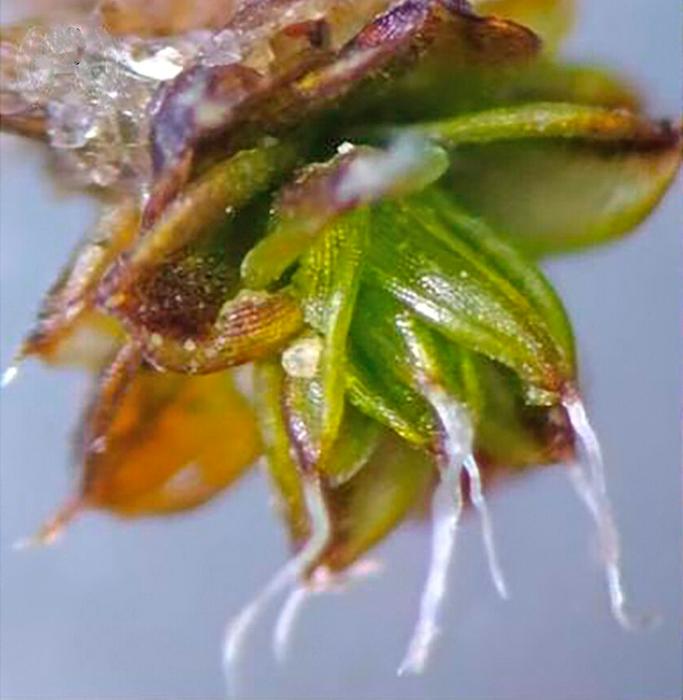
Featured image: A close-up of moss, a bryophyte relative of liverworts. Scientific Inquirer media library. (The press release image, showing male and female colonies of Marchantia polymorpha in their natural habitat, is credited to QI Xiaotong.)
Endnotes
- XU Bo, et al. “Directional water transport system resolves fertilization–dispersal conflicts in Marchantia.” Nature Plants, 2026. DOI: 10.1038/s41477-026-02450-1.
- Chinese Academy of Sciences Headquarters. “Competing reproductive needs shaped evolution of liverworts.” EurekAlert!, 1 November 2026. https://www.eurekalert.org/news-releases/1150109


Leave a Reply