Rapid global warming usually happens when Earth is already in a greenhouse state, its atmosphere loaded with carbon dioxide and methane. That is what makes an episode 304 million years ago so interesting to climate scientists. It struck in the middle of an ice age, and a new study suggests melting permafrost turned a modest warming into a much larger one.
An international team including Thomas Algeo of the University of Cincinnati and lead author Le Yao of the Nanjing Institute of Geology and Paleontology reports the findings in the Proceedings of the National Academy of Sciences.
Earth’s Penultimate Icehouse
The event occurred during the Late Paleozoic Ice Age, the second most recent ice age in Earth’s history. The researchers found that a small rise in global sea surface temperature was followed by a much larger one. In total, sea surfaces warmed by more than 7 degrees Celsius, or about 12 degrees Fahrenheit.
The team attributes the bigger jump to methane released from thawing permafrost. Their proposed sequence starts with a trigger, possibly volcanic activity, perhaps helped along by a cyclical change in the shape of Earth’s orbit that altered how sunlight was distributed across the planet. That initial nudge released a modest amount of carbon, which carried the climate past a tipping point. Thawing permafrost then released far more carbon, producing a temporary but dramatic global warming.
A Slow Burn, Then and Now
The ancient warming was not fast by today’s standards. It unfolded over tens of thousands of years, at a rate of roughly 0.1 degrees Celsius per thousand years. By comparison, sea surfaces have warmed by nearly 1 degree Celsius in just the past century.
The researchers’ concern is less about the pace than the mechanism. Today’s warming could accelerate the thaw of modern permafrost, releasing stored carbon and setting up a positive feedback loop that drives temperatures higher still. The ancient record shows that such a feedback can kick in even when the planet starts out cold.
We Are Still in One
That is why the timing of the event matters, Algeo said. Many people are surprised to learn that all of recorded human history has unfolded during the most recent ice age, whose glacial maximum came about 20,000 years ago, in the era of woolly mammoths, cave bears and giant ground sloths.
“We’re technically in an ice age,” Algeo said, because continent-scale ice sheets still cover Greenland and Antarctica. Because the 304-million-year-old warming also happened during an ice age, he argued, it offers a closer analog for the present than the greenhouse-world warming events that are more often studied.
Caveats
The announcement does not describe the methods used to estimate ancient temperatures or carbon release, nor does it give uncertainty ranges or explain how the volcanic and orbital triggers were identified. The permafrost explanation is presented as the most likely driver rather than a settled conclusion. The research was funded by Peking University and the National Natural Science Foundation of China.
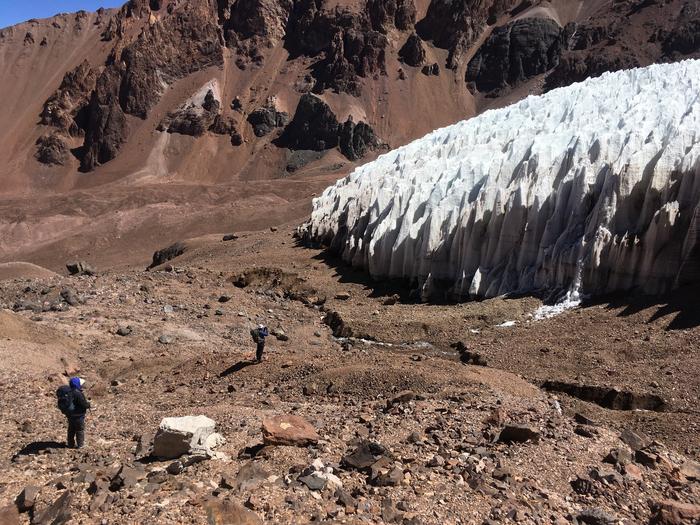
Featured image: A mountain glacier. Credit: Álvaro Ayala. (The press release image shows University of Cincinnati Professor Thomas Algeo in front of rock cores in his geosciences lab. Credit: Andrew Higley.)
Endnotes
- Yao, L., Algeo, T., et al. “A transient global warming event during Earth’s penultimate icehouse.” Proceedings of the National Academy of Sciences, 10 August 2026. DOI: 10.1073/pnas.2601643123.
- University of Cincinnati. “Ancient warming event hints at potential climate ‘tipping point.’” EurekAlert!, 11 August 2026. https://www.eurekalert.org/news-releases/1139681

Leave a Reply