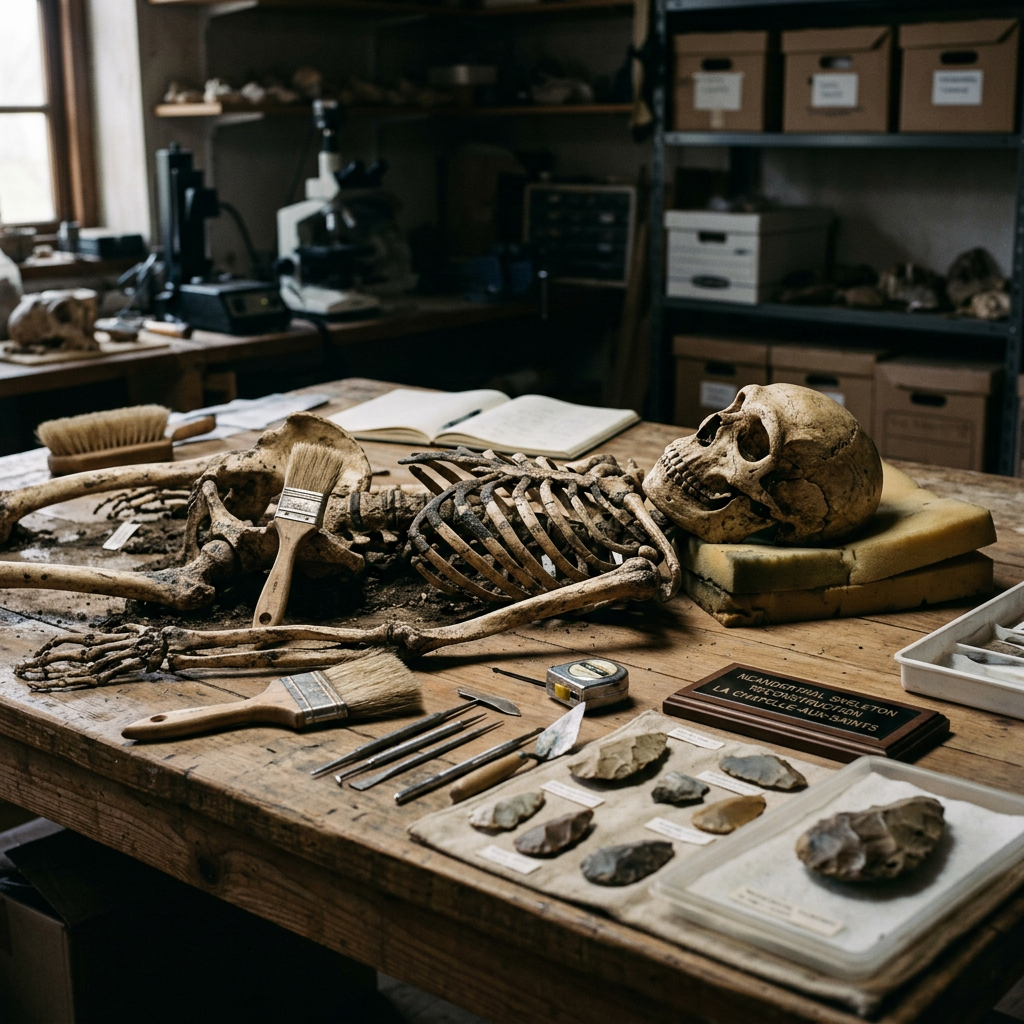
A coffin inscribed to a Roman Briton, dug up in 1869 and thought lost, holds bones radiocarbon-dated to between 987 and 1052 AD, pointing to one of two abbots of Westminster.
In 1869, workmen at Westminster Abbey uncovered a limestone sarcophagus bearing an inscription to Valerius Amandinus, a wealthy Briton who lived some time around 300 to 400 AD. Inside were human remains, described at the time as a robust young man of about 5 ft 7 in, no older than 30.
The skeleton was subsequently believed lost. It was not. When conservators lifted the lid at a studio in 2016, an almost complete skeleton was still inside, and the analysis of it, published in the Journal of the British Archaeological Association, indicates that the Victorians were wrong about nearly everything except that he was a man.
The bones are not Roman. Radiocarbon dating places the man’s death between 987 and 1052 AD, roughly six centuries after the sarcophagus was carved.
A reused coffin
The clue had been visible all along. The sarcophagus lid carries a large Latin cross dating to roughly the 10th or 11th century, cut into stone that was already old when it was recarved.
Professor Warwick Rodwell, consultant archaeologist at Westminster Abbey and the author of the analysis, concludes that the coffin was reused. A wooden coffin was placed inside the stone one, and the lid was reworked with the cross.
Evidence of the wooden coffin turned up in 2016 as well, as a white lime residue outlining a rectangle inside the stone. “Although no physical traces of that feature remained, it can only have been a timber coffin, which has completely decayed over the course of the seven centuries that the sarcophagus was buried in the sacristy courtyard,” Rodwell said.
Reusing Roman stonework was ordinary practice in Anglo-Saxon England. Dressed stone was valuable, quarrying and transporting it was expensive, and Roman ruins were abundant. A finely carved sarcophagus would have been a particularly desirable object, and burying someone in one conferred status.
Two candidates
Rodwell’s conclusion is that the bones belonged to a high-ranking medieval monk, and that the most likely individual is Aelfwig, an abbot of Westminster who died around 1020. The alternative is his successor, Wulnoth, who died in 1049 and is presumed to have been buried at the Abbey.
Both fall within the radiocarbon range, and the choice between them rests on inference rather than evidence.
“We have two viable contenders for the occupant of the sarcophagus,” Rodwell said. “We do not know the date of birth of either. But either would fit equally well if we assume the Abbot was in his early twenties when the appointment was made and close to fifty when he died.”
One detail tips it slightly. “The fact Aelfwig was already a monk of Westminster might favour him,” Rodwell said.
Both men held the abbacy in the decades before the Norman Conquest, when Westminster was a modest Benedictine house rather than the institution it became under Edward the Confessor, who rebuilt the church in the 1040s and 1050s.
What the bones say
The skeletal analysis, carried out by James Young Langthorne, a human bone specialist at Pre-Construct Archaeology, revised the Victorian reading substantially. The man was 35 to 49 years old at death and about 5 ft 9 in tall.
Both figures changed. He was older than the 19th-century assessment allowed, and two inches taller. Nineteenth-century estimates of age and stature relied on impressionistic reading of bones; modern osteology uses measured relationships between long-bone length and height, and assesses age from the fusion of joint surfaces, the degeneration of the pelvis and tooth wear.
Radiocarbon dating, carried out at the Scottish Universities Environmental Research Centre, works by measuring how much of a bone’s radioactive carbon-14 has decayed since the animal or person stopped taking in carbon. For a sample from this period it yields a range rather than a year, which is why the result spans 65 years rather than naming one.
An age of 35 to 49 is what makes the abbot identification work. A man in his late forties fits someone who had held a senior monastic office for two decades. A man of under 30, as the Victorians had it, fits neither candidate.
“This confirms that the reuse of the sarcophagus, and the associated remodelling of its cover, occurred in the late Saxon period,” Rodwell said of the radiocarbon result.
Broken in 1820, found in 1869
The object’s own history is nearly as complicated as its occupant’s. Workmen unearthed it in 1820 and broke the lid into six pieces. The damage was repaired after the official discovery in 1869.
The modern investigation came out of construction work. Channel 4’s Time Team examined the structure of Henry III’s original sacristy in 2009, and Pre-Construct Archaeology excavated the sacristy, finishing in 2025 to make way for the King Charles III Sacristy, due to open next year.
Development-driven archaeology of this kind accounts for much of what is now learned about British sites. A building project triggers an excavation, and material that would otherwise have stayed undisturbed is examined because something is about to be built on top of it.
An object with three lives
The sarcophagus now stands in the Queen’s Diamond Jubilee Galleries at Westminster Abbey, and its biography runs through three distinct periods of English history.
It was carved in Roman Britain for a man whose name is cut into the stone. Six centuries later, in a Christian England that had absorbed the ruins of that province, it was recut with a cross and used again for someone whose name was not recorded on it. Eight centuries after that, it was dug up twice, broken, repaired, emptied of attention and nearly forgotten, before the remains inside it were examined with methods that did not exist when it was found.
Valerius Amandinus, whose name it bears, may never have lain in it at all. The release does not say whether any trace of an original occupant was found.
What the study establishes is narrower than a name but firmer than a guess: a man of middle age, buried with honour in a borrowed Roman coffin at Westminster, some time within a 65-year window either side of the first millennium.
Notes
- Rodwell, W. “Westminster Abbey’s Roman Sarcophagus and its Afterlife.” Journal of the British Archaeological Association, 2026. DOI: 10.1080/00681288.2026.2675788.
- Taylor & Francis Group. “Mystery skeleton found in Roman sarcophagus at Westminster Abbey may finally have an identity.” EurekAlert!, 20 October 2026. https://www.eurekalert.org/news-releases/1147649.


Leave a Reply