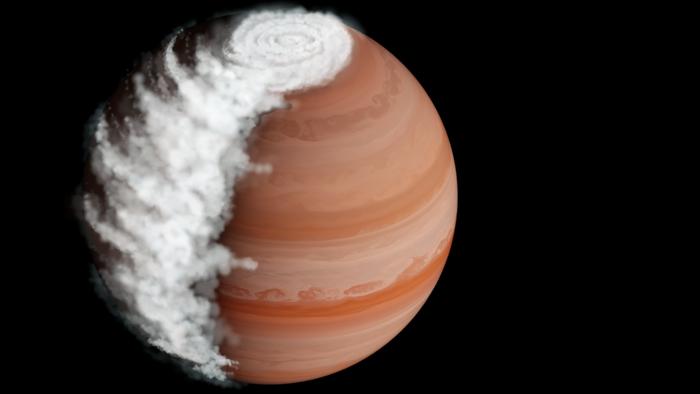
Using JWST data and a new technique called transmission strings, researchers found the hot Jupiter WASP-17b’s atmosphere bulges on its hotter evening side, as theory predicted.
When astronomers study the atmosphere of a planet orbiting another star, they usually treat it as a simple ring. As the planet passes in front of its star, a sliver of starlight filters through the thin halo of gas around its edge, and the colors absorbed reveal what the atmosphere contains. But the method lumps the entire ring together, as if every part of the atmosphere were the same.
A team led by researchers at the University of Bristol and Cornell University has now gone further. Writing in Nature Astronomy, they report a spatial map of the atmospheric edge of WASP-17b, a giant planet about 1,300 light-years from Earth, showing that its atmosphere is not a perfect circle but a lopsided, deformed sphere.
“This is proof of concept that planets are in fact 3D objects, and that consistently, as they go around their star, what we predict should be happening is happening,” said Lili Alderson, a Klarman Postdoctoral Fellow at Cornell University and the study’s lead author. “To move beyond computational exercises and see it for real is a different matter.”
A planet with permanent day and night
WASP-17b is a hot Jupiter, a gas giant that orbits extremely close to its star. Like many such planets, it is thought to be tidally locked, always showing the same face to its star in the way the Moon always shows the same face to Earth. One hemisphere is locked in permanent daylight and scorching heat. The other is in perpetual night.
That arrangement drives powerful winds. A broad jet near the equator carries gas and heat from the dayside around to the nightside. As a result, the part of the atmosphere at the planet’s evening edge, where gas arrives from the dayside, should be hotter than the morning edge, where gas arrives after cooling on the nightside. Hotter gas expands, so the evening side should puff up.
From a ring to gemstones on a ring
To test that prediction, the team used a method called transmission strings, also known as transit mapping, developed by David Grant and Hannah Wakeford at Bristol. Rather than averaging the atmosphere around the whole edge, the technique measures how far the atmosphere extends from the planet’s center at different positions around its limb, the edge of the planet as seen from Earth.
“Rather than assuming your atmosphere is a circle with the same radius all the way around, our technique allows you to pull out different distances from the centre to the edge of the planet,” Alderson said. “We’re able to go around the edge. So, we’ve gone from a ring to understanding where on the ring the gemstones are, so to speak.”
The data came from the James Webb Space Telescope, through a Guaranteed Time Observations program called TST DREAMS. Webb’s sensitivity makes it possible to detect the tiny differences in starlight needed for such measurements.
Bang on the prediction
The resulting map showed an atmosphere that was roughly circular but asymmetrical. One side was more extended than the other, and it was the evening side of the equator, exactly where the heat-carrying jet should inflate the atmosphere. The team measured the shape of the atmosphere across angles from pole to pole for the first time.
“Theory predicts that the morning and the evening sides should have a strong temperature difference, and WASP-17b fits really nicely in that trend – pretty much bang-on what we thought it would be,” Alderson said.
The changes in chemical composition and temperature from the equator to the poles, and from the dayside to the nightside, also matched predictions from theoretical models and other methods.
“Planets are temperamental, their atmospheres complex and chaotic,” said Wakeford, an associate professor in astrophysics at Bristol and a co-author. “The fact that all of these numbers came together and showed us this very structured, dynamical picture of this giant world over 1,000 light-years away was just really exciting.”
Why shape matters
Understanding an atmosphere’s shape is more than a curiosity. Measurements of an exoplanet’s composition depend on assumptions about its temperature and structure. If an atmosphere is lopsided but treated as uniform, the conclusions drawn about its chemistry can be skewed. Mapping the limb in detail allows astronomers to separate signals from different regions and build more accurate pictures of distant worlds.
Previous work, including earlier Webb studies of other hot Jupiters, had found differences between the morning and evening sides of exoplanets by splitting the limb into two halves. The new technique goes further, resolving variations around the full edge of the planet.
“Having this very robust mathematical model that we can apply to this state-of-the-art data is incredibly exciting,” Wakeford said. “The results are a really beautiful demonstration of the dynamics that are going on in these multidimensional and multifaceted worlds.”
Toward exoplanet weather maps
More than 6,000 exoplanets have been confirmed so far. The researchers say the method paves the way for mapping many more of them, potentially revealing differences between latitudes and patterns on the scale of weather systems.
There are limits. The technique works best for large planets with extended atmospheres orbiting relatively bright stars, where the signal is strongest. Applying it to smaller, cooler planets, including rocky worlds that might be habitable, will be far more challenging and may require future telescopes.
The work was funded by NASA, the UK’s Science and Technology Facilities Council and the Klarman Fellowship. For WASP-17b, it offers a rare look at a distant world not as a dot or a ring, but as a three-dimensional place with winds, heat and weather.
Notes
- “A Spatial Map of the Atmospheric Limb of a Hot Jupiter.” Nature Astronomy, 2026. DOI: 10.1038/s41550-026-02986-4.
- University of Bristol. “Trailblazing technique uncovers real shape of scorching-hot exoplanet atmospheres.” EurekAlert!, 14 October 2026. https://www.eurekalert.org/news-releases/1147384.
Hannah Robbins/Johns Hopkins University


Leave a Reply