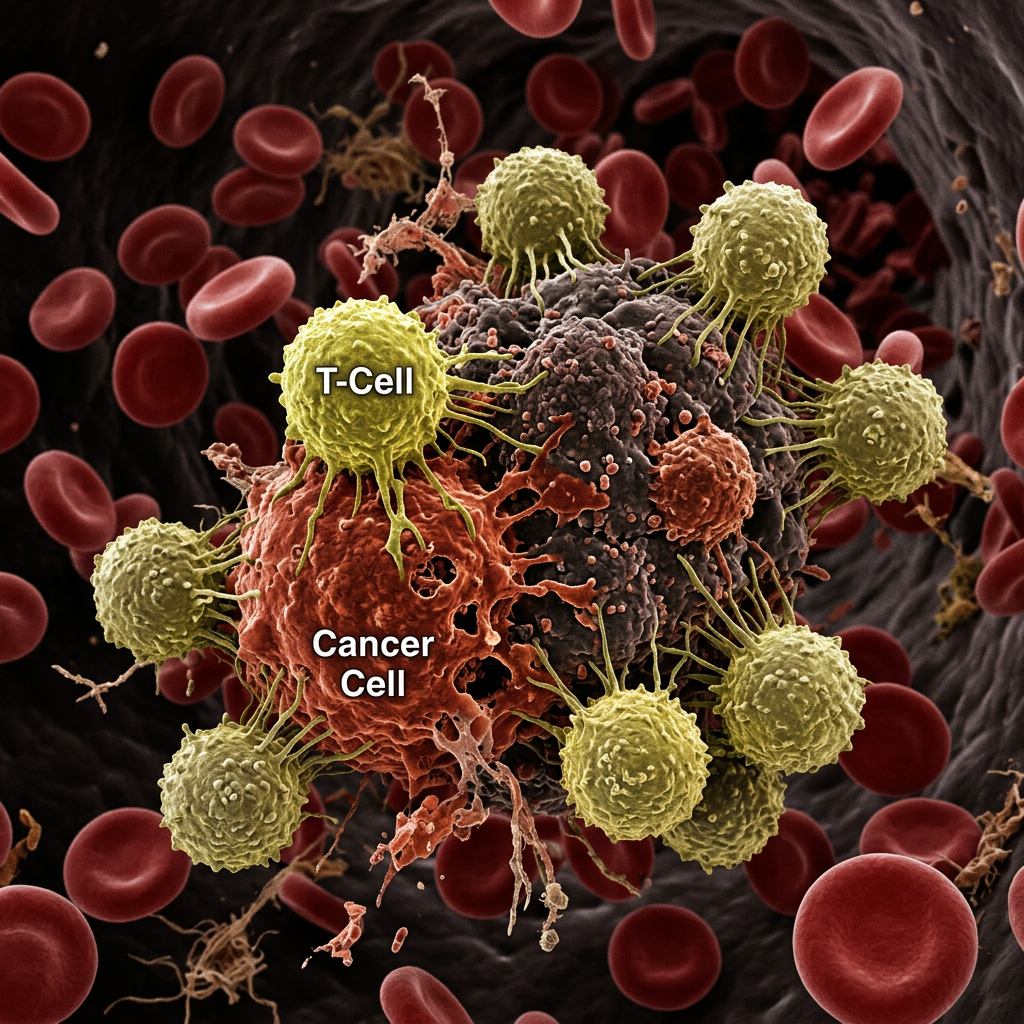
Nagoya University researchers found that complement C3 produced locally by tumor fibroblasts, not the C3 circulating in blood, kept immune-suppressing cells out and boosted checkpoint drugs.
Immune checkpoint inhibitors have transformed cancer treatment. Drugs that release the brakes on the immune system have produced lasting remissions in some patients with melanoma, lung cancer and other tumors once considered nearly untreatable, and the discoveries behind them earned the 2018 Nobel Prize in Physiology or Medicine. But in many cancers, only a minority of patients respond. Understanding why the rest do not is one of the biggest questions in oncology.
Checkpoint drugs work by blocking molecular off-switches on immune cells. One of the most important is PD-1, a receptor on T cells that normally prevents the immune system from attacking healthy tissue. Many tumors exploit it, displaying a partner molecule that tells approaching T cells to stand down. Antibodies such as pembrolizumab and nivolumab block PD-1 and can restore the attack. Doctors already use markers such as tumor PD-L1 levels to guess who will benefit, but those predictors are imperfect, and many patients still receive treatment that does not help them.
A study from Nagoya University in Japan, published in Nature Communications, points to an unexpected player: complement C3, one of the oldest proteins in the immune system. The researchers found that C3 made inside tumors helps keep immune-suppressing cells at bay, improving the odds that immunotherapy will work. The C3 circulating in the blood, by contrast, made no difference.
An ancient defense
C3 is the central component of the complement system, a cascade of proteins that tags microbes for destruction, recruits immune cells and punches holes in invaders. It is remarkably old in evolutionary terms, with versions found in simple animals such as sponges and jellyfish. In humans, the liver produces most of it, and it circulates in the blood to help fight infection.
What C3 does when it is made locally, within tissues and organs, is much less understood. That is the question lead author Yuki Miyai, an assistant professor at Nagoya University’s Graduate School of Medicine, and colleagues set out to answer.
“Cancer tumors are surrounded by normal cells called fibroblasts,” Miyai said. “Until now, the role of complement C3 produced by these cancer-associated fibroblasts within tumor tissue was not known.”
Local, not circulating
Cancer-associated fibroblasts are among the most abundant cells in many tumors. They build and remodel the scaffolding around cancer cells, and they are often thought to help tumors grow and evade treatment. The Nagoya team found that some of them also produce C3, and that this local supply matters.
To separate the effects of liver-made and tumor-made C3, the researchers turned to mice. Cutting liver C3 production by 90 percent did not change how well an anti-PD-1 antibody, a common type of checkpoint inhibitor, worked against tumors. But stopping C3 production by the tumor’s fibroblasts made the drug less effective, even though C3 levels in the blood fell by only 9 percent.
“What determined the efficacy of the immunotherapy treatment was not the C3 in the blood but the local C3 produced at the tumor site,” Miyai said.
Keeping suppressors out
The researchers traced the effect to myeloid cells, a broad family of immune cells that includes macrophages. In tumors, certain myeloid cells can be co-opted to suppress the immune response, shielding cancer from attack and blunting the effects of checkpoint drugs. Tumors whose fibroblasts made more C3 contained fewer of these immune-suppressing macrophages.
“When this C3 breaks down, it forms a fragment called iC3b that stops harmful myeloid cells from entering the tumor,” Miyai said. “As a result, immunotherapy is more likely to work.”
iC3b is a well-known breakdown product of C3 that is recognized by receptors on several types of immune cells. The finding gives it a new role as a gatekeeper of the tumor environment.
Turning resistant tumors around
The team then tested whether the effect could be reproduced artificially. They used a drug that mimics C3’s blocking effect on myeloid cells. In mice, it made immunotherapy effective against tumors that had previously resisted treatment and significantly extended survival. The release does not name the drug or report survival figures.
Human data pointed in the same direction. The researchers analyzed tumor samples from patients with lung cancer who had received immunotherapy. Patients with more C3 in the tissue around their cancer had better treatment outcomes and survival. About half of the high-C3 patients responded to treatment, compared with none of those with low C3. Once again, blood levels of C3 made no difference.
Promise and caveats
The findings suggest two possible uses. Local C3 levels in a biopsy might help predict which patients are likely to benefit from checkpoint inhibitors, sparing others from treatments that will not help them. And for patients whose tumors make little C3, mimicking its effect might turn a resistant tumor into a responsive one.
Both remain some way off. Most of the evidence comes from mice, and the release does not report how many patients contributed tumor samples or give statistical details for the human analysis, which covered only lung cancer. The complement system is also notoriously double-edged in cancer: in some settings, complement activity has been linked to inflammation that fuels tumor growth. Whether the protective effect seen here holds across tumor types is an open question.
The team plans further experiments to raise local C3 levels and identify the best timing for treatment. The authors also suggest that understanding locally produced C3 could shed light on wound healing and inflammation, though that remains speculative. For now, the study adds an ancient molecule to the growing list of factors that may decide whether a patient’s immune system can be unleashed against cancer.
Notes
- Miyai, Y., et al. “Local, but not circulating, complement C3 shapes immune checkpoint blockade efficacy by controlling myeloid cell infiltration.” Nature Communications, 15 July 2026. DOI: 10.1038/s41467-026-75542-3.
- Nagoya University. “Ancient molecule made inside tumors drives immune response, study finds.” EurekAlert!, 23 July 2026. https://www.eurekalert.org/news-releases/1137062.



Leave a Reply