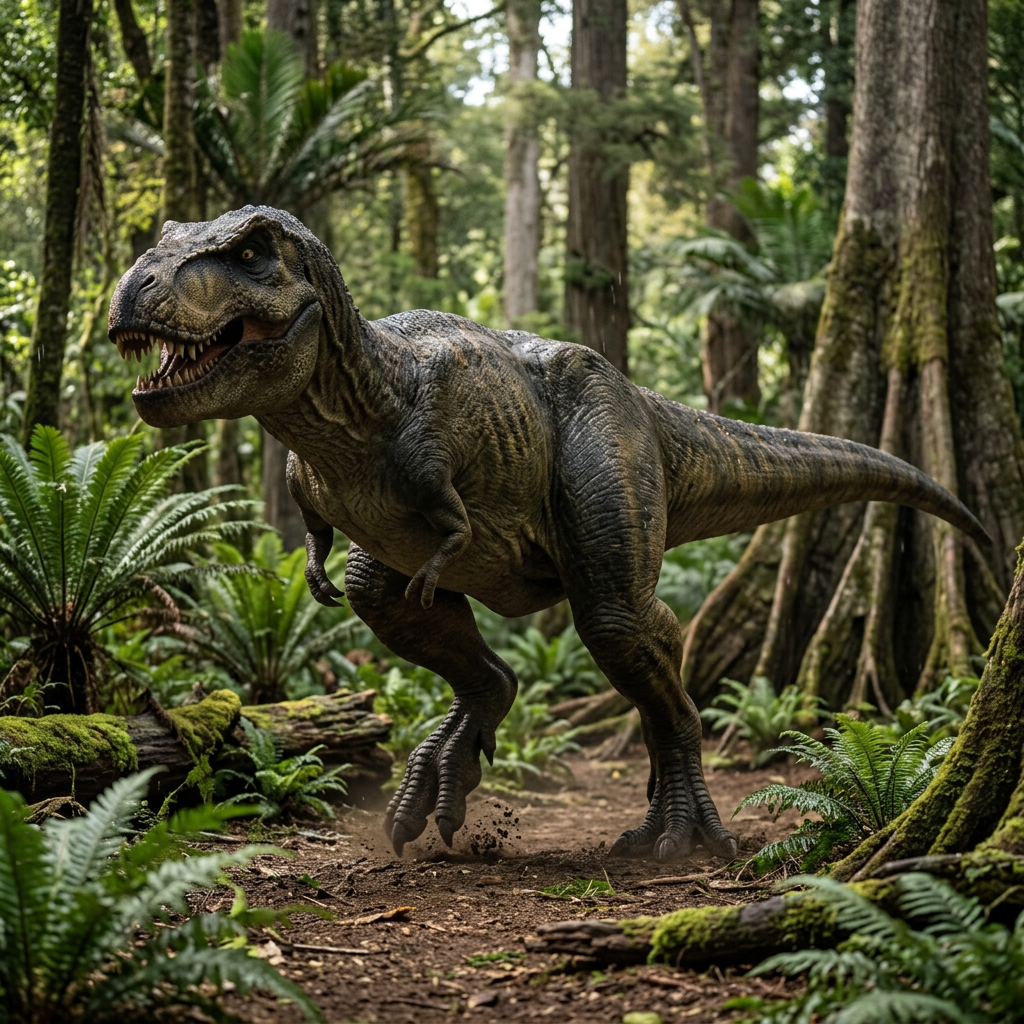
A new Purdue study finds that a global blanket of fine dust trapped the impact’s heat near the surface, turning a regional disaster into a planetwide extinction.
Sixty-six million years ago, a rock roughly the size of Mount Everest slammed into the shallow sea near what is now Mexico’s Yucatan Peninsula. The collision carved out the Chicxulub crater and set in motion the extinction of roughly three-quarters of all living species, most of the dinosaurs among them. That much is textbook. What has always been harder to explain is the mechanism. How does a single impact, however violent, reach out across an entire planet and kill things on the far side of the world?
A team of planetary scientists at Purdue University thinks it has found the missing piece, and it is not the fireball or the blast wave. It is dust. According to a study published in the Journal of Geophysical Research: Biogeosciences, the impact lofted a cloud of extremely fine particles that spread around the globe and trapped heat so effectively that almost none of it could escape into space. The result was a planet whose surface was, in the researchers’ memorable phrasing, charbroiled.
“That much kinetic energy has to go somewhere and eventually it is converted to heat,” said Brandon Johnson, the study’s lead author and a professor in Purdue’s Department of Earth, Atmospheric, and Planetary Sciences. “With the dust cloud trapping thermal radiation, it was like the surface and everything on it was being charbroiled. And that’s what killed the dinosaurs and all the other animals.”
A forensic investigation, 66 million years late
Johnson has spent much of his career studying what happens when planetary bodies collide, a kind of crash-scene reconstruction performed tens of millions of years after the fact. Earlier work with his former advisor, the late impact physicist Jay Melosh, established that the Chicxulub asteroid vaporized more than 1,000 cubic kilometers of material on impact, mostly rock and soil, along with whatever happened to be living there.
That vapor rose above the atmosphere in an expanding plume. As it cooled, it condensed, much the way water vapor condenses into droplets. But instead of rain, the plume produced tiny beads of once-molten rock known as spherules, each about 250 micrometers across, roughly half the size of a grain of sugar.
When the spherules fell back toward Earth, friction with the air heated them, turning each one into a miniature meteor. Collectively, they added an enormous pulse of heat to the energy already released by the impact itself. Spherules from the event have been found all over the world, including lodged in the gills of fossil paddlefish at a site in North Dakota, fish that likely died on the very day the asteroid struck.
Yet earlier analyses had shown something curious: the spherules are made entirely of terrestrial material, with nothing from the asteroid itself. The new study accounts for where that asteroid material went. Rather than condensing into spherules, it became a cloud of fine dust that ballooned outward to envelop the entire planet.
Why the dust changed everything
On its own, the rain of hot spherules would have been devastating but not necessarily apocalyptic. Johnson is blunt about the difference the dust layer made. “It’s not the blast wave from the impact or the fireball — those don’t go very far,” he said. “It’s the global ejection of this vapor plume material that makes this a global extinction event. Without the dust cloud, it would have been bad. It would have killed a lot of creatures. But it wouldn’t have been a planetary catastrophe.”
The physics is straightforward once the dust is in place. Heat radiating from the falling spherules would normally escape upward and out into space. With a dense, fine-grained layer capping the atmosphere, that escape route was closed. “With this fine dust cloud capping the atmosphere, the heat radiation can’t escape to space,” Johnson said. “So the only place that radiation can go is back down to the earth.”
The numbers the team calculated are staggering. With the dust layer in place, animals living in the late Cretaceous received roughly 17 times the dose of thermal radiation that is fully lethal to humans. That was enough, Johnson said, “to ignite grass, pine needles, lichen and maybe even directly ignite wood.” The planet’s surface became a tinderbox, and wildfires spread across continents.
It is tempting to compare the scene to Venus, with its crushing, heat-trapping atmosphere. Johnson thinks a darker comparison is more apt. “It probably looked more like hell than like Venus,” he said. The clouds would have blocked out daylight, leaving the landscape dark to any creature that, like us, cannot see far into the infrared. “You would only have been able to see a reddish glow from the wildfires. But there really wouldn’t be anything alive to do the seeing anyway, except for any animal that was able to burrow or swim or shelter in some way.”
A lid on a pot
To quantify just how well the dust insulated the planet, the team turned to Alexandria Johnson, a Purdue assistant professor of earth, atmospheric and planetary sciences who studies clouds on Earth and on other worlds. She analyzed the physical properties of individual dust grains and of the cloud as a whole to work out its radiative behavior, essentially how it absorbed, reflected and re-emitted heat.
Her conclusion was stark. “We found that the cloud layer was so impermeable that it trapped almost all of the heat from the falling spherules near the surface of the planet — the dust is essentially acting like a lid on a pot,” she said. Anything that could not get out of the heat, by digging underground or retreating underwater, “would have gotten baked or fried.”
That finding fits the broad pattern paleontologists have long noted in who survived: small burrowing animals and freshwater creatures fared far better than large animals living exposed on the surface. Soil and water behave very differently from air when it comes to heat, and those thermodynamic differences, Alexandria Johnson noted, would have protected animals that were below ground.
A long, toxic aftermath
The danger did not end when the spherules stopped falling. The dust itself could have lingered in the atmosphere for years or even decades before settling, and the particles posed their own threat. While the spherules were large enough to see with the naked eye, the dust grains were about ten times smaller, roughly 2.5 micrometers across, or about 30 times narrower than a human hair.
That size class will sound familiar to anyone who has checked an air-quality app during wildfire season. “The 2.5-micrometer dust we studied here is the same size as the smoke particles we worry about with wildfires,” Alexandria Johnson said. “It gets in people’s lungs and even in our bloodstreams, which is why it’s such concern for public human health.” Even creatures that escaped the heat, she suggested, may have suffered lasting health effects from breathing it. Still, she noted, the timelines are not comparable: the cooking happened far faster than any inhalation damage.
Rethinking the mechanics of mass extinction
The Chicxulub impact has been the leading explanation for the end-Cretaceous extinction for decades, but debate has continued over exactly how its effects propagated around the globe. Proposals have ranged from a prolonged “impact winter” caused by soot and sulfur blocking sunlight to the global firestorms implied by layers of charcoal found in rocks at the boundary. The Purdue work suggests that the fine dust layer acted as a force multiplier, amplifying the heat pulse from the falling debris and making widespread fires far more likely.
The picture that emerges is of an extinction that unfolded in stages: an initial, ferociously hot interval in which surface life was cooked under a dusty lid, followed by a long, darkened, particle-choked aftermath. For the dinosaurs, the first stage was very likely enough.
For Brandon Johnson, the takeaway is the scale of the difference one ingredient made. A Chicxulub impact without the dust, he said, “still wouldn’t have been a good day for dinosaurs.” With it, the day became a turning point in the history of life on Earth.
Endnotes
- “Heat and wildfires during the K-Pg mass extinction enhanced by fine dust.” Journal of Geophysical Research: Biogeosciences (2026). DOI: 10.1029/2026JG009837.
- Purdue University. “Dinosaur-killing asteroid also created a dust cloud that insulated Earth, ‘charbroiling’ Cretaceous creatures.” News release via EurekAlert!, July 28, 2026. https://www.eurekalert.org/news-releases/1137806


Leave a Reply