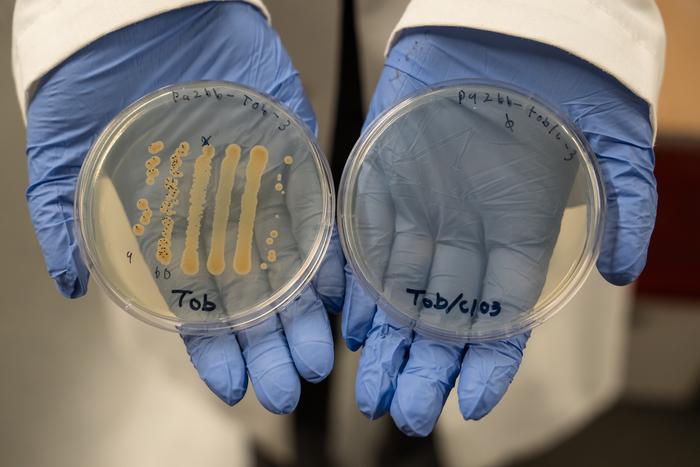
Doxycycline is one of the most widely prescribed antibiotics in the world, and it works at remarkably low concentrations against some bacteria. A University of Exeter team studying why the drug is so potent against Coxiella burnetii, a bacterium that can cause severe, sometimes fatal flu-like illness in people exposed to livestock, has found that it works in a way nobody had previously documented.
Ribosomes, the molecular machines that build proteins inside every cell, release finished proteins through a narrow exit channel. The team, led by Professor Nicholas Harmer of the university’s Living Systems Institute, confirmed doxycycline’s long-known mechanism of blocking tRNA from binding at the ribosome’s decoding centre, which halts protein assembly early on. But using advances in cryo-electron microscopy that allow finer-grained imaging of molecular structures, the researchers also found a second, previously unrecognized mechanism: in Coxiella’s ribosomes, doxycycline molecules stack together in groups of three, forming a plug that completely seals off the protein exit channel. With nowhere for new proteins to go, the bacteria lose the ability to grow or reproduce.
The team found a related but distinct effect in E. coli, where a single doxycycline molecule was enough to reconfigure the ribosome into an entirely inactive state that had not previously been observed. Harmer described the stacking mechanism in Coxiella as an entirely new way for doxycycline to act against the bacterium, while lead author Dr. William Stuart, also of the Living Systems Institute, said the discovery caught the team by surprise.
The findings arrive amid a global antibiotic resistance crisis, in which bacteria are increasingly evolving ways to survive drugs that once reliably killed them. Understanding the full range of mechanisms by which an existing antibiotic disables its target gives researchers more angles to work from when designing new drugs or combinations meant to stay a step ahead of resistance. The Exeter team now plans to test whether the stacking and reconfiguration mechanisms they identified in Coxiella and E. coli show up in other bacteria, and whether either mechanism could be deliberately exploited in the design of new antibiotics. The work was funded by UKRI’s Biotechnology and Biological Sciences Research Council and the UK’s Defence Science and Technology Laboratory.
Journal: Nature Communications
Article Title: Cryo-EM reveals multiple mechanisms of ribosome inhibition by doxycycline
DOI: 10.1038/s41467-026-73421-5
Publication Date: July 23, 2026
Source: EurekAlert


Leave a Reply