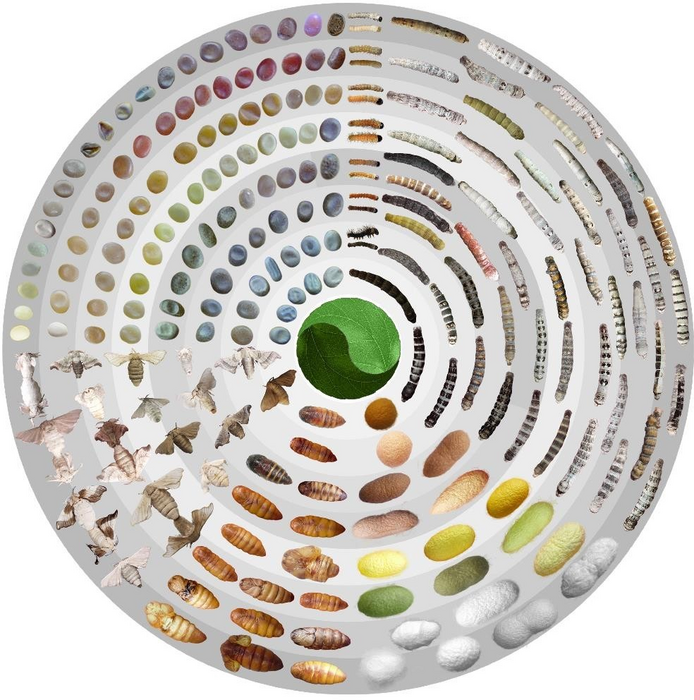
Painstakingly woven from the cocoons of silkworms, silk has been valued for over 4,000 years as a luxury material. More than just beautiful, silk is also lightweight, strong, and biocompatible, which allows it to be used as clothes, medical materials, and more. However, conventional silk has a glaring weakness – it shrinks and loses its shape after repeated exposure to moisture.
Researchers at Tohoku University have developed high-performance silk that largely solves this weakness. Instead of tampering with the silk fibers, the research team targeted an earlier step in the process by altering the diet of silkworms. The result is silk fibers with 50% greater tensile strength, and reduced shrinkage after wetting and drying to less than one-quarter of that of untreated silk. These remarkable improvements were even seen when the silk fibers were processed into yarn and woven fabrics, meaning that we may be on the right path to use this “super silk” effectively in final products.
These remarkable improvements were achieved by adding plant-derived cellulose nanofibers (CNFs) to silkworm feed. Other methods may require toxic chemical treatments or extensive changes to the silk production process. In contrast, simply adding a sprinkle of sturdy CNF to silkworm feed represents a practical and environmentally-friendly way to produce higher-value silk products.
“Silk is not just for fashion – it is also used in a plethora of different industries,” said Associate Professor Hiroki Kurita of Tohoku University.
Based on their previous work, the researchers expected the new diet to strengthen individual silk fibers, but were unsure whether these benefits would persist after spinning and weaving, or whether they could improve dimensional stability under wet conditions. These impressive new findings suggest that small changes during silk production can have a large impact on the performance of finished textile products.
“Our goal was to improve silk while preserving its natural advantages. We were excited to find that simply changing the silkworms’ diet produced silk that is both stronger and much more dimensionally stable in wet environments. We hope this sustainable approach will contribute to the development of next-generation functional textiles,” Kurita said.
Journal: Journal of Industrial Textiles
DOI: 10.1177/15280837261463657
Article Title: Tensile Properties and Dimensional Stability of Cellulose Nanofiber-Reinforced Silk Fabrics by Silkworm Feeding
Publication Date: June 25, 2026
Source: EurekAlert



Leave a Reply