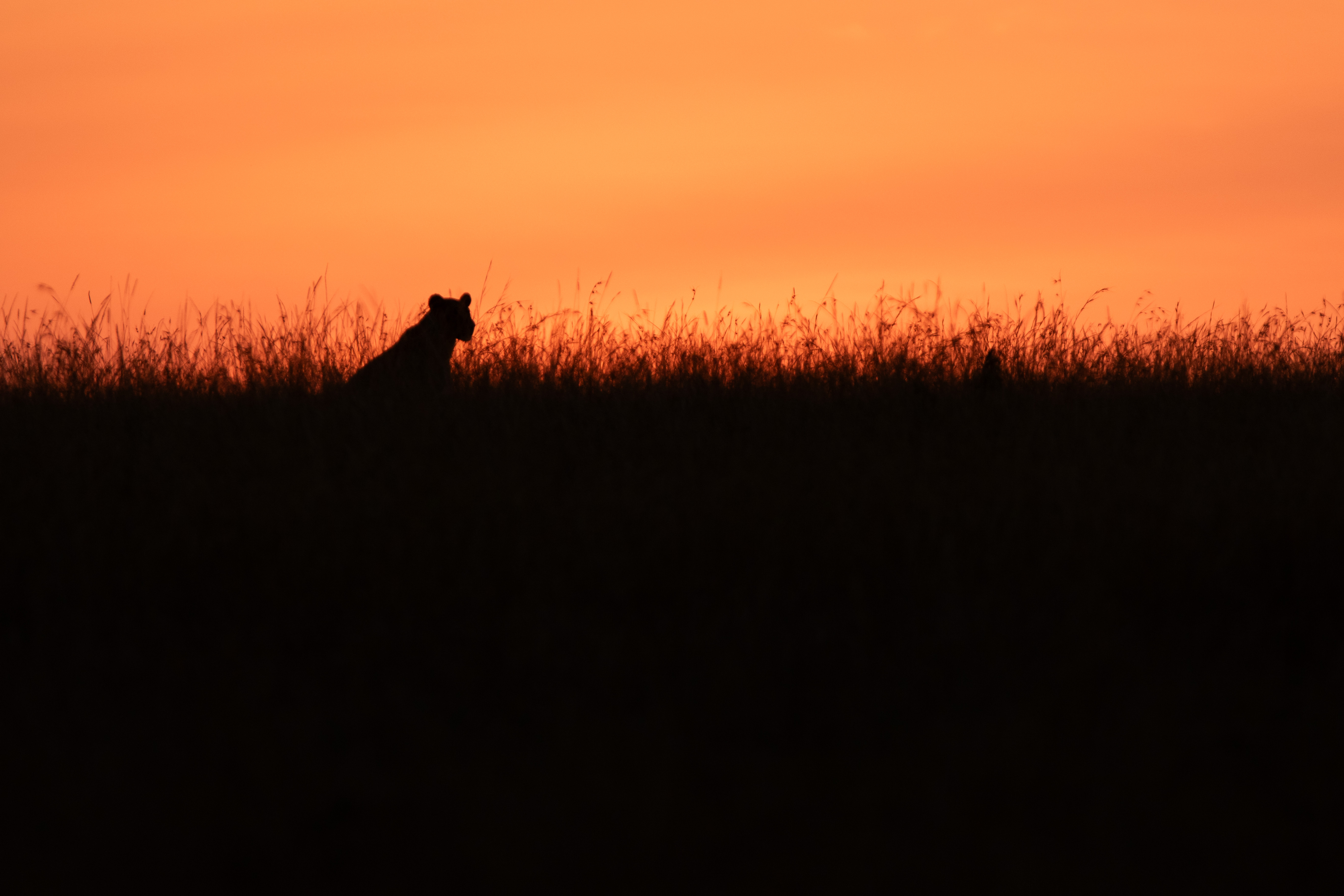
Lions have been filmed countless times, but National Geographic’s Lion attempts something unusually ambitious: following a single animal from vulnerable cub to adulthood. From The Lion King director Jon Favreau and BBC Studios executive producer Mike Gunton, the series spent four years chronicling Kio as he navigates the shifting social world of his pride, loss and exile, rival males, and the constant struggle for survival. The result combines the scale and visual language of cinematic storytelling with the patience of long-form natural history filmmaking, using one lion’s coming of age to offer an unusually intimate view of the lives, relationships and personalities behind an animal audiences may think they already know.
Behind many of those images is director of photography Sophie Darlington, whose career in wildlife filmmaking spans more than three decades. Darlington began learning her craft in the Serengeti as an apprentice to legendary wildlife filmmaker Hugo van Lawick and has since worked on productions including Queens, Dynasties, Our Planet, Planet Earth II, The Hunt, and Disneynature’s Penguins and Bears. A member of the BAFTA-winning cinematography team behind The Hunt, she became the first dedicated wildlife cinematographer invited to join the American Society of Cinematographers in 2025. Scientific Inquirer spoke with Darlington about what decades of observing lions have taught her, becoming emotionally invested in Kio, the technology and fieldcraft behind a four-year shoot, and the challenge of finding a fresh visual language for one of nature filmmaking’s most familiar subjects.

Can we start with some background before we jump into the series itself? You have a long history of filming cats, especially lions and cheetahs. Can you tell me about some of the work you’ve done in the past? I know you worked on Queens most recently, but you’ve done so much.
I’ve been fortunate enough to work in this industry for 35 years, and I’ve worked on three of Disneynature’s feature films, which I adored: Penguins, Bears and African Cats. There are more cats! I did the cheetahs on those.
And then, as you mentioned, Queens, which is one that’s really, really close to my heart because of what it did—not only showing female leadership in nature, but also championing women behind the camera and actively mentoring. That’s something I believe passionately in.
What was so lovely about Match was that I got to work with Faith Musembi on Queens, and Faith is one of the producers and directors on episode two of Match, so we carried that relationship forward.
I’ve been doing this for a long old time.
And in that time, you’ve observed lions quite a bit. I imagine at some point you have to learn to almost start thinking like one.
Trying to.
So, just in general, what have you learned over the years about lions?
Here’s what I’ve learned about lions: You can never think you know everything about lions.
Coming into this, I’m thinking, “I’ve seen this, I’ve seen that. I’ve worked here, there and everywhere with lions.” What I love about them is that they always do something to surprise you—the unexpected.
It’s this constant ability, because they’re social, they’re dynamic, and they have such an incredible combination of being hugely effective at conserving power—sleeping for three days if they’ve eaten a buffalo, for example—or going hammer and tongs if they want to hunt or find a female. They have this incredible range.
Lions are extraordinary.
Great answer. So you spent four years with Keo, from the time he was a cub until he was an adult. What did you come to understand about him during that time?
Sammy Muneni, who is our lead specialist film driver, and I have worked together for 10 years, and he was on this project with me. I remember really clearly the first day going out and finding a pride of lions. Sammy found them—he always does. He’s got eyes like a vulture. He can just see. He’s amazing.
Then he spotted another lioness that we chased after, and that was the first day. It was the very beginning of all our shoots, and that was the day we met Kiongozi.
I think what we learned about Keo was that, because he was so out of sync with the rest of the pride, he was always watching. That’s such a brilliant thing when you’re a filmmaker trying to tell his story because he’s this amazing conduit into the rest of the pride and into their lives.
He was always allowing us those moments where he would be looking to his mum, to his brothers, to the males. There’s that beautiful shot, which I adore, at the very beginning where he goes and clambers onto the big male’s head. He’s just a conduit into a lion’s life.
That stayed pretty much all the way through the four years of filming. He was very observant, and his characteristic was that he was quite timid and quiet because he was so out of sync.
But over those four years, we watched how he grew into himself and grew into his mane. He’s now this magnificent male with this massive mane, and to think that we knew him when he was about the size of a bag of sugar—it kind of blows me away that we got to tell this story.
Following him for four years, did you find yourself becoming emotionally invested in him and his story?
I would defy anyone following anything for four years—a brick, even—not to become emotionally invested. Of course I did. The whole team did.
Every single time we were away, we’d finish a shoot and the last thing would be, “Please be here when we come back, Keo. Please be here. Please be alive,” because male lions have a really tough time. I mean, all lions have a tough time. I hope this show really illustrates that to people.
Then we’d come back, and it would be, “Is he alive? Is he alive?”
It was pretty tricky at times.
I defy anyone who’s spent any time with any animal not to be.
The entire team was completely invested—so much so that the project is out and I’m still checking on him whenever I can, seeing how he’s doing.
There’s an amazing scene early on when the male lions have more or less pushed all the females away from the food, and then Keo starts inching his way closer. You don’t know what’s going to happen. Can you describe how that scene came about and how it felt watching it?
That was Tanya Escobar, one of our incredible cinematographers on this project.
Everyone knew about Keo. Everyone knew the brief. The brief was that Keo was the focus. The young males—the bigger ones, the boys—had been very clearly told, “You are not coming in.” The females, not coming in.
But Tanya spotted—and it was amazing hearing her talk about it—how this little lion crept in. You can see the emotion in his eyes, the fear, and yet the “I really want to eat this warthog,” and the tolerance of the males.
She got such a brilliant combination of the energy and the tension. That’s what the specialist long-lens camera people do in our industry, and Tanya just nailed it.
Going into a four-year project is a pretty significant undertaking. What kind of preparation goes into something like this from a cinematographer’s perspective?
Making sure you’ve got the right gear. Making sure you’ve got the very best cameras—the cameras that are going to allow you to shoot in really low light, that are going to be robust enough to survive four years of filming, and that are going to deliver the quality that this deserves.
The ARRI Alexa 35, which was our long-lens camera, really sings with the greens and the browns. It just brings a beautiful rendition to those colors, but also to the light and the sense of atmosphere.
Then we used a RED V-RAPTOR on the gimbal, and again, that’s got a fantastic ability to see both in the shadows and in the highlights, which we need because we have no control over the environment we’re filming in.
We’re out there at the behest of the lions, the weather and the landscape. Nothing is controllable. The only thing we can control is how we move around the lions and anticipate their behavior. So we use the gear that will give us the best opportunity—the best chance—to tell those stories.
And the drones, in particular: When we started, there were no Inspire drones in Kenya. Anthony Njuguna, who was one of our specialist drone camera operators, was absolutely brilliant with a Mavic, but he’d never had an opportunity to use the Inspire.
Over the course of the project, we managed to get an Inspire and get him trained up. Here was someone who, at the very beginning of the project, had never filmed a lion before—even though he was Kenyan and had lived there his whole life—and by the end, he knew every single lion by name. Like me, he still checks where they are every morning because he wants to know how they’re doing.
Lions have been filmed quite a bit? How do you approach a subject that familiar and make it look fresh—never mind amazing—but fresh rather than clichéd?
That was about having a very strong style guide that everyone stuck to. It was about really using the natural light, using long takes, and making sure that every single shot maximized the drama and the intimacy while also showing the epic scale.
It was about having the time and the luxury, but also, at moments, having no time because something happens in an instant. You have no choice. You’ve just got to go for it, and you’ve got to have the experience. Our team was deeply experienced.
But I think the freshness was about the fact that we were all about character, not about behavior. We were about personality and immersing our audience in that lion’s world—getting to eye level, not using slow motion distractingly, not using anything that took the lions out of the forefront.
We want you to be part of the pride, to see everything as they would. Everything, from the grade to the choice of cameras, was about that.
And hopefully—I’m delighted if you came away feeling it—that means our team will be thrilled.
IMAGE CREDIT: National Geographic/Simon Blakeney.
.

Leave a Reply