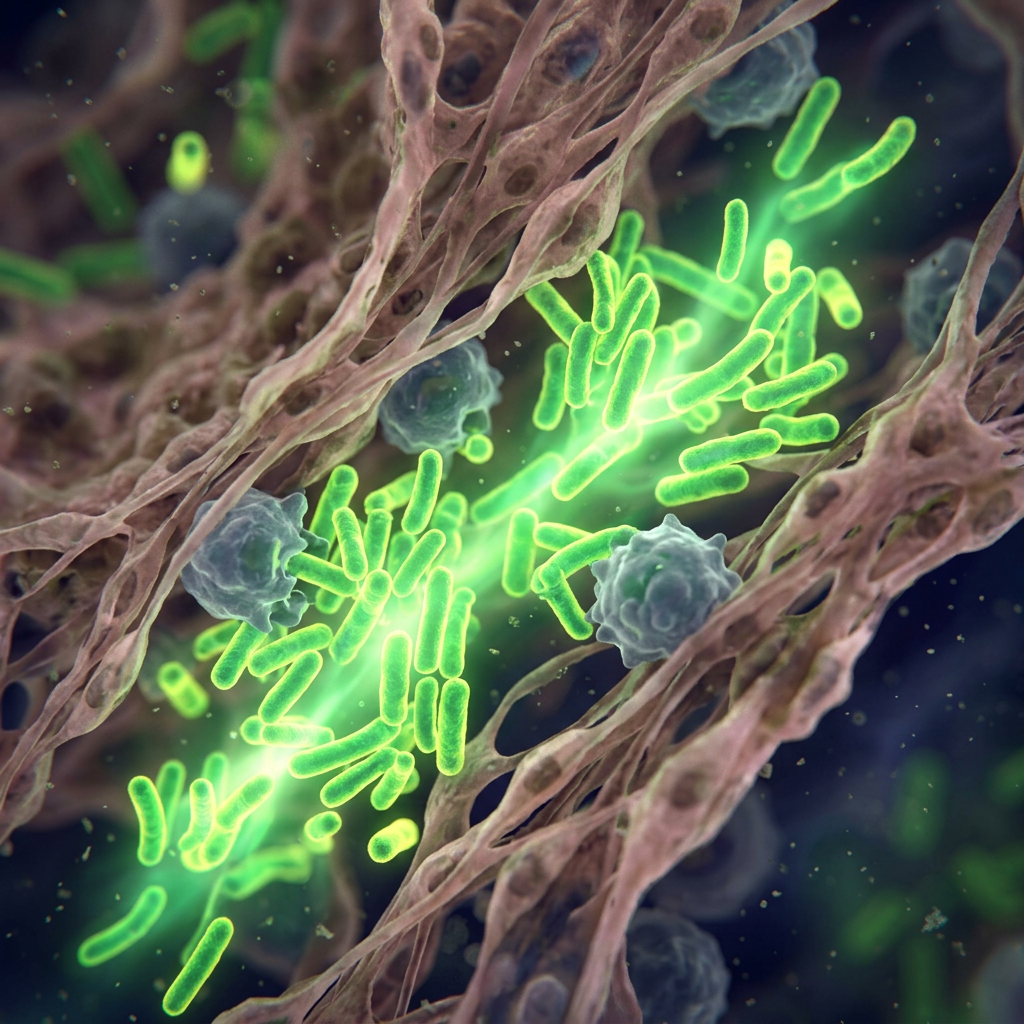
Hypervirulent Bacteria Evolved Inside One Patient: A 63-year-old woman’s sudden vision loss led doctors to a brain abscess and an unusual lesson in bacterial evolution. Samples from her urine and brain all grew Klebsiella pneumoniae, a common bacterium that can cause urinary tract infections, pneumonia, and sometimes dangerous bloodstream spread. But researchers found that some of the bacteria had mutated into a sticky, heavily encapsulated form known as hypervirulent K. pneumoniae. These “gloopy” bacteria resisted immune cells, proved lethal in mice, and spread from the urinary tract to the brain and eye. Genome sequencing suggested the strains diverged one to two years earlier, possibly after a prior UTI. The case reveals “heterovirulence,” where a less dominant bacterial subpopulation becomes more dangerous by evolving new invasive traits. (Ars Technica)
Fatal Gene-Editing Trial Raises Oversight Alarms: A 6-year-old girl in Shanghai died after receiving an experimental brain-directed gene-editing therapy for Snijders Blok-Campeau syndrome, Science and Retraction Watch report. The child, identified by the pseudonym Mei, had a rare CHD3 mutation linked to developmental delays, but her condition was not considered fatal. Doctors infused trillions of AAV viruses carrying a CRISPR base editor into her spinal fluid, hoping to correct the mutation in neurons. Seven days later, she died from thrombotic microangiopathy, an immune-related complication the hospital later deemed “definitely related” to treatment. Experts said researchers downplayed risks, ignored primate safety signals showing liver and kidney damage, and proceeded under China’s looser investigator-initiated trial pathway. The case raises major questions about consent, disclosure, and gene therapy oversight. (Science)

Blood RNA Signature May Flag Alzheimer’s Earlier: Nature Medicine highlights a blood-based circular RNA signature that could help detect Alzheimer’s disease earlier and less invasively than some current diagnostic paths. The briefing says the signature performed as well as, or better than, existing biomarkers and may even predict who will develop symptoms before they appear. That matters because Alzheimer’s diagnosis still often depends on expensive imaging, specialized cerebrospinal fluid tests, or symptoms that emerge after disease biology is already underway. A reliable blood test could make screening, monitoring, and trial enrollment easier, though outside validation and real-world clinical testing remain essential. The story’s promise is practical: earlier detection without pretending that a blood marker alone solves treatment access, prognosis, or patient counseling. (Nature)
Oral JAK1 Drug Advances for Painful Skin Disease: Two phase 3 trials published in Nature Medicine report that povorcitinib, an oral JAK1 inhibitor, significantly reduced abscesses and inflammatory nodules in people with moderate to severe hidradenitis suppurativa. The condition is painful, chronic, stigmatizing, and often undertreated, with lesions that can drain, scar, and disrupt daily life. A pill-based treatment would be meaningful for patients who do not respond well to topical therapies, antibiotics, biologics, or surgical approaches. The findings do not make the drug a cure, and safety monitoring matters because JAK inhibitors can carry immune and cardiovascular concerns. Still, the studies add a serious late-stage option to a field where many patients cycle through inadequate therapies for years. (Nature)
One Workout Cannot Erase a Day of Sitting: Health.com revisits the “sitting is the new smoking” idea with a useful correction: exercise helps enormously, but it does not fully cancel out uninterrupted sedentary time. The article notes that regular workouts improve circulation, insulin sensitivity, blood pressure, inflammation, and muscle mass, and older evidence suggests high activity levels can blunt mortality risks tied to long sitting. But prolonged stillness still slows blood flow and worsens short-term vascular and metabolic function, even in fit people. The practical recommendation is two-layered: keep structured workouts, then add brief movement breaks every 30 to 60 minutes. Walking, standing calls, stairs, squats, or refilling a small water bottle are not glamorous, but they may protect cardiometabolic health better than relying on one heroic gym session. (Health)
Early PFAS Exposure Linked to Children’s Gut Inflammation: The Guardian reports on peer-reviewed research linking prenatal and early-life PFAS exposure to higher intestinal inflammation markers in children. Researchers followed 107 mother-child pairs in the United States and Mexico for up to 11 years, measuring PFAS in maternal blood, cord blood, or newborn dried blood spots, then later checking fecal calprotectin, a marker associated with intestinal inflammation. The study does not prove children developed inflammatory bowel disease, and the sample is relatively small. But it adds a troubling developmental-health angle to “forever chemicals,” already linked to cancer, immune problems, kidney disease, liver harms, and birth defects. The public-health implication is familiar but urgent: exposure reduction requires more than individual shopping choices; it needs stronger chemical policy and environmental controls. (The Guardian)
Healthier Diets Could Reshape Global Farming: A ScienceDaily report on modeling published in Nature argues that a global shift toward healthier diets, more efficient agriculture, and less food waste could sharply change farming by 2050. The analysis estimates farmland use could fall by up to 6% compared with current trends, while livestock production value could drop 42% from 2020 levels. Ruminant production would be hit hardest, with about 400 million fewer cattle, sheep, and goats. Meanwhile, vegetables, fruits, nuts, and legumes could rise 57% in value. The health stakes are just as large: the earlier EAT-Lancet framework estimated healthy-diet transitions could prevent 15 million premature deaths annually. The model is disruptive, especially for farmers, but frames diet as both climate policy and preventive medicine. (ScienceDaily)
Intermittent Fasting Benefits Persisted One Year Later: A 12-week intermittent fasting program produced weight-loss effects that were still visible a year later, according to ScienceDaily’s report on University of Granada research. The study followed 99 adults with overweight or obesity and compared people eating within eight-hour windows with those eating across 12 hours or longer. One year after the intervention ended, both early and late fasting groups maintained more weight loss than the control group. The early schedule, roughly 9 a.m. to 5 p.m., also preserved a larger reduction in fat mass. The study does not mean fasting is automatically superior for everyone, or easy to sustain, but it suggests time-restricted eating may be more than a short-term trick. Eating window timing may matter less than consistency. (ScienceDaily)
Cyclospora Outbreak Exposes Produce Safety Blind Spots: CIDRAP examines the large U.S. Cyclospora outbreak and the confusion surrounding it. Michigan reported 3,309 cyclosporiasis cases and 44 hospitalizations, while northwestern Ohio reported 1,119 cases and 46 hospitalizations. Across the country, 31 states had reported cases, and the CDC listed 1,645 confirmed infections, with more than 5,100 additional reports needing confirmation. The source remained unclear. Cyclospora is hard to investigate because it is not easily grown in laboratories, its incubation period can run one to two weeks, and cases may be linked only through partial genotyping. Experts warned that broad advice to avoid fresh produce could do more harm than good. The most useful guidance is targeted: seek care for persistent or severe diarrhea and participate in public-health interviews. (CIDRAP)
Anthrax Exposure Report Tests Emergency Prevention Playbook: CIDRAP reports on a Public Health Alerts case study involving 13 people exposed to anthrax in Wyoming after a cattle outbreak in 2024. Three had cutaneous exposure only, seven had inhalation exposure only, and three had both. Officials recommended postexposure prophylaxis for 11 people who were still within the relevant incubation windows: 17 days for cutaneous anthrax and 60 days for inhalation anthrax. All 11 received preventive doxycycline, while some with inhalation risk were offered a two-dose vaccine regimen. Four people declined vaccination, underscoring a recurring challenge in emergency response: tools exist, but uptake is not automatic. The report is useful because anthrax is rare, high-consequence, and operationally tricky, especially when exposure type determines prevention strategy. (CIDRAP)
CDC Nutrition Report Shows New Gaps and Excesses: Food & Wine summarizes the CDC’s 2026 National Report on Biochemical Indicators of Diet and Nutrition, which tracks blood and urine biomarkers through NHANES. The report covers 131 indicators, more than double the 58 included in the 2012 version. Vitamin D levels rose roughly 20% from the early 2000s, but excess vitamin D also increased, especially among supplement users. Folate and iodine levels fell 10% to 30%, raising concern for women of reproductive age because folate helps prevent neural tube defects and iodine supports thyroid-driven growth and development. The report also measured omega-3 status for the first time and found about 98% of Americans below the optimal range. The takeaway is not “supplements good” or “supplements bad,” but nutrition is uneven. (Food & Wine)
Lilly’s Next Obesity Drug Posts Big Phase 3 Losses: Reuters reports that Eli Lilly’s experimental obesity drug retatrutide produced strong late-stage weight-loss data and could be submitted to the FDA in early 2027. Retatrutide targets three metabolic hormone pathways: GLP-1, GIP, and glucagon. In one 80-week trial of adults with severe obesity and established heart disease, the highest dose produced average weight loss of 22.6%. In another trial involving overweight or obese patients with type 2 diabetes, the highest dose produced 20.8% weight loss and lowered A1C by 1.6%. Common side effects included nausea and diarrhea. One caution: severe cardiovascular events were 12% higher in the retatrutide group, though analysts said the event dataset was too limited to interpret clearly. Full peer-reviewed results are still pending. (Reuters)




Leave a Reply