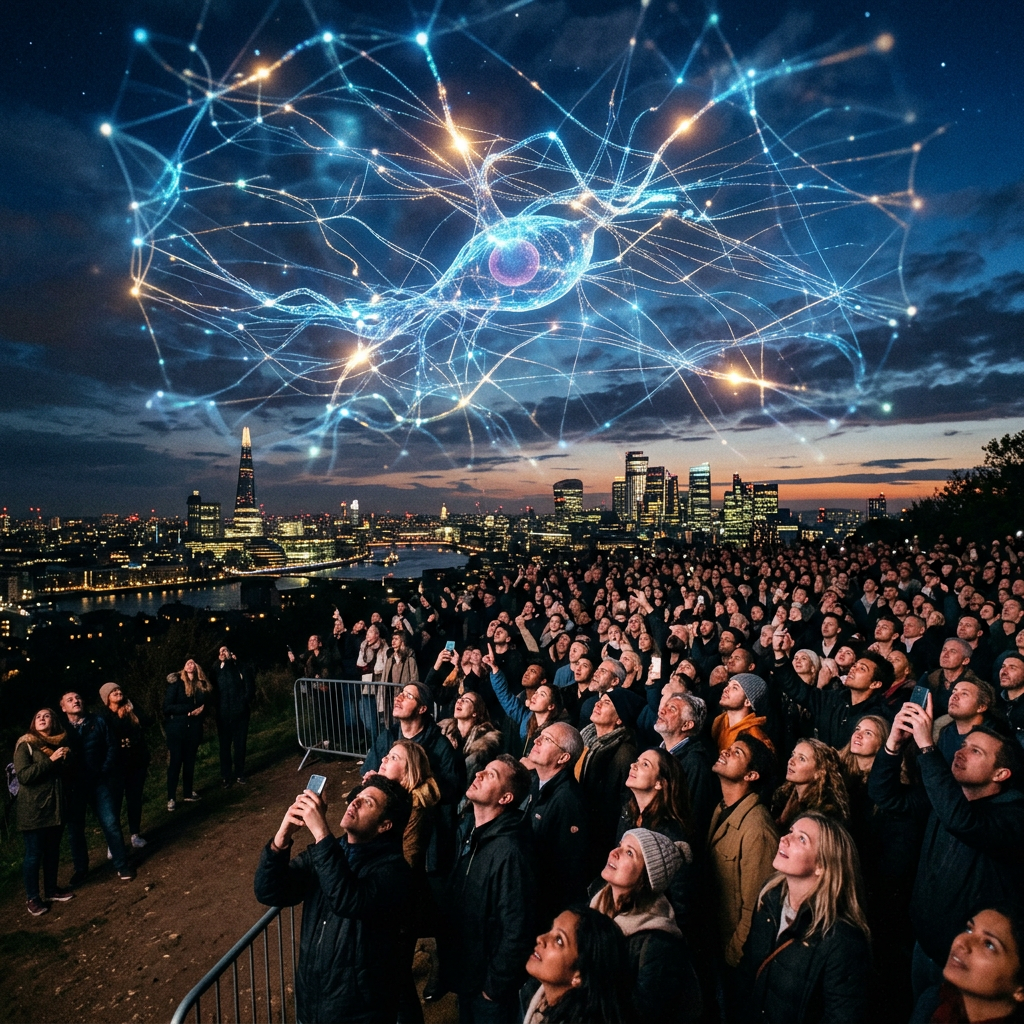
Most Americans, even those who most appreciate AI, strongly support more regulation of it, a new survey by Johns Hopkins University researchers finds.
More than 70% of Americans want the right to interact with a human rather than an AI in medical, legal, educational and government settings. This proposed regulation and others were endorsed across party lines and by both regular users of AI and novices.
“What was surprising to us in this new poll was that daily users of AI, and people who view AI positively, also want regulation,” said Christopher Honey, a computational cognitive neuroscientist at Johns Hopkins and a member of the university’s Data Science and AI Institute.
In April and May, more than 2,000 people in the United States were asked their views on artificial intelligence. Questions explored how people generally felt about the technology, how much they trusted it in personal and workplace settings, and about their support for new laws being considered across the country.

Americans’ overall feelings about AI are split: about one third positive, one third negative, and one third mixed. These overall attitudes varied greatly with how often people use AI: 80% of skilled daily users feel positively about AI versus 24% of people who have only tried it a few times.
Younger people were more positive about AI: 41% of adults ages 18 to 29 had a positive overall view, compared with 18% of adults 60 and older. At the same time, younger people felt more pressure to use AI at work: nearly 50% of working adults ages 18 to 29 reported feeling pressure to use AI, compared with about 20% of adults ages 60 and older.
Republicans and Democrats felt similarly about the technology.
Most Americans strongly support “right to a human” laws which would allow them to opt out of AI interactions. People want to deal with people when it comes to medical care (79%), legal proceedings (76%), and education (74%).
Americans strongly support more rules to protect their privacy and to make AI more transparent:
- 75% want to be told when they’re interacting with AI
- 73% want to ban AI from using individuals’ faces and voices
- 68% want labels on AI-generated images and video
Americans trust AI for certain tasks more than others:
- Look up factual information: 67% trust AI somewhat or a great deal
- File taxes: 42% trust it somewhat or a great deal
- Create art or music: 57% trust it somewhat or a great deal
- Be a coworker: 32% trust it somewhat or a great deal
- Manage retirement: 33% trust it somewhat or a great deal
- Provide medical advice: 63% don’t trust it much or at all
- Teach high school: 69% don’t trust it much or at all
- Decide a court case: 81% don’t trust it much or at all
- Drive a car: 76% don’t trust it much or at all
About six in ten U.S. adults expect AI to widen inequality over the next decade. There was broad support for a “digital dividend,” which is a small monthly payment to every American adult that is funded by a tax on large tech companies: this was endorsed by Republicans (52%), Democrats (60%) and political independents (52%).
As AI advances, about four in 10 Americans expect the large technology companies to reap the biggest gains in power. Fewer than 1 in 10 expect individuals to gain the most power. And nearly 1 in 5 Americans think that it will be the AI systems themselves.
“We were interested to hear the national voice as the public tries to understand these problems. What are people thinking and feeling?” said Rolando Masís-Obando, a computational neuroscientist who uses AI to study how people think and remember. “We are taking the pulse of the nation with this poll and we want to run this every year to see how opinions change over time.”




Leave a Reply