Mild cognitive impairment (MCI) can be an early indicator of Alzheimer’s disease or dementia, so identifying those with cognitive issues early could lead to interventions and better outcomes. But diagnosing MCI can be a long and difficult process, especially in rural areas where access to licensed neuropsychologists is limited.
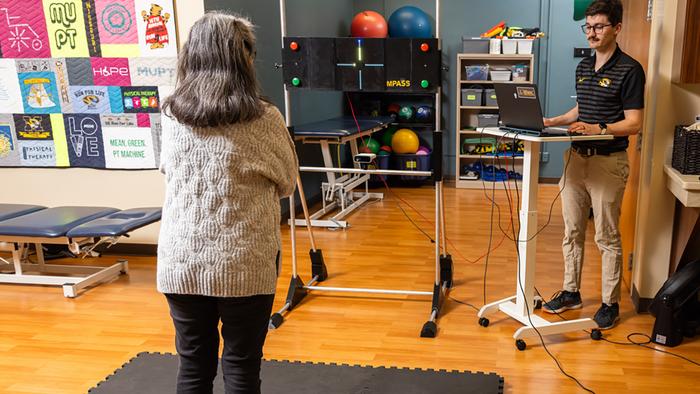
To increase accessibility to cognitive assessments, a team of researchers at the University of Missouri created a portable system to efficiently measure multiple aspects of motor function. The device is simple and affordable, combining a depth camera, a force plate and an interface board.
The interdisciplinary team of Mizzou researchers includes Trent Guess, an associate professor in the College of Health Sciences, Jamie Hall, an associate teaching professor in the College of Health Sciences, and Praveen Rao, an associate professor in the College of Engineering. In a recent study, the team examined older adults, some of whom had MCI, and asked them to complete three activities: standing still, walking and standing up from a bench. The catch? Participants had to complete these activities while counting backwards in intervals of seven at the same time.
Based off their performance, which was captured by the new portable system, the data was fed into a machine learning model — a type of artificial intelligence — that accurately identified 83% of those in the study with MCI.
“The areas of the brain involved in cognitive impairment overlap with areas of the brain involved in motor function, so when one is diminished, the other is impacted as well,” said Guess. “These can be very subtle differences in motor function related to balance and walking that our new device is able to detect but would go unnoticed through observation.”
With the number of Americans with Alzheimer’s disease expected to more than double by 2060 according to the Centers for Disease Control and Prevention, the portable device has the potential to help millions of older adults given that MCI is one of the precursors to Alzheimer’s and dementia.
Sign up for the Daily Dose Newsletter and get every morning’s best science news from around the web delivered straight to your inbox? It’s easy like Sunday morning.
“Alzheimer’s disease is a significant problem here in the U.S. We know that if we can identify people early, we can provide early intervention to halt or slow the progression of the disease,” Hall said. “Only about 8% of people in the U.S. who are believed to have MCI receive a clinical diagnosis.”
Hall added the team’s long-term goal is get the new portable system into various settings such as county health departments, assisted living facilities, community centers, physical therapy clinics and senior centers to allow for more screenings.
“There are new drugs coming out to treat those with MCI, but you need a diagnosis of MCI to qualify for the medications,” Hall said. “Our portable system can detect if a person walks slower or doesn’t take as big of a step because they are thinking very hard. Some people have more sway and are less balanced or are slower to stand up when they are sitting. Our technology can measure these subtle differences in a way that you could not with a stopwatch.”
Guess will continue the research with additional participants and also look at the portable system’s ability to detect fall risk and frailty among older adults.
“This portable system has many other applications, too, including looking at those with concussions, sports rehabilitation, ALS and Parkinson’s disease, knee replacements and hip replacements,” Guess said. “Moving is an important part of who we are. It’s rewarding to see that this portable system can be beneficial in a lot of different ways.”
And those participating in the study are invested in the research, Hall added.
“Many of those who came in to be tested either have been diagnosed with MCI or have a family member who has Alzheimer’s disease, so they feel strongly about helping us move this forward,” Hall said. “It really amplifies why this is so important to me.”
“Feasibility of using a novel, multimodal motor function assessment platform with machine learning to identify individuals with mild cognitive impairment” was published in Alzheimer’s Disease and Associated Disorders. Funding was provided by the University of Missouri Coulter Biomedical Accelerator, which provides internal funding for engineers and clinicians at the university interested in working together to develop devices that improve society.
IMAGE CREDIT: University of Missouri




Leave a Reply