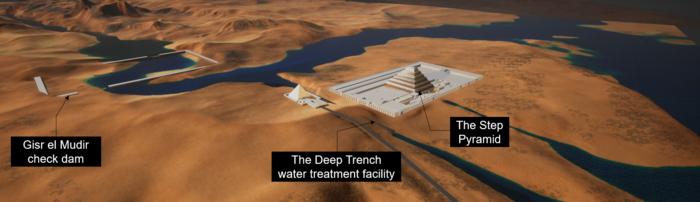
The Pyramid of Djoser, the oldest of Egypt’s iconic pyramids, may have been built with the help of a unique hydraulic lift system, according to a study published August 5, 2024, in the open-access journal PLOS ONE by Xavier Landreau from CEA Paleotechnic Institute, France, and colleagues. The new study suggests that water may have been able to flow into two shafts located inside the pyramid itself, where that water could have been used to help raise and lower a float used to carry the building stones.
The Pyramid of Djoser, also known as the Step Pyramid, is believed to have been built around 2680 BCE as a funerary complex for the Third Dynasty pharaoh Djoser. Yet the exact method of its construction remains unclear. In this new interdisciplinary analysis, researchers suggest that the nearby Gisr el-Mudir enclosure — a previously unexplained structure — may have functioned as a “check dam” to capture water and sediment. In addition, a series of compartments dug into the ground outside of the pyramid may have served as a water treatment facility, allowing sediment to settle as water passed through each subsequent compartment. Water may then have been able to flow into the pyramid shafts themselves, where the force of its rise could help carry the building stones.

Further research is still needed to understand how water might have flowed through the shafts, as well as how much water was available on the landscape at that point in Earth’s history. But the authors of this new study suggest that even as other building methods like ramps were probably also used to help build the pyramid, a hydraulic lift system could have been used to support the building process when there was enough water.
The authors add: “A collaborative effort between the newly established research institute, Paleotechnic, and several national laboratories (INRAE, University of Orléans) has led to the discovery of a dam, a water treatment facility, and a hydraulic elevator, which would have enabled the construction of the Step Pyramid of Saqqara. This work opens a new research line for the scientific community: the use of hydraulic power to build the pyramids of Egypt.”
IMAGE CREDIT: Paleotechnic of Paris, France

Leave a Reply