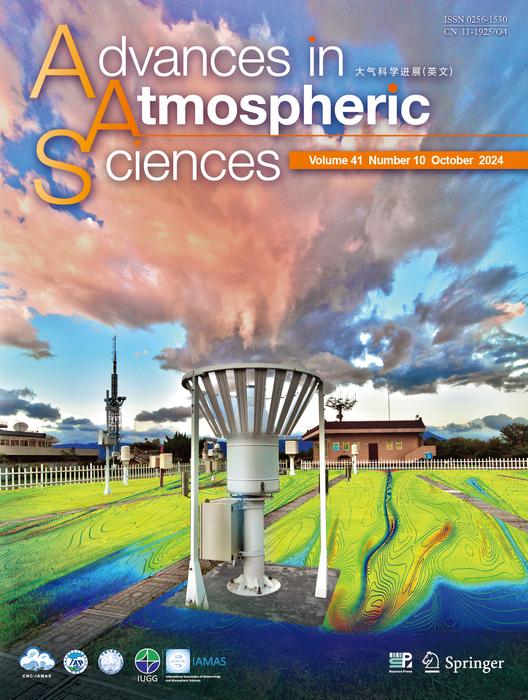
Turbulence is an area of fluid dynamics that has been known about and researched for over a century. Most of us are broadly aware of it as a concept from our travels in the air, wherein it can at best be an inconvenience but at worst a frightening and dangerous experience. Indeed, this was starkly demonstrated recently when, in May 2024, a Singapore Airlines flight from London to Singapore encountered severe turbulence that was fatal for one passenger and left many others injured.
Perhaps less familiar to people is the specific phenomenon of penetrative turbulence, or penetrative convection, which is the subject of a recent review article written by Professor Zijing Ding and his team from the School of Energy Science and Engineering at the Harbin Institute of Technology in China, published in the journal Advances in Atmospheric Sciences.
Penetrative turbulence occurs when a fluid that has been heated in an unstable manner penetrates another layer of fluid that has been stratified stably. It is a phenomenon often observed in large-scale natural and engineering environments, and is especially important in the earth and planetary sciences, as highlighted.

For example, penetrative turbulence is thought to play an important role in the mass–momentum transport in the tachocline (the transition region of stars between the radiative interior and the differentially rotating outer convective zone); and, here on Earth, it is also important for underwater oceanic life in winter. It influences the distribution of phytoplankton and other marine organisms, and can thus serve as an indicator of ecosystem health and contribute to the carbon cycle within these water bodies.
In our atmosphere, penetrative turbulence is central to the motions of key circulation systems, and thus its successful incorporation into prediction models ultimately impinges on our ability to forecast the weather. Of course, this takes on added importance in the current context of climate change and the effects it is having in the form of extreme weather events, such as droughts and floods.
“Our paper examines past theoretical, numerical, and experimental studies on penetrative turbulence, along with field studies that have provided insights into turbulence modeling”, explains Professor Ding.
Sign up for the Daily Dose Newsletter and get every morning’s best science news from around the web delivered straight to your inbox? It’s easy like Sunday morning.
“We look at the physical factors that initiate penetrative convection, state-of-the-art methods being applied to better understand its transport mechanisms and statistical properties, and discuss some perspectives emerging from the knowledge we have gained in terms of implications and practical applications in various scientific fields”.
A central theme of the review is the derivation of scaling laws embedded within large-scale penetrative turbulence. The ability to do so has, for example, enhanced our comprehension of heat distribution dynamics in the oceans, which, when integrated with other dynamic oceanographic factors such as wind-driven currents and thermohaline circulation, can help elucidate the influences of oceanic processes and glacial melt on Earth’s climate.
In addition, the exploration of penetrative convection extends beyond natural systems to technical applications in engineering, such as the design of heat exchangers and the optimization of geothermal energy systems.
“However, practical applications often expose the limitations of our theoretical models”, adds Professor Ding, “and this is perhaps most notably the case in the atmospheric sciences”.
The frequency of extreme weather events is on the rise due to global warming, and scientists have been aware of penetrative convection as a contributing factor to this trend. By integrating more precise representations of penetrative convection into climate models, it should become possible to generate more reliable predictions of long-term climate patterns.
“Ultimately, in the atmospheric sciences, our goal is clear”, concludes Professor Ding. “We need a more realistic model of atmospheric convection to facilitate better predictions of both weather and climate. This requires us to successfully incorporate such influences as boundary conditions, Earth’s rotation, and solar radiation, to name but a few”.
Advancements in our understanding of penetrative turbulence are central to these aims, and this timely review by Professor Ding and his colleagues provides a valuable point of reference for scientists to continue their studies in this important field.
IMAGE CREDIT: Advances in Atmospheric Sciences
If you enjoy the content we create and would like to support us, please consider becoming a patron on Patreon! By joining our community, you’ll gain access to exclusive perks such as early access to our latest content, behind-the-scenes updates, and the ability to submit questions and suggest topics for us to cover. Your support will enable us to continue creating high-quality content and reach a wider audience.
Join us on Patreon today and let’s work together to create more amazing content! https://www.patreon.com/ScientificInquirer




Leave a Reply