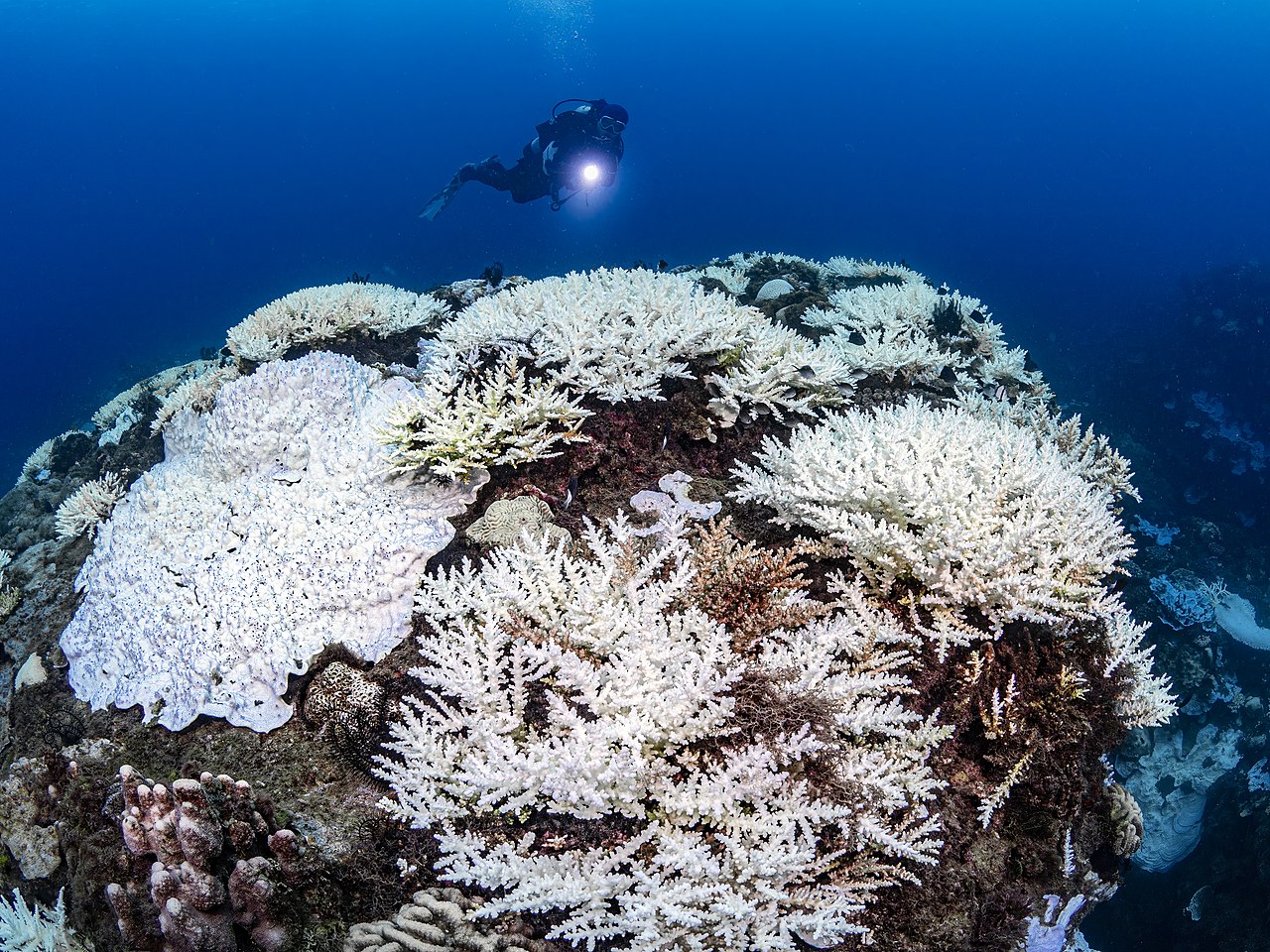
NOAA REPORTS FOURTH GLOBAL CORAL BLEACHING CRISIS BEGINS.
The National Oceanic and Atmospheric Administration’s (NOAA) Coral Reef Watch has announced the onset of the fourth global coral bleaching event, signaling a dire phase for the world’s corals and the communities dependent on them. Triggered by a consecutive ten-month streak of record-breaking global air temperatures in 2024, ocean temperatures have soared, causing corals to expel essential algae and turn white—a process known as bleaching. This phenomenon increases corals’ susceptibility to starvation, disease, and death, although it can be reversible if temperatures stabilize. Currently, over 54% of global coral reefs have undergone heat-induced bleaching since February 2023, with the rate increasing weekly. This event may become the largest of its kind, surpassing previous mass bleachings in 1998, 2010, and 2014-2017. Notably affected are regions like the Great Barrier Reef and diverse coastal areas worldwide. Experts, like David Obura of CORDIO East Africa, warn that we may have crossed a critical threshold for coral survival, emphasizing the urgent need to curb carbon emissions to prevent further devastating losses. Coral reefs, vital to a $2.7 trillion global economy through tourism, fisheries, and coastal protection, face a stark decline, potentially impacting millions globally. (Smithsonian)
UK DRUG SHORTAGES WORSEN POST-BREXIT, REPORT REVEALS
The UK is facing escalating drug shortages, now exacerbated by Brexit, according to a Nuffield Trust report. The frequency of drug supply warnings surged from 648 in 2020 to 1,634 in the previous year, indicating a shift from rare to routine medicine shortages. These shortages are impacting essential drugs for conditions like ADHD, type 2 diabetes, and epilepsy, with certain ADHD medications still scarce despite predictions of normalization by the end of 2023. The scarcity is so severe that it threatens the health and lives of patients, leading to an increase in calls to health charities from those struggling to obtain their medications. Factors such as global manufacturing issues and Brexit-related disruptions, including new customs requirements and the UK’s exit from the EU’s European Medicines Agency, have intensified these shortages. Additionally, the Department of Health and Social Care has had to pay significantly more to secure scarce drugs, spending £220 million in 2022-23 on price concessions. The report highlights that Brexit has not only heightened existing global supply chain issues but has also positioned the UK unfavorably in the global market for essential drugs. (The Guardian)
If you’re enjoying the Daily Dose, sign up for the Daily Dose Newsletter and get the morning’s best science news from around the web delivered straight to your inbox? It’s easy like Sunday morning.
CLIMATE CHANGE IMPACTS QUEBEC MAPLE SYRUP PRODUCTION
Jean-Francois Touchette, a maple syrup producer in rural Quebec, operates a small-scale syrup facility amidst an industry grappling with climate change challenges. Quebec, a major global maple syrup producer, experienced a significant drop in production in 2023, with output falling 41.4% due to erratic temperatures and shorter winters affecting sap collection. Producers like Touchette must now start tapping trees earlier, adjusting to a shifting season that could potentially alter the duration of syrup production and affect the quality and quantity of sap. Technological advancements have helped increase efficiency, but the traditional freeze-thaw cycle crucial for sap flow remains dependent on increasingly unpredictable weather patterns. Quebec’s industry also features a unique Strategic Reserve, which has seen its stockpile hit a 15-year low due to high global demand and reduced production. Despite these challenges, producers remain hopeful for better yields in upcoming seasons, relying on the reserve to stabilize supply. (Al-Jazeera)
CANADA’S 2024 FEDERAL BUDGET BOOSTS RESEARCH FUNDING SIGNIFICANTLY.
Canada’s 2024 federal budget has significantly increased support for researchers, with a notable rise in postgraduate pay and additional funding for scientific infrastructure and research. Finance Minister Chrystia Freeland announced an investment exceeding $5 billion, aimed at attracting transformative talent to Canada. The budget boosts stipends for master’s and PhD students, and significantly raises postdoctoral salaries. It also increases the number of scholarships and fellowships, expanding by about 1,720 annually after five years. These enhancements are intended to retain domestic talent and position Canada competitively on the global stage. Additionally, the budget allocates funds for basic research, including $1.8 billion for federal research councils and $400 million for the TRIUMF particle accelerator. Furthermore, it introduces organizational reforms in science funding, consolidating scholarship and fellowship programs and creating a new research-funding body and advisory council to streamline and enhance the impact of research investments. However, concerns remain about the sustainability of funding due to political uncertainties, with much of the budget’s research funding scheduled for later years. (Nature)

UAE METEOROLOGISTS: CLOUD SEEDING DIDN’T CAUSE RECENT DELUGE
In response to the heavy rainfall that recently inundated the United Arab Emirates, meteorologists have clarified that cloud seeding did not cause the deluge. Cloud seeding, a method first developed in the 1940s, involves dispersing particles into clouds to encourage precipitation. Although used in various regions to increase water supply marginally, it is ineffective at generating significant weather changes like those witnessed in the UAE. Meteorologist Ryan Maue and other experts assert that such extreme weather events are more likely linked to climate change, which can intensify storm activity due to a warmer atmosphere holding more moisture. The recent UAE storm, forecasted days in advance, was part of a series of low-pressure systems influenced by natural atmospheric patterns. Despite some regional reliance on cloud seeding, its overall impact on major weather events remains minimal, with larger atmospheric dynamics playing a far more significant role. (Associated Press)
INDIA ELECTIONS USE AI FOR VOTER OUTREACH, RAISE CONCERNS.
India’s election campaigns are increasingly utilizing artificial intelligence (AI) to reach voters, showcasing a trend where digital technology is used for hyperpersonalized political communication. An AI-generated version of Prime Minister Narendra Modi demonstrates the potential of AI in elections, with personalized messages being sent to voters through WhatsApp. These messages, which can be generated in any of India’s numerous languages, address voters by name and discuss specific government programs. The technology allows for rapid and cost-effective voter outreach, with AI avatars and chatbots delivering tailored messages. However, this rise of AI in politics is also raising concerns about the potential for misinformation and the challenge of distinguishing between real and synthetic communications. As AI becomes a common tool in political campaigns, there are calls for regulations to prevent misuse, including adding disclaimers to AI-generated content to avoid misleading the public. (New York Times)
SOUTHEAST ASIA BATTLES SURGE IN ILLEGAL EUROPEAN WASTE SHIPMENTS.
Southeast Asian nations like Malaysia, Vietnam, Thailand, and Indonesia are grappling with increasing illegal waste shipments from Europe, a new UN report reveals. Criminal networks exploit loopholes and legitimate business operations, making waste trafficking a major environmental crime. Despite regulations, weak law enforcement and minimal penalties encourage this lucrative illegal trade. It is estimated that 15-30% of EU waste shipments are illicit, generating substantial illicit profits annually. The issue has escalated following China’s 2018 ban on waste imports, redirecting waste flows to Southeast Asia, where countries like Indonesia have become hotspots for both legal and illegal waste imports. This influx has led to severe environmental and health issues, as improper disposal methods like burning release toxic chemicals, affecting local populations. Efforts are underway to harmonize international laws and strengthen penalties to combat this issue, with the EU working to tighten waste shipment regulations and technological solutions like drones being suggested to monitor illegal waste activities. (DW)
MAGNITUDE 6.6 EARTHQUAKE HITS WESTERN JAPAN, INJURES NINE
A magnitude 6.6 earthquake struck western Japan late on Wednesday, affecting areas on Shikoku Island and the Kyushu region. The earthquake, which occurred at 11:14 p.m., registered a lower 6 on Japan’s seismic intensity scale of 7 in Ainan, Ehime Prefecture, and Sukumo, Kochi Prefecture. It resulted in injuries to nine people—six in Ehime, one in Kochi, and two in Oita Prefecture. Following the quake, Shikoku Railway suspended some services, and the Ikata nuclear complex in Ehime reported a minor valve defect that slightly reduced power output. In Sukumo, 23 people evacuated temporarily and water supplies were disrupted due to burst pipes. Fallen trees temporarily isolated ten residents in Yusuhara, Kochi Prefecture. The earthquake’s focus was in the Bungo Channel, an area at risk for a potentially devastating future quake, but officials noted that this event did not increase the likelihood of a future massive temblor. (Japan Today)
TWO STARTUPS WIN S$1M EACH FOR SUSTAINABLE INNOVATIONS IN AVIATION, FOOD
Two innovative startups have been awarded S$1 million (US$730,000) each for their sustainable solutions in aviation fuel and food production, as part of The Liveability Challenge 2024, hosted by Temasek Foundation and organized by Eco-Business. The Netherlands-based GAFT won the climate grand prize for developing sustainable aviation fuel from fat and sugar, aiming to reduce aviation’s greenhouse gas emissions. They plan to produce this synthetic alternative to used cooking oil in Singapore, aligning with the country’s mandate for flights to adopt sustainable fuel by 2026. Vietnamese startup Cricket One received the top award in the food and nutrition category for creating a meat alternative from crickets, which offers a sustainable and cost-effective protein source. Their product, cricket chips, is already available in 27 countries, with plans to expand in Vietnam and Singapore, pending regulatory approval for insect consumption. Both startups exemplify innovative approaches to pressing environmental challenges. (Channel News Asia)
HYBRIDIZATION IN AMAZON BUTTERFLIES BIRTHS NEW SPECIES, STUDY SHOWS
A study published in Nature reveals a rare case where hybridization between two butterfly species has led to the emergence of a new, genetically distinct species, Heliconius elevatus, in the Amazon. This finding challenges the traditional view that hybridization generally results in infertile offspring or species merging. Instead, H. elevatus has thrived as a separate lineage due to an ancient crossbreeding between its ancestor Heliconius pardalinus and Heliconius melpomene, dating back about 180,000 years. Researchers found that while H. elevatus shares most of its genome with H. pardalinus, crucial traits inherited from H. melpomene, like wing patterns and sex pheromones, play a significant role in maintaining its genetic uniqueness. These traits influence mating preferences and survival tactics, helping H. elevatus remain distinct and preventing it from merging back with its parent species. This discovery underlines the potential for hybridization to contribute positively to biodiversity, offering insights into evolutionary processes and the impact of species interactions on biodiversity. (Science)
Thanks for reading. Let’s be careful out there.
WORDS: The Biology Guy.



Leave a Reply