
Like humans struggling to get through the COVID-19 pandemic, bacterial cells need social distancing to thwart viruses. But in some situations, such as inside elevators or within the candy-colored bacterial structures known as “pink berries,” staying apart just isn’t feasible.
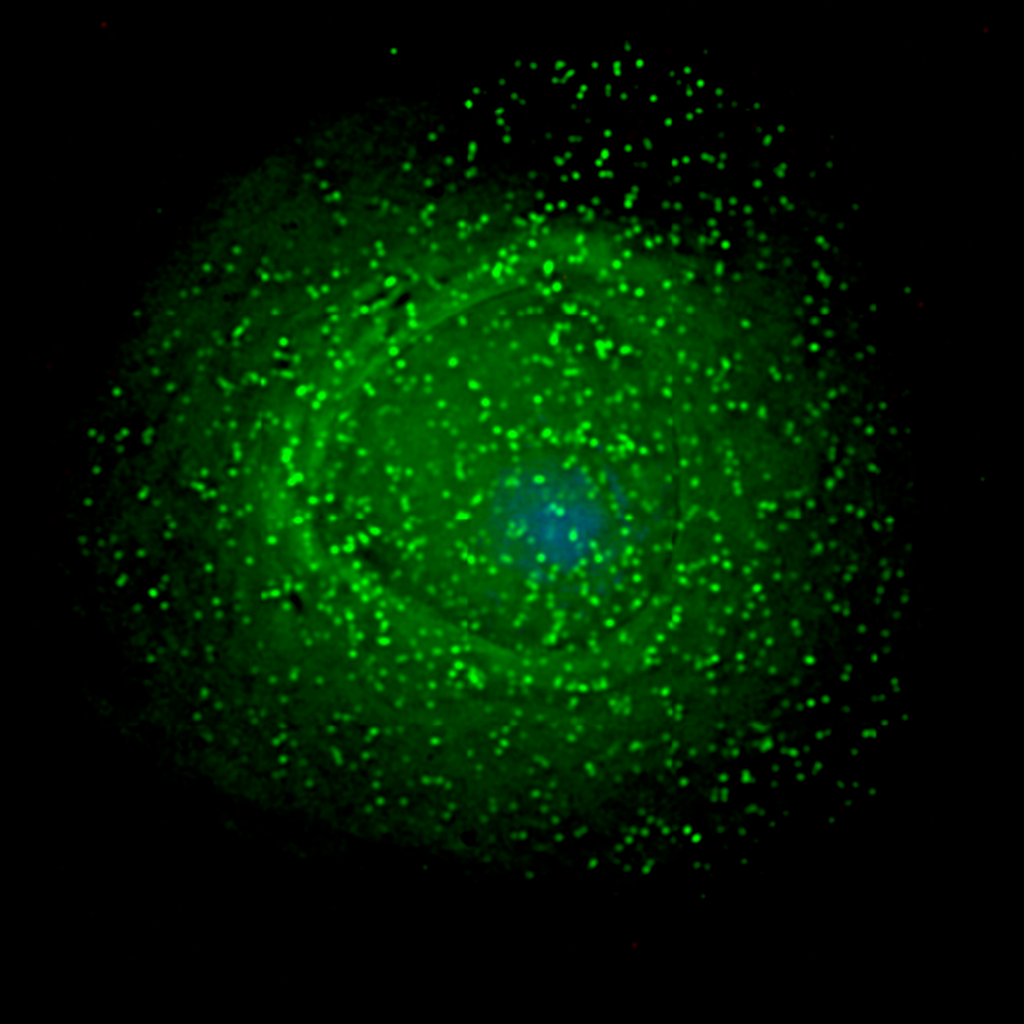
Looking like spilled Nerds or Pop Rocks, the communal, multicellular pink berries litter the submerged surface of salt marshes in and around Woods Hole. New research conducted at the Marine Biological Laboratory (MBL) uncovers evidence that a genetic mechanism may help the berry-building bacteria — and others like them — protect against disease. The study, published this week in Proceedings of the National Academy of Sciences, also has implications for understanding the evolution of single-celled organisms, like bacteria, into complex multicellular ones, including humans.
“It tells us about the challenges we faced back when we were little balls of cells,” says Lizzy Wilbanks, an MBL Whitman Fellow and a microbiologist at the University of California, Santa Barbara. “If you’re forming multicellular structures, you’ve got to evolve some pretty fancy immune defenses in order to stay alive.”

Wilbanks first encountered the pink berries as a graduate student enrolled in MBL’s Microbial Diversity course. These spherical aggregates are among the structures bacteria form when genetically similar individuals stick close together and coordinate their activity. The pink berries are populated by a species of bacteria called Thiohalocapsa PSB1, which feeds itself using sulfur and light, plus a relatively small number of other symbiotic bacteria. By working together, these cells create pockets free of oxygen, which could poison them, and acquire the weight necessary to settle safely into their ideal habitat.
Like all organisms, these cooperative microbes risk contracting viruses from their environment. Pink berries and other multicellular bacteria have a heightened need for protection, since — like us — they are composed of genetically similar cells packed tightly together, with no social distancing possible.
“It’s a perfect cocktail for an epidemic to blow through and wipe out everything,” Wilbanks says.
Through her collaborator Blair Paul, assistant scientist at MBL, Wilbanks learned about an unusual genetic mechanism that they found to be abundant within Thiohalocapsa. Known as diversity-generating retroelements (DGRs), this system contains sections of DNA that are transcribed into RNA and back into DNA through an error-prone process, then inserted into a target gene for mutation.
In this way, DGRs introduce lots of new genetic variation, the raw material for adaptation, into specific spots within the genomes. Scientists have found these systems in viruses, bacteria, and other microbes called archaea, yet they don’t fully understand how the microbes use them.
Wilbanks and Hugo Doré, then a postdoctoral scientist in her lab and the study’s first author, began discussing what DGRs might accomplish for Thiohalocapsa. Through their research, they learned the DGRs’ target genes include components related to those found in the immune systems of multicellular organisms, including humans, plants and even some fungi. The similarity to pieces of other organisms’ immune systems prompted the researchers to suspect the DGRs might diversify the sensor proteins Thiohalocapsa uses to defend against pathogens, analogous to the antibodies in our own immune systems.
All living organisms need to detect threats they have never encountered before. Humans and other vertebrates solve this problem by shuffling and mutating genes for their sensor proteins (antibodies) to generate a diverse army of sentinels. Though recent research has shown many components of our innate immune systems evolved from bacterial ancestors, scientists have never before seen in bacteria anything like our hyper-diverse antibodies.
A widespread immunological connection
The team first looked broadly at DGRs found in bacteria and archaea, focusing on the gene responsible for turning RNA back into DNA. This method divides the DGRs from bacteria and archaea into two groups. Within the group to which Thiohalocapsa belongs, they found that 82 percent of DGRs belong to microbes that form many-celled, cooperative structures, akin to the pink berries. Even though they belonged to distantly related microbes, the DGRs’ alterations tend to affect the same kind of immune system genes as they do in Thiohalocapsa.
Examining hundreds of individual pink berries, they found that DGRs had been actively diversifying 14 of the 15 total target genes in Thiohalocapsa. The amount of the variation found for these genes changed, however, depending on the site from which the pink berries had been collected. The viruses in pools in the same marsh may vary — perhaps driving the differences the team saw.
“The next frontier is showing what Thiohalocapsa is actually doing with its DGRs in the environment,” Wilbanks says.
In addition to offering a peek at the evolution of life, this research has practical implications. Wastewater treatment plants use multicellular bacteria to remove nutrients that can harm local ecosystems, and federal and industrial researchers are exploring a host of other applications for engineered clumps of microbes. These microbial structures face the same challenge — viral epidemics — as the pink berries. When engineering these microbial systems, Wilbanks says, it makes sense to mimic the DGR-based immunity of wild communal bacteria.
IMAGE CREDIT: Lizzy Wilbanks
Sign up for the Daily Dose Newsletter and get the morning’s best science news from around the web delivered straight to your inbox? It’s easy like Sunday morning.

Leave a Reply