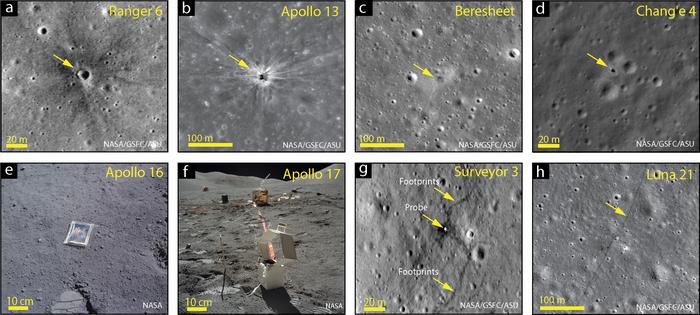
Human beings first disturbed moon dust on Sept. 13, 1959, when the USSR’s unmanned spacecraft Luna 2 alighted on the lunar surface. In the following decades, more than a hundred other spacecraft have touched the moon — both crewed and uncrewed, sometimes landing and sometimes crashing. The most famous of these were NASA’s Apollo Lunar Modules, which transported humans to the moon’s surface to the astonishment of humankind.
In the coming years, missions and projects already planned will change the face of the moon in more extreme ways. Now, according to anthropologists and geologists at the University of Kansas, it’s time to acknowledge humans have become the dominant force shaping the moon’s environment by declaring a new geological epoch for the moon: the Lunar Anthropocene.
In a comment published today in Nature Geoscience, they argue the new epoch may have dawned in 1959, thanks to Luna 2.

“The idea is much the same as the discussion of the Anthropocene on Earth — the exploration of how much humans have impacted our planet,” said lead author Justin Holcomb, a postdoctoral researcher with the Kansas Geological Survey at KU. “The consensus is on Earth the Anthropocene began at some point in the past, whether hundreds of thousands of years ago or in the 1950s. Similarly, on the moon, we argue the Lunar Anthropocene already has commenced, but we want to prevent massive damage or a delay of its recognition until we can measure a significant lunar halo caused by human activities, which would be too late.”
Holcomb collaborated on the paper with co-authors Rolfe Mandel, University Distinguished Professor of Anthropology, and Karl Wegmann, associate professor of marine, earth and atmospheric sciences at North Carolina State University.
Holcomb said he hopes the Lunar Anthropocene concept might help dispel the myth that the moon is an unchanging environment, barely impacted by humanity.
“Cultural processes are starting to outstrip the natural background of geological processes on the moon,” Holcomb said. “These processes involve moving sediments, which we refer to as ‘regolith,’ on the moon. Typically, these processes include meteoroid impacts and mass movement events, among others. However, when we consider the impact of rovers, landers and human movement, they significantly disturb the regolith. In the context of the new space race, the lunar landscape will be entirely different in 50 years. Multiple countries will be present, leading to numerous challenges. Our goal is to dispel the lunar-static myth and emphasize the importance of our impact, not only in the past but ongoing and in the future. We aim to initiate discussions about our impact on the lunar surface before it’s too late.”
While many outdoors enthusiasts are familiar with “Leave No Trace” principles, they don’t seem to exist on the moon. According to the authors, refuse from human missions to the moon includes “discarded and abandoned spacecraft components, bags of human excreta, scientific equipment, and other objects (e.g., flags, golf balls, photographs, religious texts).”
“We know that while the Moon does not have an atmosphere or magnetosphere, it does have a delicate exosphere composed of dust and gas, as well as ice inside permanently shadowed areas, and both are susceptible to exhaust gas propagation,” the authors wrote. “Future missions must consider mitigating deleterious effects on lunar environments.”
While Holcomb and his colleagues want to use the Lunar Anthropocene to highlight the potential for humanity’s potential negative environmental impact to the moon, they also hope to call attention to the vulnerability of lunar sites with historical and anthropological value, which currently have no legal or policy protections against disturbance.
“A recurring theme in our work is the significance of lunar material and footprints on the moon as valuable resources, akin to an archaeological record that we’re committed to preserving,” Holcomb said. “The concept of a Lunar Anthropocene aims to raise awareness and contemplation regarding our impact on the lunar surface, as well as our influence on the preservation of historical artifacts.”
The KU researcher said this field of “space heritage” would aim to preserve or catalog items such as rovers, flags, golf balls and footprints on the moon’s surface.
“As archaeologists, we perceive footprints on the moon as an extension of humanity’s journey out of Africa, a pivotal milestone in our species’ existence,” Holcomb said. “These imprints are intertwined with the overarching narrative of evolution. It’s within this framework we seek to capture the interest of not only planetary scientists but also archaeologists and anthropologists who may not typically engage in discussions about planetary science.”
IMAGE CREDIT: Holcomb et al.
Sign up for the Daily Dose Newsletter and get the morning’s best science news from around the web delivered straight to your inbox? It’s easy like Sunday morning.



Leave a Reply