A team led by Northwestern University researchers has developed the first artificial intelligence (AI) to date that can intelligently design robots from scratch.
To test the new AI, the researchers gave the system a simple prompt: Design a robot that can walk across a flat surface. While it took nature billions of years to evolve the first walking species, the new algorithm compressed evolution to lightning speed — designing a successfully walking robot in mere seconds.
But the AI program is not just fast. It also runs on a lightweight personal computer and designs wholly novel structures from scratch. This stands in sharp contrast to other AI systems, which often require energy-hungry supercomputers and colossally large datasets. And even after crunching all that data, those systems are tethered to the constraints of human creativity — only mimicking humans’ past works without an ability to generate new ideas.
The study will be published on Oct. 3 in the Proceedings of the National Academy of Sciences.

“We discovered a very fast AI-driven design algorithm that bypasses the traffic jams of evolution, without falling back on the bias of human designers,” said Northwestern’s Sam Kriegman, who led the work. “We told the AI that we wanted a robot that could walk across land. Then we simply pressed a button and presto! It generated a blueprint for a robot in the blink of an eye that looks nothing like any animal that has ever walked the earth. I call this process ‘instant evolution.’”
Kriegman is an assistant professor of computer science, mechanical engineering and chemical and biological engineering at Northwestern’s McCormick School of Engineering, where he is a member of the Center for Robotics and Biosystems. David Matthews, a scientist in Kriegman’s laboratory, is the paper’s first author. Kriegman and Matthews worked closely with co-authors Andrew Spielberg and Daniela Rus (Massachusetts Institute of Technology) and Josh Bongard (University of Vermont) for several years before their breakthrough discovery.
From xenobots to new organisms
In early 2020, Kriegman garnered widespread media attention for developing xenobots, the first living robots made entirely from biological cells. Now, Kriegman and his team view their new AI as the next advance in their quest to explore the potential of artificial life. The robot itself is unassuming — small, squishy and misshapen. And, for now, it is made of inorganic materials. But Kriegman says it represents the first step in a new era of AI-designed tools that, like animals, can act directly on the world.
“When people look at this robot, they might see a useless gadget,” Kriegman said. “I see the birth of a brand-new organism.”
Zero to walking within seconds
While the AI program can start with any prompt, Kriegman and his team began with a simple request to design a physical machine capable of walking on land. That’s where the researchers’ input ended and the AI took over.
The computer started with a block about the size of a bar of soap. It could jiggle but definitely not walk. Knowing that it had not yet achieved its goal, AI quickly iterated on the design. With each iteration, the AI assessed its design, identified flaws and whittled away at the simulated block to update its structure. Eventually, the simulated robot could bounce in place, then hop forward and then shuffle. Finally, after just nine tries, it generated a robot that could walk half its body length per second — about half the speed of an average human stride.
The entire design process — from a shapeless block with zero movement to a full-on walking robot — took just 26 seconds on a laptop.
“Now anyone can watch evolution in action as AI generates better and better robot bodies in real time,” Kriegman said. “Evolving robots previously required weeks of trial and error on a supercomputer, and of course before any animals could run, swim or fly around our world, there were billions upon billions of years of trial and error. This is because evolution has no foresight. It cannot see into the future to know if a specific mutation will be beneficial or catastrophic. We found a way to remove this blindfold, thereby compressing billions of years of evolution into an instant.”
Rediscovering legs
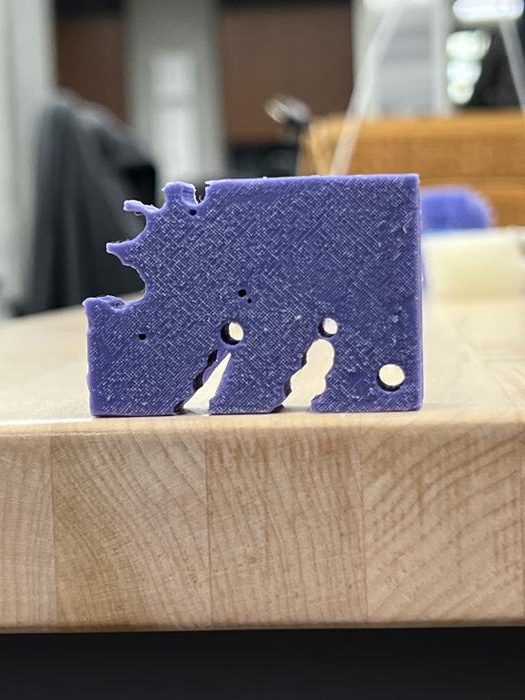
All on its own, AI surprisingly came up with the same solution for walking as nature: Legs. But unlike nature’s decidedly symmetrical designs, AI took a different approach. The resulting robot has three legs, fins along its back, a flat face and is riddled with holes.
“It’s interesting because we didn’t tell the AI that a robot should have legs,” Kriegman said. “It rediscovered that legs are a good way to move around on land. Legged locomotion is, in fact, the most efficient form of terrestrial movement.”
To see if the simulated robot could work in real life, Kriegman and his team used the AI-designed robot as a blueprint. First, they 3D printed a mold of the negative space around the robot’s body. Then, they filled the mold with liquid silicone rubber and let it cure for a couple hours. When the team popped the solidified silicone out of the mold, it was squishy and flexible.
Now, it was time to see if the robot’s simulated behavior — walking — was retained in the physical world. The researchers filled the rubber robot body with air, making its three legs expand. When the air deflated from the robot’s body, the legs contracted. By continually pumping air into the robot, it repeatedly expanded then contracted — causing slow but steady locomotion.
Unfamiliar design
While the evolution of legs makes sense, the holes are a curious addition. AI punched holes throughout the robot’s body in seemingly random places. Kriegman hypothesizes that porosity removes weight and adds flexibility, enabling the robot to bend its legs for walking.
“We don’t really know what these holes do, but we know that they are important,” he said. “Because when we take them away, the robot either can’t walk anymore or can’t walk as well.”
Overall, Kriegman is surprised and fascinated by the robot’s design, noting that most human-designed robots either look like humans, dogs or hockey pucks.
“When humans design robots, we tend to design them to look like familiar objects,” Kriegman said. “But AI can create new possibilities and new paths forward that humans have never even considered. It could help us think and dream differently. And this might help us solve some of the most difficult problems we face.”
Potential future applications
Although the AI’s first robot can do little more than shuffle forward, Kriegman imagines a world of possibilities for tools designed by the same program. Someday, similar robots might be able to navigate the rubble of a collapsed building, following thermal and vibrational signatures to search for trapped people and animals, or they might traverse sewer systems to diagnose problems, unclog pipes and repair damage. The AI also might be able to design nano-robots that enter the human body and steer through the blood stream to unclog arteries, diagnose illnesses or kill cancer cells.
“The only thing standing in our way of these new tools and therapies is that we have no idea how to design them,” Kriegman said. “Lucky for us, AI has ideas of its own.”
IMAGE CREDIT: Northwestern University
Sign up for the Daily Dose Newsletter and get the morning’s best science news from around the web delivered straight to your inbox? It’s easy like Sunday morning.




Leave a Reply