Ohio State astronomers trained a neural network on simulated data to hunt for quasars that bend the light of galaxies behind them, roughly doubling the number found this way.
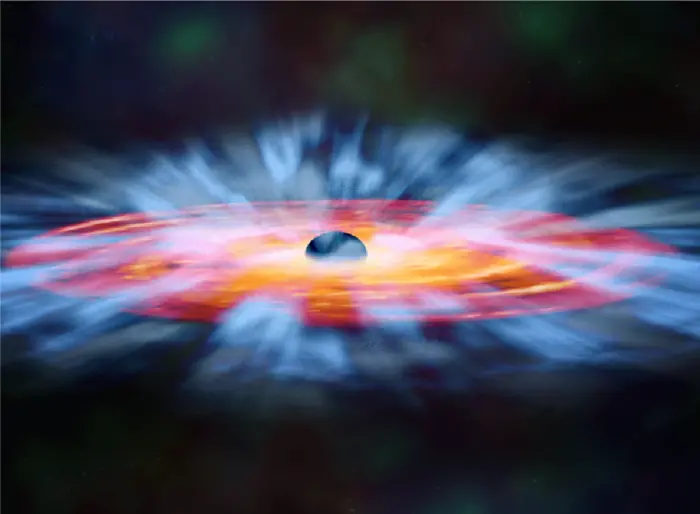
Quasars are among the brightest objects in the universe. Each one is the blazing core of a galaxy, powered by a supermassive black hole devouring the gas and dust around it. They are so luminous that they often outshine the entire galaxy they live in, which creates a frustrating problem for astronomers: the very brilliance that makes quasars easy to spot makes the galaxies around them hard to study.
An international team led by researchers at Ohio State University has found a clever way around that problem — and used artificial intelligence to do it. Searching a catalog of roughly 800,000 quasars, they identified seven rare candidates that appear to act as gravitational lenses, bending the light of more distant galaxies behind them. The findings were published in The Astrophysical Journal.
Baby pictures of black holes
For Everett McArthur, the study’s lead author and a graduate student in astronomy at Ohio State, quasars offer a window into the early lives of the giant black holes that sit at the centers of galaxies, including our own.
“Quasars are like the baby pictures of a supermassive black hole,” McArthur said. “So exploring how we get from quasars to those black holes is really important.”
Astronomers have found that galaxies and their central black holes are tightly linked — the mass of one tends to track the mass of the other. Understanding that relationship could explain a great deal about how galaxies evolve.
“By studying the tight correlation between galaxies and black holes, we could understand why our galaxy is the way that it is,” McArthur said, “and perhaps why our own black hole is sometimes dormant.”
Gravity as a telescope
The trick the team exploited is gravitational lensing, a consequence of Einstein’s general theory of relativity. A massive object warps the space around it, and light passing nearby is bent as a result. When a massive galaxy sits almost directly in front of a more distant one, it can act like a lens, distorting and magnifying the background galaxy’s light.
When the lensing galaxy happens to host a quasar, astronomers get a rare opportunity. The way the background light is bent reveals the mass of the foreground galaxy — information that is otherwise hard to extract because the quasar’s glare swamps everything else. Quasar lenses, in other words, let scientists weigh the galaxies that host these brilliant black holes.
The catch is that such systems are extremely rare, and only a handful of real examples were known.
Teaching a machine with mock data
That scarcity posed a problem for the team’s approach. Machine learning systems typically learn by studying many examples, but there weren’t enough real quasar lenses to train one.
So the researchers built their own. They created simulated lens systems by combining real quasar spectra with real spectra of background galaxies, producing realistic examples of what a quasar lens should look like in the data. They then trained a neural network on these mock systems and set it loose on the quasar catalog from the Dark Energy Spectroscopic Instrument, or DESI, survey.
The AI narrowed some 800,000 quasars down to about 200 promising candidates. The team then reviewed those by hand, settling on seven strong candidates — a number that roughly doubles the count of quasar lenses found through earlier surveys. The candidates lie at least 5 to 6 billion light-years from Earth.
“What this proves is our architecture was able to parse through a diverse array of quasar spectra in a really significant way,” McArthur said.
A tool for rare discoveries
The result illustrates a broader shift in astronomy. Modern surveys like DESI generate data on a scale no human team could inspect object by object. Machine learning offers a way to search those vast datasets for needles in the haystack, and the approach of training on simulated examples could help with any phenomenon too rare to supply its own training data.
“You can very well expand this type of study to find many rare anomalies in a spectrum,” McArthur said.
The next step is confirmation. The researchers plan to observe the candidates with space-based instruments such as the Hubble Space Telescope to verify that they are genuine lenses. They also hope to apply their AI model to hunt for other rare cosmic oddities hidden in survey data.
McArthur sees the work as part of a larger change in how discoveries are made. With enormous public datasets and powerful computational tools now widely available, the barriers to finding something new have dropped.
“We’re in an era when science has suddenly become more accessible than ever,” he said.
The study’s co-authors include Klaus Honscheid and Claire Lamman of Ohio State. The work was funded by the U.S. Department of Energy and the European Union’s Horizon 2020 research and innovation program.
Featured image: NASA/CXC/M. Weiss, Catherine Grier and the SDSS collaboration
Notes
- McArthur, E., et al. “Quasars Acting as Strong Lenses Found in DESI DR1.” The Astrophysical Journal, July 22, 2026. DOI: 10.3847/1538-4357/ae8014.
- Ohio State University. “Astronomers discover super-bright quasar lenses.” News release via EurekAlert!, July 27, 2026. https://www.eurekalert.org/news-releases/1137709




Leave a Reply