HAVE YOUR SAY.
Join us in The Bullpen, where the members of the Scientific Inquirer community get to shape the site’s editorial decision making. We’ll be discussing people and companies to profile on the site. On Wednesday, November 9 at 5:30pm EST, join us on Discord and let’s build the best Scientific Inquirer possible.
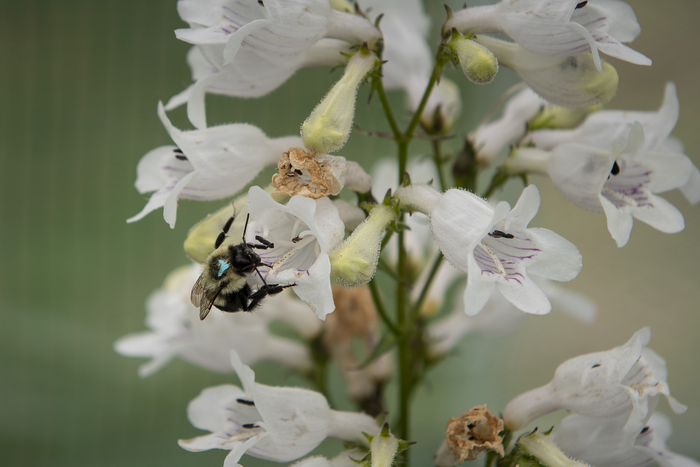
New research published in the journal Ecology conclusively shows that certain physical traits of flowers affect the health of bumble bees by modulating the transmission of a harmful pathogen called Crithidia bombi. In particular, the research, conducted by scientists at the University of Massachusetts Amherst, shows that the length of a flower’s corolla, or the flower’s petals, affects how this pathogen gets transferred between bees because shorter corollas mean that fewer bee feces wind up inside the flower itself and in the path of the bees in search of nectar.
Scientists have recently sounded the alarm over the “insect apocalypse,” or massive die-off of the world’s bugs. By some estimates, the past 50 years have seen a 75% decline in the world’s insect life. Among the many ecological implications of this apocalypse is the collapse of pollinator species, some of which scientists estimate have died back by 90% in the US during the last twenty years.
Though there are many reasons for the apocalypse, including habitat loss, pesticide use and more, one cause is the devastation wrought by pathogens. For bumble bees, a parasite called Crithidia bombi, often transmitted by bee poop, has been a widely prevalent scourge.

One widespread and popular attempt to save the bees has been to plant pollinator gardens. “But what plants ought we to be planting?” asks Jenny Van Wyk, a postdoctoral researcher in biology at the University of Massachusetts Amherst and the paper’s lead author. “We are trying to gather information on how floral traits impact pollinator health, so that we can think beyond species-specific information. That way, we may be able to generalize across species that have similar traits and so help to guide planting decisions.”
In particular, flowers with shorter petals may transmit fewer pathogens than flowers of the same species with longer petals.
This is because, in their search for nectar, bees crawl deep into flowers. When the petals are long, a bee might wiggle its entire body inside. When that bee defecates, its feces remain inside the flower, and the next bee to come through in search of nectar and pollen will wind up smeared in another bee’s poop. If that poop happened to contain C. bombi, then the second bee would be at high risk for infection.
But in shorter-petalled flowers, “bees’ butts hang out,” says Van Wyk, and their feces fall harmlessly to the ground.
To reach this conclusion, Van Wyk and her colleagues recruited an army of UMass Amherst undergrads and grad students to plant patches of native wildflowers, which were enclosed in tents. Bumble bees were turned loose in these tents. Half of the bees were healthy, and Van Wyk and her colleagues painted them blue, for easy identification. The other half were inoculated with C. bombi.
The team then altered the physical traits of the flowers in each tent to test which trait had the most impact upon bee health. To test corolla length, Van Wyk and her team used tiny scissors to trim over 105,000 flowers. To test whether or not the orientation of flowers on the plant had an effect, the researchers arranged some flowers in a cross-like pattern, and others in a more linear shape.
They also tested whether or not the amount and distribution of nectar played a role in bee health. The team did this by inserting a tiny nectar-filled pipette into more than 6,500 flowers, squirting more of the sweet substance, to see if the amount of nectar-per-flower played a role, and they spritzed entire groups of plants with sugar water to test whether the distribution of nectar affected bee health. Finally, the team tested tightly bunched plantings of flowering plants against those more spread out.
To track which bees’ poop landed where, Van Wyk and her colleagues fed the bees florescent paint. Using a black light, they located the glowing poop to understand where the pathogen was deposited.
After all of this, the team found that pathogen transmission was reduced when the corolla lips were trimmed, when nectar was distributed evenly within a group of flowers or when the flowers were planted more widely apart. Flowers with trimmed corollas saw more larval production, as did plant patches where nectar was more evenly distributed.
“This work is really exciting and novel,” says Lynn Adler, professor of biology at UMass Amherst and the paper’s senior author, “because there’s only a handful of studies that have compared how flowers from different species can transmit bee diseases—and only a single study, published more than 25 years ago, that manipulated a floral trait to establish its causal role in disease spread. Our work demonstrates that a wide range of traits may be important.”
“The number one question I get when I give public talks,” says Van Wyk, “is ‘what should I plant for bees?’ Our research opens the door to further efforts to understand how specific physical flower characteristics support bee health, which can inform management practices.”
IMAGE CREDIT: Ben Barnhart
Leave a Reply